
A rough idle at a stop most often comes from ignition misfires, intake or vacuum leaks, fuel delivery trouble, or worn engine mounts. Check for a check-engine light right away: if it’s flashing, stop driving and get it looked at. If it’s steady or off, jot down when the shaking happens before you head to a shop.
TL;DR:
- Rough idle caused by ignition, intake, fuel delivery, exhaust, or mounts requires targeted diagnosis rather than random part replacement.
- A flashing check-engine light indicates an active misfire that can damage the catalytic converter and demands immediate professional repair.
- Diagnostic steps include scanning for codes, checking live data, and performing physical tests such as vacuum or coil swaps for precise fault identification.
- Basic home inspections should focus on visible hoses, wiring, oil levels, and listening for exhaust leaks; avoid touching hot or moving components.
- A quick and accurate fix depends on proper diagnosis, with most minor problems resolved in a few hours through a careful scan and component verification.
Table of Contents
- Symptoms to observe: how rough idle at a stop feels and what to record
- Common causes by system: ignition, intake, fuel, exhaust, and mounts
- How a shop diagnoses rough idle: scans, live data, and physical tests
- Owner checklist: safe checks to try at home and what to bring to the shop
- Practical quick fixes and what to expect from tune-ups
- When to bring it to a shop and expected diagnostic timeline
- How Express Lube & Car Care diagnoses rough idle
- Mechanic perspective: why targeted diagnosis saves money
- Book a diagnostic visit for your rough idle at Express Lube & Car Care
- FAQ
- Sources
Symptoms to observe: how rough idle at a stop feels and what to record
Before you call anyone, play detective for a minute. Does the shaking happen in Park and Neutral, or only in Drive while you’re stopped at a light? That single detail separates an engine problem from a drivetrain or mount issue fast.
Here’s what to watch for and write down:
- Whether the vibration shows up in Park/Neutral, only in Drive, or both.
- RPM behavior: dipping, surging, or threatening to stall.
- Sounds like popping, chugging, or an uneven exhaust note.
- Smells or visible smoke from the tailpipe.
- Whether the check-engine light is on, flashing, or absent.
Note how often it happens. A cold-start shake that smooths out in a minute points one direction; a rough idle that only shows up once the engine’s warm, or when the A/C kicks on, points another. That pattern is often the first clue a technician uses.
Common causes by system: ignition, intake, fuel, exhaust, and mounts
A rough idle rarely has one universal cause. It usually traces back to one of five systems, and each leaves its own fingerprint.
- Ignition: Worn spark plugs or a failing coil cause misfires that show up as a shaky, uneven idle and often a noticeable loss of power. Spark plugs degrade over time and lead to misfiring, rough idling, and hard starting as they wear.
- Intake and vacuum: A cracked hose or a dirty throttle body throws off the air-fuel mix, so idle speed swings high, low, or won’t settle at all.
- Fuel delivery: Clogged injectors, a weak fuel pump, or a dirty filter starve certain cylinders. Diesel troubleshooting guidance notes that uneven fuel delivery and faulty injectors commonly cause rough idling and misfires, and the same logic applies to gasoline engines when fuel atomization is uneven.
- Exhaust and catalytic converter: A clogged converter raises backpressure and can trigger a rough idle along with a check-engine light. EPA guidance on aftermarket converters warns that non-original converters can change backpressure and performance, and improper installation can create legal problems too.
- Mounts and drivetrain: A worn or grounded-out engine mount can shake the whole cabin at a stop light, mimicking a misfire when the engine itself is running fine.
A flashing check-engine light is not a “drive it a little longer” situation. It usually signals an active misfire sending unburned fuel into the exhaust, which can overheat and permanently damage the catalytic converter. That’s an expensive mistake to make by waiting.
How a shop diagnoses rough idle: scans, live data, and physical tests
Guessing at parts is how a simple fix turns into three unnecessary replacements. A proper diagnosis follows a sequence:
- Scan for codes. A technician pulls stored and pending OBD-II codes first; a flashing CEL gets treated as urgent because of converter risk, as explained in check engine light diagnosis guidance. Our check engine light diagnostics process starts here.
- Read live data. Fuel trims, misfire counters, RPM stability, and oxygen sensor traces show which cylinder or system is struggling in real time.
- Run physical tests. A vacuum gauge or smoke test finds leaks, a coil-swap or injector balance test isolates ignition or fuel faults, and an engine-mount isolation test using a Pico sensor can rule drivetrain vibration in or out. AAA’s guidance on modern tune-ups points to scan-tool diagnosis as the right starting point, since sensors and wiring cause more rough idles today than worn-out mechanical parts.
Pro Tip: Ask any shop what test confirmed the diagnosis before you approve a repair. If the answer is “we’re just going to try a part,” get a second opinion.
Owner checklist: safe checks to try at home and what to bring to the shop
A few checks are safe to run yourself, as long as the engine is off and cool.
- Look over visible hoses for cracks, splits, or loose clamps.
- Listen near the exhaust for a hissing or ticking leak.
- Check that ignition coil wiring looks seated and undamaged.
- Confirm oil level is correct.
- Turn the A/C on and off at idle to see if the shake changes.
Never touch hot components or anything moving while the engine runs. And if the check-engine light is flashing, skip the home inspection and get it to a shop.
What speeds up diagnosis once you’re there: a short phone video of the shaking, notes on when it happens, and any dashboard lights or codes you’ve seen.

Practical quick fixes and what to expect from tune-ups
Some fixes are genuinely simple. Others just feel simple until the shaking comes back.
- Worn spark plugs or a failing coil often resolve a rough idle once replaced, but only if that’s actually the cause; swapping plugs on a fuel-starved engine changes nothing.
- A dirty throttle body or MAF sensor cleaning frequently smooths out an idle that’s surging or hunting, though it won’t fix a vacuum leak hiding downstream.
- A fuel-system cleaner can help with minor injector buildup, but a true flow-rate problem needs a professional fuel pressure test, not another bottle of additive.
Pro Tip: Replacing parts one at a time without a scan is the slowest and most expensive way to find a rough idle. A quick diagnostic session almost always costs less than two guesses.
When to bring it to a shop and expected diagnostic timeline
Some symptoms mean “today,” not “this weekend.”
- Get it looked at immediately if the CEL is flashing, the engine keeps stalling, you smell fuel, or you see smoke.
- A shop visit typically includes a scan, an attempt to replicate the shake, targeted tests on the suspect system, then an estimate before any repair work starts.
- A straightforward scan with a minor fix, like a coil or a hose, often wraps up in one to three hours. A rough idle with no obvious code can take half a day or more once live-data logging and component testing are involved.
How Express Lube & Car Care diagnoses rough idle
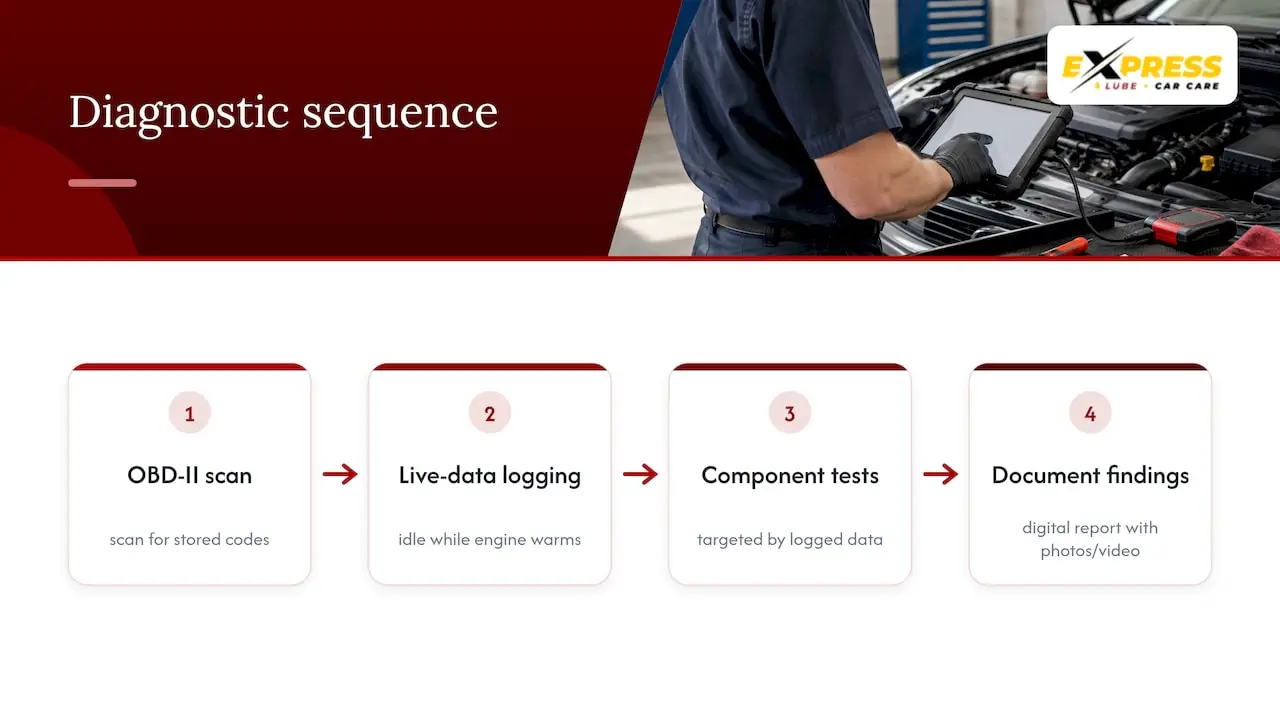
We run the same sequence every time: OBD-II scan, live-data logging while the engine idles and warms, then targeted component tests based on what the data shows. Every finding gets documented in a digital vehicle inspection with photos and video, so you see exactly what we saw. Our technicians work from that evidence, not a hunch. Bringing your own symptom video and notes shortens the visit.
Mechanic perspective: why targeted diagnosis saves money
Parts roulette, replacing plugs, then a coil, then a sensor, hoping something sticks, costs more than a scan ever will. Stick to a tune-up schedule, keep your intake and exhaust in good shape, and save any shaky-idle video along with your service history. That record turns a guessing game into a five-minute diagnosis.
— Express Lube & Car Care
Book a diagnostic visit for your rough idle at Express Lube & Car Care

A rough idle at a stop deserves a real diagnosis, not a guess. Our team runs the full scan-and-verify workflow on everything from ignition and fuel delivery to engine diagnostics and repair, so the fix matches what’s actually wrong. Bring your symptom notes and that phone video; it genuinely speeds things up.
- Diagnostics, tune-ups, and engine repair are all available at our full services page.
- Ignition-related shaking often starts with a tune-up and ignition check.
- Suspect a mount or drivetrain vibration? Our engine R&R service team can isolate it.
Schedule a visit and let’s find the actual cause before it turns into a bigger repair.
FAQ
Why does my engine idle rough but drive fine?
A rough idle with normal driving often points to a vacuum leak, a dirty throttle body, or a minor misfire that only shows up at low RPM. Higher engine speeds can mask small air or fuel imbalances that are obvious at idle.
Why does my car shake when idling at a stop light?
This usually comes from an engine or transmission mount issue, a misfire, or a vacuum leak that only becomes noticeable once the car settles into idle speed. OEM diagnostic procedures describe testing for a grounded-out engine mount by loosening mount bolts and watching whether the vibration changes.
Does a bad transmission cause rough idling?
A failing torque converter or a ground-out transmission mount can produce vibration that feels like a rough idle, even though the engine itself is running normally. Isolating the mount, rather than assuming an engine fault, is part of a proper diagnostic workflow.
How do I fix a rough idle?
The fix depends entirely on the cause: a scan and live-data check identify whether it’s a spark plug, a vacuum leak, a fuel delivery issue, or a mount problem. AAA’s guidance on tune-ups recommends starting with a scan-tool diagnosis rather than replacing parts on a guess.
Sources
These sources back the technical and regulatory points made above, covering sensor and fuel-delivery faults, catalytic converter regulations, spark-plug wear, modern scan-based diagnostics, and engine-mount isolation testing.
- What is a car tune-up? | AAA
- Common Diesel Engine Problems: Your Troubleshooting Guide | UTI
- What You Should Know About Using, Installing or Buying Aftermarket Catalytic Converters | EPA
- Rough idle in drive – OEM TSB (example diagnostic method)
- What Do Spark Plugs Do? | AAA