
A stuck brake caliper usually shows up as a car that pulls to one side, a wheel that smells hot or burnt after a drive, a grinding or whining noise, or a vehicle that feels like it’s dragging an anchor. It happens when the caliper keeps squeezing the brake pad against the rotor after you lift your foot off the pedal. Left alone, it cooks your pads, rotor and brake fluid, and it can leave you with less stopping power when you need it most.
If any of that sounds familiar, you’re in the right place. Below we walk through each symptom, what’s behind it, why a collapsed brake hose can fake the same problem, and what a proper diagnosis looks like.
TL;DR
- The classic signs of a stuck caliper are pulling to one side, a burning smell near one wheel, grinding or whining, sluggish acceleration, shaking while slowing, and one pad wearing faster than the others.
- The cause isn’t always the caliper itself. Seized slide pins, a stuck piston, pads stuck to the rotor, or a restricted brake hose can all produce the same symptoms.
- Don’t treat it as a “drive it until the weekend” problem. Have a mechanic inspect it right away, and don’t keep driving if the wheel is smoking or the car won’t roll freely.
- Get a proper diagnosis before replacing parts. Swapping a caliper when the real culprit is a hose is a quick way to pay twice.
- We inspect brakes at 2105 Brown Blvd in Arlington. Call (682) 248-3416 or book an appointment online.
Table of Contents
- What does a stuck brake caliper actually do wrong?
- The symptoms of a stuck or seized caliper
- Why do calipers stick in the first place?
- When it isn’t the caliper: the brake hose trap
- Is it safe to drive with a stuck caliper?
- Can a stuck caliper unstick itself? What about WD-40?
- How a technician diagnoses a stuck caliper
- How a stuck caliper gets repaired
- Preventing a repeat
- Our perspective: what we see at the shop
- Brake inspections and repairs in Arlington
- FAQ
- Schedule a brake inspection in Arlington
- Sources
What does a stuck brake caliper actually do wrong?
A brake caliper is the clamp that squeezes your brake pads against the spinning rotor. When you press the pedal, hydraulic pressure pushes a piston (or pistons) out of the caliper. When you let go, the piston should relax and the pads should back off a hair, so the wheel spins freely. If you’d like a refresher on the part itself, we cover it in the real role of the brake caliper.
A “stuck” or “seized” caliper is one that doesn’t let go. According to Haynes Manuals, a seized brake can come from a piston stuck in the caliper, pads stuck to the disc, or seized slide pins on a single-piston (floating) caliper. AAA describes a stuck caliper as one that can latch onto the rotor or stay grabby, applying pressure after you’ve released the pedal.
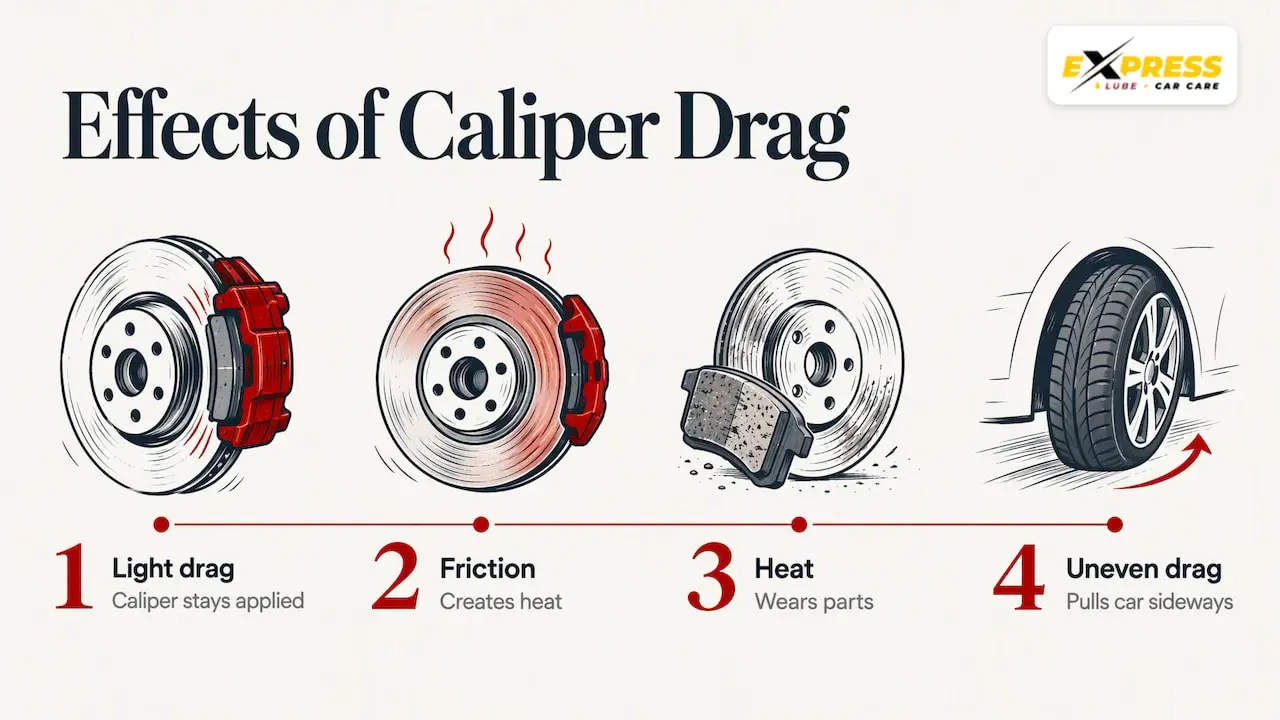
That constant light drag is the root of nearly every symptom below. Friction creates heat, heat wears parts, and uneven drag between the left and right sides pulls the car sideways.
The symptoms of a stuck or seized caliper
Not every stuck caliper shows every sign. Early on you might notice just one. Here’s what to watch for, roughly in the order drivers tend to notice them.
The car pulls to one side
This is the big one. If one front caliper drags, that wheel is being braked a little all the time, and the steering wants to drift toward it. It’s often more obvious when you actually brake: the car tugs left or right instead of stopping straight. AutoZone lists pulling to one side among the common sticking-caliper symptoms, along with grinding, a burning smell, sluggishness and faster wear of one pad.
Pulling has other causes, too. We’ll get to that in a moment, because it matters for diagnosis.
A burning smell after driving
A dragging brake generates heat all the time, not just when you’re stopping. You might catch an acrid, hot-metal smell near one wheel after a drive, or notice that one wheel is far hotter than the others. Smoke from a wheel is a stop-now situation. Pull over somewhere safe and call for help.
Grinding, squealing or a high-pitched whine
A stuck caliper can keep the pad pressed against the rotor so firmly that you hear it while rolling, not only when braking. It may sound like a constant whine or a light grinding that rises and falls with speed. If the pad has worn through entirely, you’ll hear metal on metal. Squeals have other possible causes too, which we cover in common causes of brake squeal.
The car feels sluggish or like the brakes are on
Your engine is fighting the drag. You may notice weaker acceleration, a drop in fuel economy, or a vehicle that feels heavy and slow to coast. Haynes notes that a vehicle with seized brakes while parked may feel as though the brakes are on and, in severe cases, may not move at all.
Shaking or vibration while slowing
Overheated rotors can warp, and a rotor that’s been dragged hot gives you a pulsing pedal or a shaking steering wheel when you slow down. AAA lists shaking while slowing among the signs of a stuck caliper in its guide to steering wheel shakes. So yes, a stuck caliper can cause vibration, though warped rotors, tire problems and worn suspension parts can too.
One brake pad wears faster than the others
When you or a technician pull the wheels off, the clue is often right there: an inner pad worn down to the metal while the outer pad still has life, or one corner wearing far faster than the opposite side. Pad wear that’s uneven from side to side or from inner to outer is a classic fingerprint of slide pins that aren’t sliding.
Quick reference chart
| What you notice | What it can point to | What a shop checks |
|---|---|---|
| Pulls left or right, especially when braking | Dragging caliper on one side, or a tire, steering or suspension issue | Tire pressure, wheel rotation by hand, caliper and hose |
| Burning smell, hot wheel | Constant pad-to-rotor contact | Rotor temperature, pad condition, slide pins |
| Grinding or whine while rolling | Pad dragging, or worn through to metal | Pad thickness, rotor surface |
| Sluggish, poor mileage | Brake drag fighting the engine | Free wheel rotation, caliper piston |
| Shaking when slowing | Overheated or warped rotor | Rotor runout and thickness |
| Uneven pad wear | Seized slide pins or sticking piston | Pins, boots, hardware |
| Brake feels “on” when parked | Severe seizure, stuck parking-brake mechanism | Piston, parking-brake cable and lever |
A lot of these overlap with other brake trouble. Our guide to brake problem symptoms covers the wider picture, including noises and pedal feel.
Why do calipers stick in the first place?
Calipers rarely fail overnight. Something slowly stops moving freely. The usual suspects:
- Seized slide pins. On a floating caliper, the body slides on two pins. If the grease dries out or the rubber boots tear and let moisture in, the pins corrode and the caliper can’t center itself. That’s where uneven pad wear comes from.
- A stuck piston. Rust and brake dust build up around the piston, usually where the dust boot has split. The piston stops retracting.
- Pads stuck to the rotor. This is common after a vehicle sits for a while, especially in humid weather. Haynes lists pads stuck to the disc as one of the three main forms of a seized brake.
- A stuck parking-brake mechanism. On many vehicles with rear disc brakes, the parking brake works through the rear caliper. A rusty actuator can leave the rear brake dragging. A U.S. NHTSA recall notice describes a rusted rear brake caliper actuator shaft that may cause rear-brake drag and reduced parking-brake holding force.
- Seal problems. NHTSA recall documentation for one manufacturer describes piston seal contamination from incorrect assembly lube causing seal swelling and brake drag after pedal release, with overheating of the pads, rotor and fluid. It’s a rare case, but it shows why materials and workmanship in a brake job matter.
- Old, contaminated brake fluid. Moisture and debris in aging fluid contribute to internal corrosion. Haynes suggests flushing brake fluid every other year as prevention.
- A collapsed brake hose. More on this next, because it’s the cause people miss most.
When it isn’t the caliper: the brake hose trap
Here’s the part that catches both DIYers and rushed repairs. A rubber brake hose can break down on the inside, even when it looks fine outside. Brake & Front End explains that a collapsed hose can act as a restrictor, delaying caliper application, or as a one-way valve that lets pressure in but won’t let it back out. That mimics a stuck piston almost perfectly.
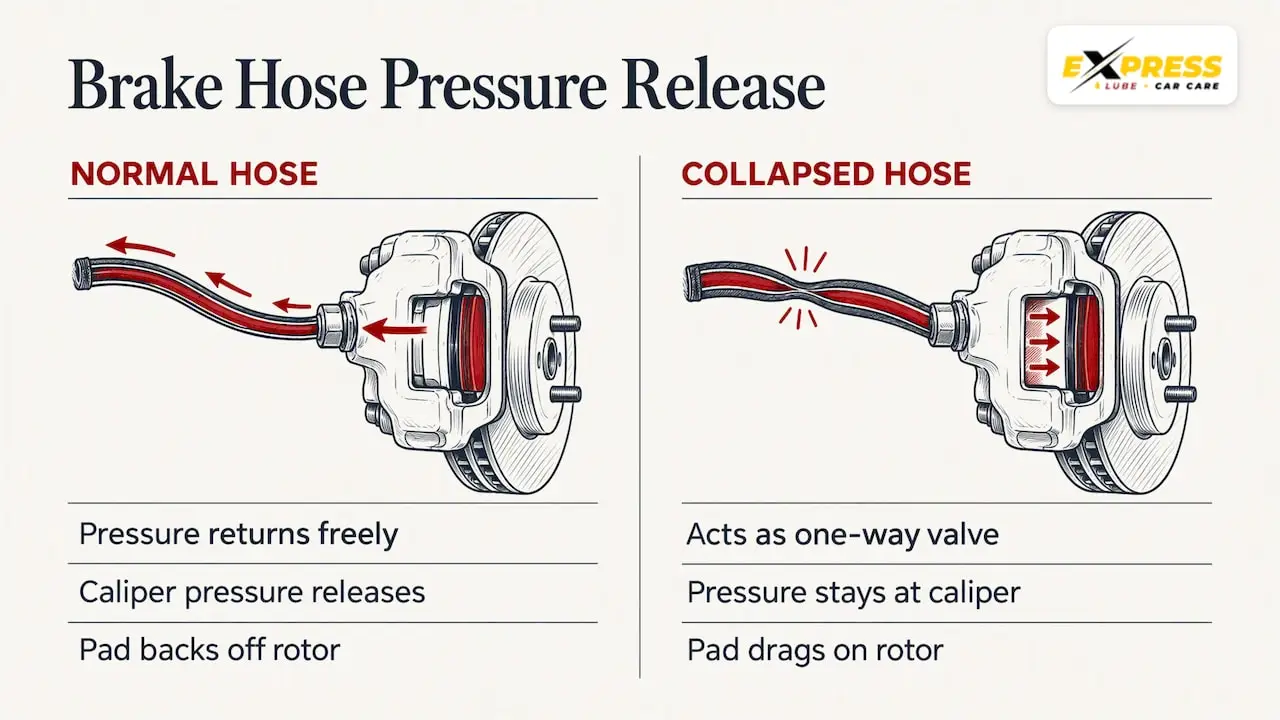
The result: the caliper stays applied, the pad drags, and everything looks like a bad caliper. Replace the caliper, and the new one gets trapped the same way.
The same Brake & Front End article also reminds technicians that a pull under braking can come from tire pressure, mismatched tires, or steering and suspension faults rather than any brake part. That’s why our own car pulling to one side guide starts with tire pressure before anyone touches a caliper.
Is it safe to drive with a stuck caliper?
Short answer: don’t plan on it. AAA says a stuck caliper can make a vehicle unsafe to drive and recommends having a mechanic inspect it immediately.
Here’s why we take it seriously:
- Constant friction overheats pads, rotor and brake fluid. Overheated fluid can lead to a soft or fading pedal.
- The NHTSA recall documentation mentioned above notes that seal-related drag can reduce front-brake performance without prior warning.
- A dragging brake wears out pads and rotors fast, so a cheap fix can turn into a bigger one.
- A strong pull to one side is a handling problem at highway speed, such as on I-30 or Highway 360.
If you’ve had a scare on the road, Michelin USA’s brake problem guidance says to keep the vehicle off the road after a brake emergency until a professional has inspected the braking system, and to call for help if repositioning the car isn’t safe.
Pull over and call for a tow if: you see smoke from a wheel, the wheel is too hot to hold your hand near, the pedal goes soft or sinks, or the car pulls hard enough that you’re fighting the wheel.
Get it in the same day or next day if: you’ve got a mild pull, an odd smell after driving, or a faint whine, and the pedal feels normal.
Can a stuck caliper unstick itself? What about WD-40?
Occasionally a caliper that stuck because the pads rusted to the rotor will free up after a few miles of driving. Don’t count on it, and don’t treat it as a fix. If the problem is a corroded piston, dry slide pins or a collapsed hose, driving won’t cure it. It generally gets worse, because the dragging builds heat and wear while the underlying corrosion keeps going.
As for WD-40 or any other spray lubricant: we’d steer you away from it. Brakes work through friction, and oily residue on pads or rotors is exactly what you don’t want. A spray won’t repair a corroded piston, a worn seal or a bad hose either. Proper repair means cleaning and servicing the parts with the right brake-rated products, or replacing them. We haven’t found an authoritative source that backs lubricant spray as a caliper repair, so we’d leave it on the shelf.
How a technician diagnoses a stuck caliper
Good diagnosis separates the caliper from everything that imitates it. A thorough check looks like this:
- Start with the basics. Tire pressure, tire condition and obvious steering or suspension issues come first, since they cause pulls too.
- Check for heat and free rotation. With the vehicle safely lifted, a technician compares how freely each wheel spins and looks for heat marks or discoloration on the rotor.
- Inspect pads and hardware. Pad thickness side to side, inner versus outer wear, torn boots, and rusted slide pins or clips all tell a story.
- Open the bleeder. Per Brake & Front End, if the wheel frees up when the bleeder is cracked open, trapped pressure points toward the hose or upstream hydraulics. If it doesn’t free up, the piston and caliper hardware are next on the list.
- Measure pressure when needed. Pressure gauges can compare how pressure rises and releases on each side.
That sequence is why we recommend proper diagnostics before replacing parts. It’s cheaper to find the cause once than to chase symptoms.
How a stuck caliper gets repaired
The fix depends on what the inspection finds. Per Haynes, repairs can include:
- Lubricating the parking-brake system when that’s the cause.
- Correcting pads that have been installed or seated skewed.
- Resurfacing the disc and replacing pads when the pads have stuck to it.
- Rebuilding or replacing a seized piston or slide pins.
A collapsed hose gets a new hose, followed by a brake fluid bleed. In most cases, brakes get serviced in pairs on the same axle so the car stays balanced, and any damaged pads and rotors get replaced along with the caliper. Brake fluid is bled after any hydraulic part is replaced.
A word on DIY: pad swaps are a common driveway job, and we’ve written about DIY versus professional brake pad replacement. But a seized caliper is a different animal. You’re dealing with corroded parts and the hydraulic system your safety depends on, and an error can leave you with no brakes at all. Most people are better off letting a shop handle this one.
Preventing a repeat
- Have your brakes inspected regularly. We explain why in brake inspection frequency and safety.
- Replace torn caliper boots and rusty hardware when pads are changed, not later.
- Flush brake fluid on the schedule in your owner’s manual. Haynes suggests every other year as a general prevention practice, but your manufacturer’s recommendation is the one to follow.
- Use your parking brake periodically if your vehicle has one, so the mechanism doesn’t seize. If it’s already stuck, see our guide on what to do about a stuck parking brake.
- Don’t let a car sit for weeks with the brakes wet and parked. Pads can rust to the rotor.
- Act on small signs: a faint pull, a smell, one wheel dirtier than the rest.
Our perspective: what we see at the shop
When a driver tells us the car “pulls” or “smells like burning,” we don’t start by quoting a caliper. We start by asking when it began, whether it happens only when braking, and how the brakes feel at a stoplight. Then our ASE-certified technicians check the simple things first and work toward the complicated ones.
That approach exists because the same symptoms can come from a caliper, a hose, a tire or a worn suspension part. Our digital vehicle inspections include photos and videos, so you can see the rusted slide pin or the torn boot yourself instead of taking our word for it. Then you decide what to approve.
For most Arlington drivers, the hard part isn’t the repair. It’s knowing when to stop putting it off. Stop-and-go on Brown Boulevard and hard braking on the I-30 and Highway 360 corridors are tough on brakes, so small drag problems turn into big ones sooner than you’d think. A short inspection now is almost always easier than a tow later.
— Express Lube & Car Care
Brake inspections and repairs in Arlington
If you’re hearing, smelling or feeling any of the above, our team can inspect the whole brake system, from pads and rotors to calipers, hoses and fluid, and explain what we find with photos. Same-day service is available for most jobs, and qualifying repairs are backed by a 24-month/24,000-mile warranty. See our brake repair and pad replacement page, or browse everything we handle on our full services list. If you’re comparing costs, ask us about third-party repair financing through Snap Finance, subject to provider approval and terms.
FAQ
Can a stuck caliper cause vibration?
Yes. A dragging caliper overheats the rotor, which can warp and make the steering wheel or pedal shake when you slow down. AAA lists shaking while slowing among the symptoms. Worn tires and suspension parts can cause similar shaking, so a professional inspection is the way to tell them apart.
What are the common causes of a brake caliper not releasing?
The usual causes are seized slide pins, a corroded or stuck piston, pads rusted to the rotor, a stuck parking-brake mechanism and a collapsed brake hose that traps pressure. Old brake fluid and torn dust boots speed up the corrosion. A technician needs to check each one, because the symptoms overlap.
Can I drive with a seized brake caliper?
It isn’t a good idea. AAA says a stuck caliper can make the vehicle unsafe, and recommends an immediate inspection by a mechanic. If you see smoke, smell strong burning, or the pedal feels soft, stop somewhere safe and call for a tow.
How can I tell a stuck caliper from a bad brake hose?
You usually can’t from the driver’s seat. Both leave a wheel dragging. A technician can crack open the bleeder at the affected wheel: if the wheel frees up, the hose or upstream hydraulics are suspect, and if not, the caliper itself is. That’s why diagnosis should come before replacement.
Does a stuck caliper always mean I need a new one?
No. Sometimes slide pins can be cleaned and re-greased, a stuck parking-brake mechanism lubricated, or a hose replaced. When the piston is corroded or the bore is damaged, a rebuild or replacement is the safer path. Your technician should show you the reason.
Schedule a brake inspection in Arlington
Don’t wait for a hot, smoking wheel to tell you something’s wrong. If your car pulls, smells or drags, bring it in to Express Lube & Car Care at 2105 Brown Blvd, Arlington, TX 76006, call us at (682) 248-3416, or request an appointment online. You can also visit our website to see all our services.
Sources
- Why Your Steering Wheel Shakes: 6 Possible Causes, AAA Club Alliance
- How To Diagnose and Fix a Seized Brake Caliper, Haynes Manuals
- Brake Caliper Sticking: Causes, Signs, and What to Do Next, AutoZone
- Finding the Cause of Brake Pulls, Brake & Front End
- NHTSA recall 17V393, rear brake caliper actuator shaft
- NHTSA recall 19V635, caliper piston seal contamination
- Brake Problems: Safe Driving Tips, Michelin USA