

If your dashboard shows the battery or ALT warning light alongside dimming or flickering lights, a whining noise from the engine bay, or a burning smell, your alternator may be failing. Stop driving as soon as it’s safe and get a diagnostic voltage test. A healthy charging system typically reads a voltage within a range around 13 to 15 volts with the engine running; voltages outside this range suggest a problem that only gets worse the longer you drive on it.
TL;DR:
- A voltage reading below 13 volts or above 15 volts during running tests indicates an alternator malfunction that requires immediate attention.
- Alternator issues often cause dim or flickering lights, repeated battery failures, slow electrical accessories, grinding noises, or a burning smell, especially under load.
- Common internal failure causes include worn brushes, damaged diodes, or a faulty voltage regulator, but wiring problems or slipping belts can mimic these symptoms.
- Visual inspections and load tests with a multimeter are essential before replacement, as wiring faults or belt issues are common causes of false alarms.
- Driving on a failing alternator only sustains the vehicle briefly on battery power, risking sudden stalls and system failures, so prompt diagnostic testing is critical.
Table of Contents
- Alternator Failure Symptoms: The Full Checklist
- What’s Actually Failing Inside the Alternator
- How to Diagnose Alternator Issues Yourself and What a Shop Checks
- Is It Safe to Keep Driving? Here’s the Real Risk
- When to See a Mechanic and What Happens Next
- How Express Lube & Car Care Diagnoses Charging System Problems
- Schedule a Charging System Check in Arlington
- Sources
- FAQ
Alternator Failure Symptoms: The Full Checklist
Recognizing alternator failure symptoms early saves you from a roadside breakdown, or worse, a stall in the middle of traffic. Here’s what to watch, hear, and smell, roughly in the order most drivers notice them.
- Battery or ALT warning light on the dash. A steady light usually means the charging system has stopped producing enough voltage. A flickering light often signals a loose connection or an intermittent internal fault, like a worn brush making inconsistent contact.
- Lights that dim, flicker, or brighten with engine RPM. If your headlights sag at idle and perk up when you rev the engine, your alternator likely can’t keep up with demand at low speed. This is one of the earliest and most reliable alternator warning light clues.
- A battery that keeps dying, even after replacement. If you just installed a new battery and it’s dead again within days, the alternator probably isn’t recharging it between drives.
- Slow or glitchy electrical accessories. Power windows that crawl, a radio that cuts out, or HVAC blower motors that surge and fade all point to inconsistent voltage reaching the accessory circuits.
- Trouble starting, or stalling shortly after you do. A weak charging system can crank the engine over slowly, then let it die once it’s running because there isn’t enough voltage to sustain ignition and fuel systems.
- Grinding, whining, or screeching from the engine bay. A whine that changes pitch with engine speed often means a failing bearing inside the alternator. A screech usually points to belt slippage rather than the alternator itself.
- A burning rubber or hot-wire smell can mean the belt is slipping under load, or the alternator is overcharging and cooking its own internal wiring, according to Car Care Total. This can mean the belt is slipping under load, or the alternator is overcharging and cooking its own internal wiring, according to Car Care Total. Either way, it’s not something to ignore.
- Age and mileage. Alternators don’t fail on a fixed schedule, but a unit that’s original to a high-mileage vehicle is a more likely suspect than one replaced two years ago.
Pro Tip: Note exactly when a symptom shows up, whether it’s only at idle, only with the headlights and A/C running, or only after the car sits overnight. That detail alone can cut a diagnostic appointment in half.
What’s Actually Failing Inside the Alternator
Symptoms tell you something’s wrong. The failure mode tells you why, and that matters because a few of these issues aren’t the alternator’s fault at all.
- Worn brushes, damaged diodes, or a bad voltage regulator cause undercharging or overcharging, which is the root of most warning-light and dimming complaints, per HELLA Techworld’s alternator diagnostics.
- A slipping belt, worn pulley, or weak tensioner can starve the alternator of the rotation speed it needs, producing the same dim-light symptoms as an internal fault, plus a telltale squeal.
- A worn bearing inside the alternator produces a whine that rises with RPM. That’s different from a belt-driven accessory noise, which tends to stay steady regardless of throttle input.
- Loose or corroded grounds and wiring can trigger the same dashboard warnings as an actual alternator failure, which is exactly why a shop checks wiring before condemning the part.
- Repeated deep discharges or sustained overcharging can permanently shorten a battery’s life, meaning a bad alternator today can mean a second repair bill for a new battery tomorrow.
How to Diagnose Alternator Issues Yourself and What a Shop Checks
Before anyone touches a multimeter, do a quick visual check with the engine off: look for a belt that’s loose, glazed, or cracked, wiring that’s frayed or disconnected at the alternator plug, and battery terminals with white or greenish corrosion buildup. None of this requires tools, just a flashlight and a few minutes.
- Check battery voltage with the engine off. A healthy, charged battery reads roughly 12.4 to 12.7 volts.
- Start the engine and check voltage again. A properly functioning alternator should push that reading up to 13.5 to 14.8 volts, according to AAA’s guidance on distinguishing battery and alternator problems.
- Run a simple load test. Turn on the headlights, blower motor, and rear defroster, then watch the voltage. A significant drop under load suggests the alternator can’t keep pace with demand.
- Understand why static tests can fool you. A battery can test fine sitting still while an intermittent regulator fault only shows up under real electrical load, which is why running tests matter more than a resting voltage check.
- Let the shop finish the job. A technician will run a diode bridge test, measure output current against the Delco Remy diagnostic manual’s rated specifications, and isolate whether a noise is coming from the alternator bearing or a nearby accessory.
Pro Tip: If your multimeter reading climbs past 15.5 volts with the engine running, that’s overcharging, not a good sign, and it’s the same threshold the Delco Remy manual uses to call for alternator replacement.
Is It Safe to Keep Driving? Here’s the Real Risk
Driving on a failing alternator means your car is running purely on stored battery power, and that power runs out fast under real-world load from headlights, climate control, and fuel injection systems. Batteries Plus notes that driving time on battery alone varies widely, anywhere from a few minutes to about an hour, depending on the battery’s condition and what’s drawing power. Don’t count on it.
- Power steering assist, headlights, and even engine control can fail as voltage drops too low to sustain them.
- Turn off anything nonessential (stereo, seat heaters, phone chargers) to stretch what battery power you have left.
- Get to a safe spot and call for a tow rather than pushing toward home on a dying battery.
- Stop immediately if you smell burning or see smoke. That’s not a “get it looked at soon” situation.
- A jump start can get the engine running again, but it does nothing to fix the charging system. You’ll be back in the same spot within a few miles.
When to See a Mechanic and What Happens Next
Some symptoms mean “schedule a visit this week.” Others mean “stop driving now.” A burning smell, repeated stalling, or a battery that won’t hold a charge overnight fall into the second category.
A proper shop visit follows a sequence for a reason: testing wiring and grounds, checking belt tension, measuring resting and running voltage, and running a load test, in that order, before anyone recommends replacing the alternator itself. Skipping steps is how car owners end up paying for a new alternator when the real problem was a $30 wiring connector.
Depending on what the tests show, repair paths vary:
- Belt or tensioner replacement, if the alternator itself tests fine
- Wiring or connector repair for corroded or loose grounds
- Alternator repair or replacement when internal components have failed
- Battery replacement, if repeated deep discharges have already damaged it
Ask for the actual voltage and load test numbers, along with photos from a digital vehicle inspection, and get a written estimate before any parts get replaced.
How Express Lube & Car Care Diagnoses Charging System Problems
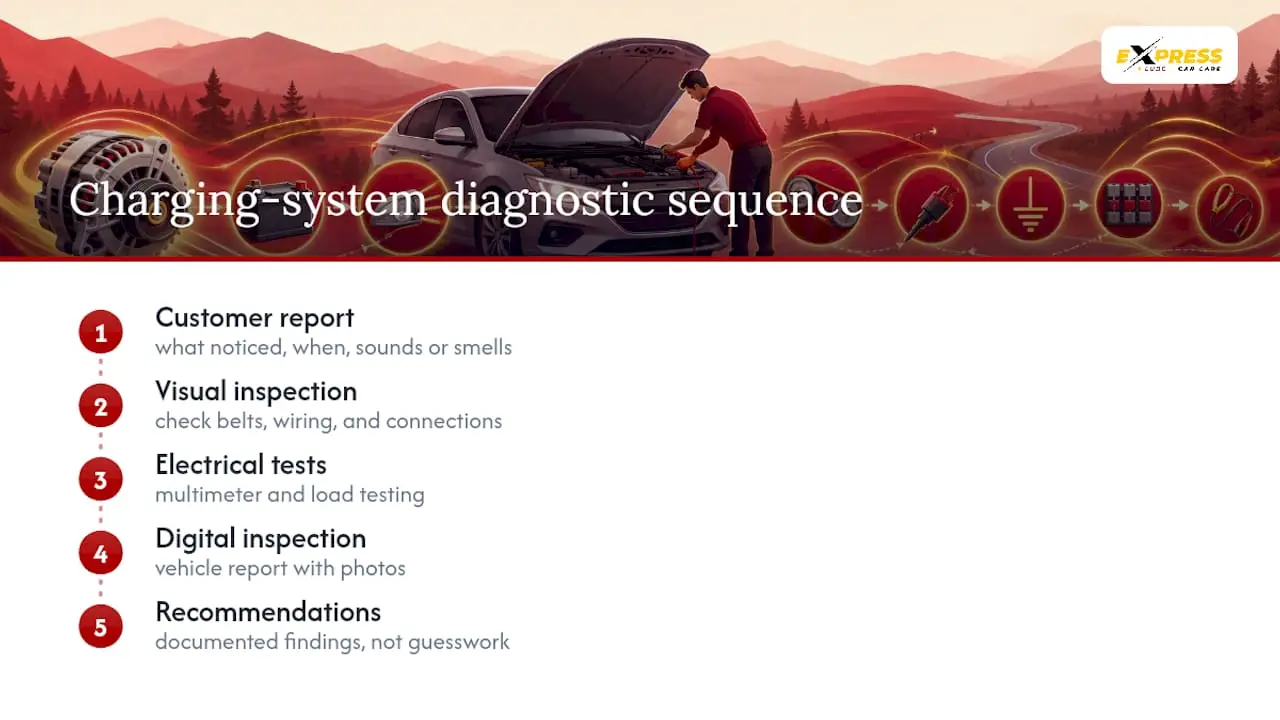
We start every charging-system complaint the same way: what you noticed, when it happens, and what it sounds or smells like. From there, our ASE-certified technicians move through a visual inspection, multimeter and load testing, and a digital vehicle inspection with photos, so you see exactly what we saw. Our recommendations are built on a documented diagnostic process, not guesswork. Bring us the details, and we’ll find the answer faster.
Schedule a Charging System Check in Arlington
A whining alternator or a flickering dashboard light doesn’t fix itself, and driving on it risks a dead battery at the worst possible moment. Express Lube & Car Care runs full charging-system diagnostics, alternator and belt repairs, and battery testing, all performed by ASE-certified technicians using the same voltage and load testing standards covered above.

Every repair backed by our findings comes with a clear, documented diagnosis before we touch a single part, and covered work carries our 24-month/24,000-mile warranty for peace of mind. If your dashboard light is on or your battery keeps dying, don’t wait for a tow truck to make the decision for you. Check what a car diagnostic actually costs and schedule your charging-system diagnostic today, so you know exactly what’s wrong and exactly what it takes to fix it.
Sources
Test numbers and diagnostic sequences in this article come from the following technical and industry sources:
- DIAGNOSTIC PROCEDURES MANUAL (Delco Remy)
- Checking the alternator (HELLA Techworld)
- How far can I drive with a bad alternator? | Batteries Plus
- Bad alternator vs bad battery (AAA TripCanvas)
FAQ
How do you detect an alternator failure?
Watch for the battery or ALT warning light, dimming or flickering lights, a dying battery, whining noises, or a burning smell, then confirm it with a voltage test. A running engine should read 13.5 to 14.8 volts; a lower reading under load points to a failing alternator.
Why is my battery light on if the battery seems fine?
The battery light actually monitors the charging system, not just battery health, so it turns on when the alternator isn’t producing enough voltage to keep the battery charged. A fine-looking battery can still be running on borrowed time if the alternator has stopped doing its job.
Can a bad alternator drain a good battery?
Yes. An alternator that isn’t charging properly forces the battery to run every electrical system on its own, and repeated deep discharges can permanently shorten that battery’s lifespan.
How long can I drive with a failing alternator?
There’s no reliable answer. Depending on your battery’s condition and electrical load, you might get anywhere from a few minutes to about an hour before the car stalls, so treat it as an emergency rather than something to manage on the road.
Will a jump start fix a bad alternator?
No. A jump start can get your engine running again, but it doesn’t repair the charging system, so the same symptoms will return within miles. Get a diagnostic voltage test as soon as possible, and consider a visit to Express Lube & Car Care for a full charging-system check.