

The most reliable sign of a blown fuse is simple: one electrical function quits while everything else keeps working fine. Your radio goes silent, your power windows stop rolling down, or one headlight goes dark while the rest of your dash lights up as usual. If you spot that pattern, a quick look at the fuse or a continuity check will usually confirm it.
TL;DR:
- A blown fuse typically affects only one specific circuit, such as a headlight, power window, or radio, while the rest of the vehicle’s electrical system remains operational.
- Visual inspection or a multimeter test confirms a fuse’s condition, with a blown fuse showing a broken filament or an open circuit reading.
- Repeated fuse blows usually indicate underlying wiring issues or faulty components, not the fuse itself, requiring circuit diagnosis rather than just replacement.
- Never upgrade to a higher-rated fuse or bypass a fuse with metallic objects, as these actions risk electrical fires and damage.
- Professional diagnosis is recommended when a fuse keeps blowing after initial troubleshooting, especially if it involves main fuses, relays, or bolted components.
Table of Contents
- Common symptoms by component
- How to locate and inspect the fuse
- Common causes of blown fuses
- If a new fuse blows immediately: step-by-step diagnosis
- Safety, limits of DIY, and when to call a pro
- Technician perspective and practical tips from Express Lube & Car Care
- What the checklist approach gets right (and where it falls short)
- How Express Lube & Car Care can help
- Sources
- FAQ
Common symptoms by component
Blown fuses tend to announce themselves in one narrow spot, which is actually good news. It means you’re not chasing a mystery all over the car, just one circuit.
- Power accessories quit cold: windows, door locks, the power outlet, or the radio simply stop responding.
- Lighting fails on one circuit only: interior lights, the dome light, or a single headlight or taillight goes dark while its twin stays lit.
- Warning signs before total failure: flickering, clicking, buzzing, or a faint burning smell can show up right before a fuse gives out.
- Dashboard messages appear: some vehicles flash a “CHECK FUSES” alert or a localized warning light tied to the affected system.
According to AutoZone’s breakdown of blown fuse symptoms, the telltale pattern is a sudden, complete loss of one specific function like the radio, wipers, power windows, headlights, or interior lights, while every other system keeps running normally. That contrast is your biggest clue.
If more than one unrelated system goes dark at the same time, say your radio and your dashboard lights, you’re probably not looking at a single blown fuse. That points toward a bigger electrical issue, like a failing alternator or a main fuse or relay problem, and it’s worth having a technician take a look before you start swapping parts.
How to locate and inspect the fuse
Before you can fix anything, you need to find the right fuse, and that starts with your owner’s manual. Most vehicles have two fuse boxes: one under the hood near the battery, and one tucked under the dash or behind a panel inside the cabin. The manual or the diagram printed on the fuse box cover will tell you exactly which fuse controls which circuit.
Once you’ve found the right one, here’s how to check it.
- Turn off the ignition before touching anything electrical.
- Pull the fuse using the small plastic puller often clipped inside the fuse box, or a pair of needle-nose pliers if there’s no puller.
- Look through the clear plastic housing. A good fuse has an intact metal filament running from one end to the other. A blown one shows a broken filament or a smoky brown or black residue inside the housing.
- If it’s hard to tell by eye, grab a multimeter and set it to continuity or resistance mode, then touch a probe to each metal tab on top of the fuse.
- Read the result. A working fuse shows a low reading, generally between 0 and 5 ohms. A blown fuse shows “OL,” meaning the circuit is open, according to J.D. Power’s guide on checking car fuses.
If you want to skip pulling fuses altogether, a test light or a basic voltage-drop check across the fuse’s metal tabs can confirm the same thing without disturbing anything else in the panel.
Pro Tip: Keep the fuse in place when testing continuity in the panel itself, since some multimeters give a false reading if the circuit isn’t fully closed.
Common causes of blown fuses
A fuse doesn’t just fail on its own. It blows because something downstream is asking for more current than the circuit was designed to handle, and understanding the cause is what keeps you from replacing the same fuse next week.
- Short circuit: a wire’s insulation wears through or gets pinched, letting bare metal touch a grounded surface and spike the current.
- Overloaded circuit: an aftermarket accessory, a failing motor, or too many devices on one circuit pull more amps than the fuse rating allows.
- Component failure: a motor or switch that’s on its way out can draw excess current even when it appears to be working.
- Wrong fuse type installed previously: mixing up a slow-blow fuse with a fast-blow one changes how much of a current surge the circuit can tolerate before it opens, a detail confirmed in peer-reviewed guidance on fuse selection and safety.
- Aging connectors or fuse clips: corrosion or heat damage raises resistance at the contact points, generating extra heat that pushes a marginal fuse over the edge.
If a new fuse blows immediately: step-by-step diagnosis
Popping in a fresh fuse and watching it blow instantly is your car telling you the fuse was never the actual problem. Do not reach for a higher-amperage fuse to make it “stick.” That hides a genuine fault and raises real fire risk, a warning echoed in fuse safety guidance from peer-reviewed sources.
- Disconnect the load on that circuit (unplug the motor, radio, or accessory it powers), then replace the fuse and see if it holds.
- If it holds with the load disconnected, the short is likely in the component itself rather than the wiring.
- If it still blows with everything disconnected, the short is in the wiring between the fuse box and the component.
- Use an ammeter or a parasitic-draw test with the ignition off to catch a circuit pulling current when it shouldn’t be.
- Check voltage drop across the tops of the fuses instead of pulling each one, a method automotive electrical troubleshooting guidance points to as a faster way to isolate a bad circuit without resetting your car’s modules.
Pro Tip: A wiring diagram specific to your vehicle turns a guessing game into a quick trace. If you don’t have one on hand, that’s the point where a shop visit saves you time and frustration.
Safety, limits of DIY, and when to call a pro
Never bridge a fuse with foil, a paperclip, or a wire, and never install a fuse rated higher than what the circuit calls for. Both tricks remove the safeguard the fuse is there to provide, and both can start an electrical fire.
Call in a professional when a fuse keeps blowing after you’ve isolated the load, when the issue touches a main fuse or relay, or when the fuse or relay in question is bolted or fastened rather than simply plugged in. Manufacturer guidance for some vehicles specifically warns that bolted fuses and relays need to be secured to exact specifications, since a loose connection there can also become a fire hazard, according to OEM fuse-check guidance.
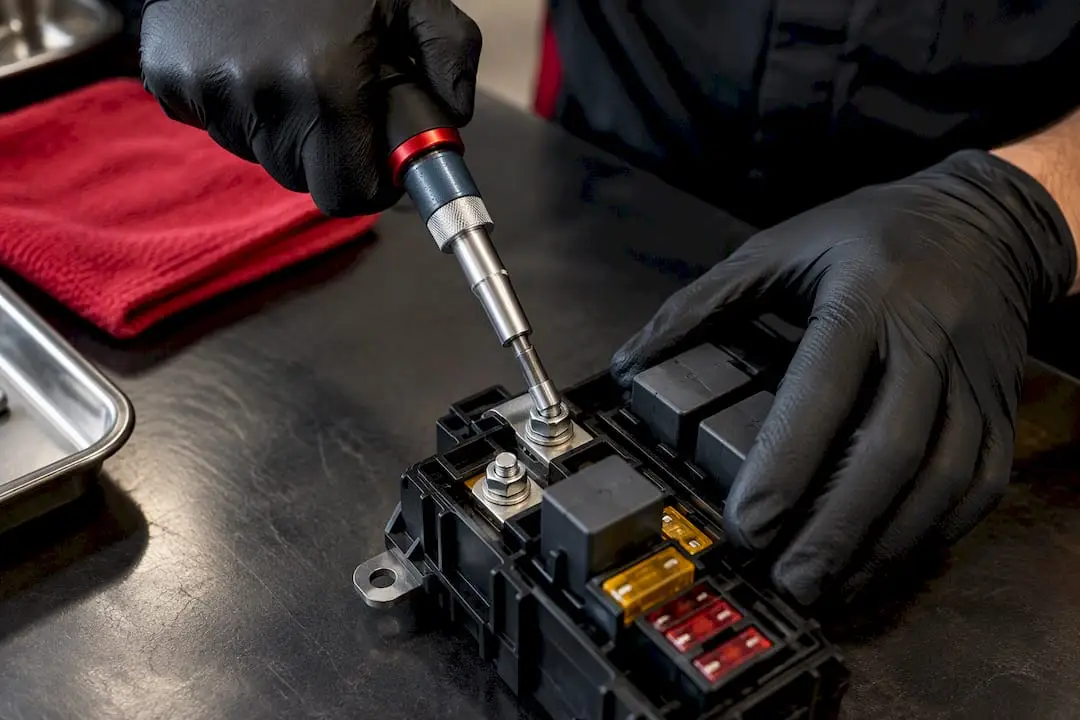
A shop brings wiring schematics, proper torque tools for fastened components, and voltage-drop equipment that traces a fault a lot faster than trial and error. Express Lube & Car Care’s ASE-certified technicians handle exactly this kind of diagnostic work, and their electrical services cover both the fuse and whatever caused it to blow in the first place.
Technician perspective and practical tips from Express Lube & Car Care
A careful approach to a blown fuse is to isolate the circuit first, then confirm with continuity and voltage-drop tests before replacing the fuse. That order matters, because swapping the fuse before finding the fault often leads to repeated failure.
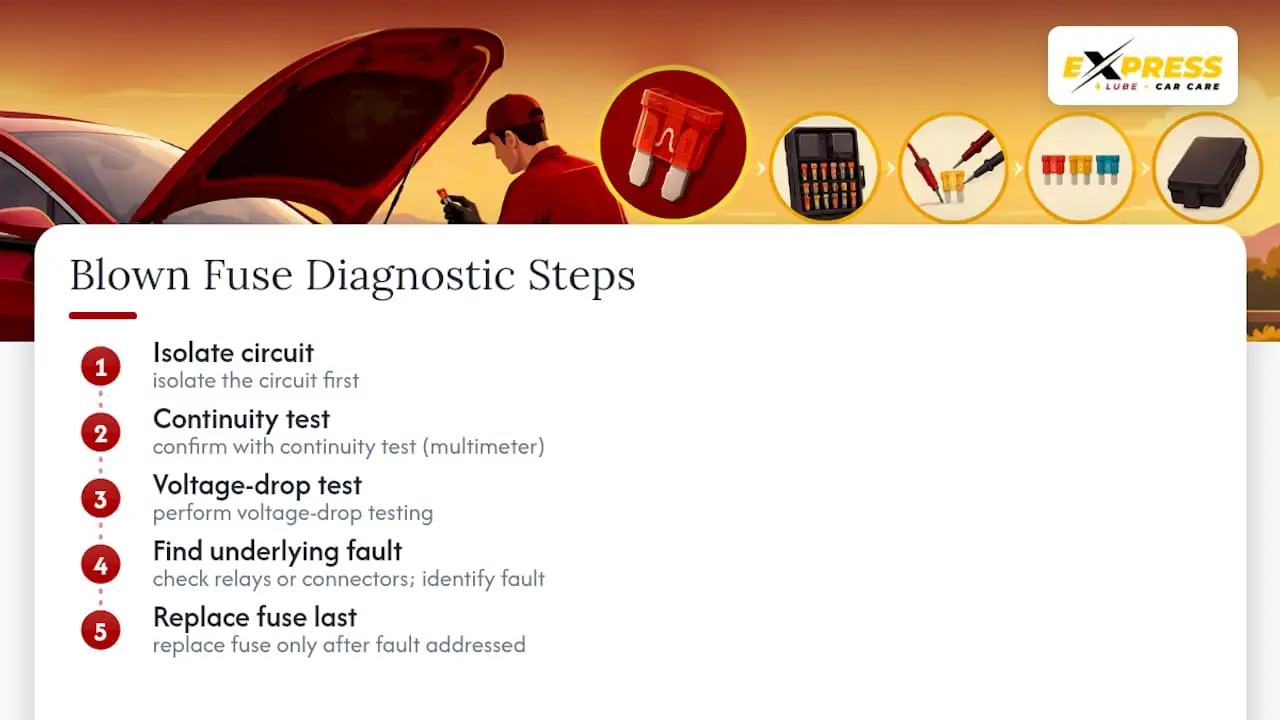
The most common mistake we see is a driver grabbing whatever fuse fits the slot instead of matching the amperage rating on the panel diagram. The second most common is overlooking a nearby relay or connector that’s just as likely to be the actual culprit.
When a vehicle is serviced for this kind of issue, it typically involves a visual inspection of the fuse box, continuity and voltage tests, and documentation via photos or video as part of a digital vehicle inspection process. If you’re troubleshooting at home first, a quick checklist helps: note which function failed, check the fuse visually, confirm with a multimeter, and stop there if a fresh fuse blows again.
What the checklist approach gets right (and where it falls short)
Most advice about blown fuses stops at “replace it and see.” That’s the part we’d push back on. A fuse blowing is a symptom, not the problem, and treating it like a five-minute fix is how drivers end up back at the same fuse three times in a month.
The checklist approach works because it forces you to match the symptom to the circuit before touching a wrench, which is exactly the discipline a technician uses. Where it falls short is in convincing people that a passed visual check means the job is done. A fuse can look intact and still fail a continuity test, and a fuse that blows once under a genuine surge is different from one that blows every time you replace it.
If you take one thing from this, prioritize the pattern over the part. Watch what stopped working, confirm it with a multimeter instead of a guess, and treat a repeat failure as your cue to stop swapping fuses and start tracing the circuit.
— Express Lube & Car Care
How Express Lube & Car Care can help

A blown fuse that keeps coming back usually means there’s a wiring or component issue hiding behind it, and that’s exactly the kind of diagnostic work our ASE-certified technicians handle daily. We trace the fault with the right tools instead of guessing, and our digital vehicle inspection gives you photos and video of exactly what we find.
- Electrical diagnostics and repairs for fuses, relays, and the components behind them.
- Battery and alternator checks when a charging issue is feeding the short.
- Timely service on many jobs to minimize the time without your car.
Ready to get it sorted? Book a diagnostic check through our services page and we’ll trace it down for you.
Sources
- Symptoms of a Blown Car Fuse – AutoZone
- How to tell if a car fuse is blown – J.D. Power
- Checking and replacing fuses – PMC (peer-reviewed guidance)
- Automotive electrical system troubleshooting guide – AllTradesJournal
FAQ
How do I tell if a fuse is blown or not?
Look for a broken metal filament or brown and black residue inside the clear fuse housing, which usually means it’s blown. If the fuse looks fine but the circuit still isn’t working, a multimeter continuity test settles it: an “OL” reading confirms the fuse is open, according to AutoZone.
Can a car fuse be blown without looking like it?
Yes, a fuse can appear intact while its internal filament is actually broken in a way that’s hard to see by eye. That’s why a multimeter continuity check is the more reliable confirmation method, since a working fuse reads a low resistance while a blown one reads “OL,” per J.D. Power.
What is the most common cause of a blown fuse?
A short circuit, where a damaged or pinched wire touches a grounded surface, and an overloaded circuit, where a component draws more current than the fuse allows, are the two most frequent causes. A mismatched fuse type installed previously can also make a circuit less tolerant of normal current surges.
How expensive is it to fix a blown fuse?
Pricing depends on what caused the fuse to blow, since the fuse itself is inexpensive but the underlying wiring or component repair can vary. Express Lube & Car Care doesn’t publish fixed repair prices online, so the most accurate way to get a number is to book a diagnostic check and have a technician confirm the cause first.