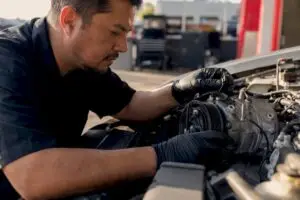

A check engine light paired with misfire codes, a rough idle, hard starting, hesitation under acceleration, or a sudden drop in fuel economy are the clearest signs an ignition coil is failing. Most of these problems are drivable for short trips, but a flashing check engine light or a severe stall means stop driving and get the car towed.
TL;DR:
- Ignition coil failure symptoms include a check engine light with misfire or coil codes, rough idle, hard starting, and hesitation under acceleration.
- Heat cycling, oil leaks, wiring issues, worn spark plugs, and physical damage are common causes of coil failure, often requiring fixing the root problem to prevent repeated issues.
- Proper diagnosis involves code reading, coil swap tests, and live data checks to confirm coil problems, especially for intermittent or heat-related faults.
- Driving with a mild misfire or steady light is usually safe for short trips, but a flashing check engine light or severe stalling requires immediate stopping and towing.
- Professional diagnostics, coil replacement, spark plug service, and fixing oil leaks prevent repeat failures and ensure accurate repairs.
Table of Contents
- What Are the Main Ignition Coil Failure Symptoms?
- What Causes Ignition Coils to Fail?
- How Do You Test an Ignition Coil?
- Is It Safe to Keep Driving on a Bad Coil?
- What Our Technicians See on the Shop Floor
- Get Your Ignition System Checked
- Sources
- FAQ
What Are the Main Ignition Coil Failure Symptoms?
Ignition coils fail in patterns, and once you know the pattern, you can usually narrow down the problem before you even pop the hood. Here are the signs that show up most often, roughly in the order drivers tend to notice them.
- Check Engine Light with misfire or coil codes. A scan tool reading P0301 through P0308 points to a misfire on a specific cylinder, while codes in the P0351 to P0358 range point more directly at the coil circuit itself. A steady light usually means a persistent, low-grade problem. A flashing light means the misfire is severe enough to risk damage.
- Rough idle or a misfire you can feel. The engine shakes at a stoplight, smooths out once you’re rolling, or does the opposite. Coil-related misfires often show up worse at idle than under light cruising load, though a heat-affected coil can flip that pattern entirely.
- Hard starting, especially in cold weather. A weak coil struggles to generate enough spark energy when the engine is cold and the battery is working harder. You might crank two or three extra seconds before it catches.
- Loss of power, hesitation, or jerking under acceleration. Stomp the gas and the car stumbles instead of pulling. This is the coil dropping spark right when the engine demands the most from it.
- Reduced fuel economy and occasional backfiring. Unburned fuel passing through a misfiring cylinder lowers your miles per gallon and can pop or bang in the exhaust.
- Intermittent faults that only show up hot. This is the one that fools a lot of people. The car runs fine for the first ten minutes, then starts missing once the engine reaches full operating temperature, a pattern mechanics call heat-soak failure.
Not every rough-running symptom is a coil. A worn spark plug, a clogged injector, or low compression can mimic several items on this list, which is exactly why the diagnostic steps below matter more than guessing from symptoms alone.
What Causes Ignition Coils to Fail?
Coils rarely fail for no reason. Something is usually stressing them, and if you don’t fix that root cause, the replacement coil will follow the same path as the old one.
- Heat cycling breaks down internal insulation. Coils sit right on top of a hot engine, and repeated heating and cooling eventually cracks the windings inside, which is why a coil can test fine cold and fail once the engine warms up.
- Oil in the spark plug well. A leaking valve cover gasket lets oil seep down onto the coil boot, and that oil attacks the rubber and insulation until the coil arcs or shorts out.
- Wiring, connector, or ground problems. A corroded ground point or a weak connection at the coil plug starves it of the clean power it needs, shortening its life even if the coil itself is otherwise healthy.
- Worn spark plugs. As a plug’s electrode gap widens with age, the coil has to push out significantly more voltage to jump that gap. That extra strain wears down a marginal coil faster, per the technical notes from Rick’s Free Auto Repair Advice.
- Cracked boots or physical damage. Moisture intrusion or a boot that’s been nicked during other engine work lets spark leak to ground instead of the plug.
Pro Tip: If you’re pulling a coil that’s caked in oil, don’t just wipe it off and reinstall a new one. Fix the valve cover gasket first, or you’ll be back under the hood in a few months replacing the same coil again.
How Do You Test an Ignition Coil?
A methodical sequence beats guesswork every time, and it keeps you from throwing parts at a problem that turns out to be somewhere else entirely.
- Pull the codes first. A P030x code tells you which cylinder is misfiring but not necessarily why, while a P035x code points more directly at the coil’s own circuit. Codes narrow the search, but they rarely close the case by themselves.
- Run the swap test. Move the suspect coil to a different cylinder and see if the misfire follows it. If cylinder 3 was misfiring and now cylinder 1 misfires instead, that coil is your problem. This single test is the fastest way to confirm a coil without buying a new part on a hunch.
- Check power, ground, and trigger signal. A test light or scope at the coil connector confirms it’s actually getting battery voltage and a clean switching signal from the PCM before you blame the coil itself.
- Use resistance and spark checks as backup. A multimeter across the coil’s primary and secondary windings can catch an obvious open circuit, though these checks have real limits.
Resistance testing has a blind spot worth knowing about: a coil can measure within spec sitting cold on a bench and still fail once it’s hot and under load. That’s why the swap test should be run under the same driving conditions, engine temperature and load included, that originally triggered the misfire. Skipping that step is the most common way a coil issue gets misdiagnosed as something else. When the fault only shows up intermittently or under specific load, live-data monitoring or a lab scope becomes necessary, and that’s typically where a shop visit makes more sense than a driveway diagnosis.
Is It Safe to Keep Driving on a Bad Coil?
A steady check engine light with a mild misfire is often safe for short, careful trips, but treat a flashing light or a hard stall as your cue to stop immediately and arrange a tow. Unburned fuel from a sustained misfire can overheat and damage your catalytic converter, which turns a moderate coil repair into a much larger exhaust repair.
If you have to drive it a short distance, keep these limits in mind:
- Avoid long highway drives or heavy loads that push the engine harder.
- Skip towing anything or carrying extra weight until it’s fixed.
- Have the battery and visible spark plug condition checked if you’re comfortable doing so safely.
Pro Tip: Don’t just replace the failed coil and call it done. Replace worn spark plugs at the same time and track down the oil leak or wiring issue that likely caused the failure in the first place. Skipping that step is how the same repair ends up back on your invoice.
What Our Technicians See on the Shop Floor
Our ASE-certified technicians run this exact sequence on real vehicles: pull the codes, run the swap test, verify power and ground, then confirm with live data when the fault is stubborn or heat-related. Professional diagnoses often come with a digital vehicle inspection, complete with photos and video, so you see exactly what the technicians found. Oil-contaminated plug wells from worn valve cover gaskets are common culprits in ignition coil issues, and fixing the leak alongside the coil helps prevent repeat visits.

Get Your Ignition System Checked
You could keep chasing misfire symptoms with a borrowed code reader and a lot of guesswork, or you could have certified technicians run the full swap test and live-data workup in one visit and get it right the first time. Professional shops offer quick diagnostics, coil replacement, spark plug service, and valve cover gasket repair when oil contamination is the real culprit, often with a warranty on qualifying repairs.

When you book, bring along any symptoms you’ve noticed (rough idle, stalling, hesitation) and, if you know them, the check engine codes your car threw. We’ll pull up the engine diagnostics and repair history, run our full sequence, and walk you through the digital inspection report before any work starts. Browse our full lineup of services, including maintenance and tune-up work for spark plug replacement, and schedule your visit today.
Sources
- Ignition coil failure: a DIYer’s guide to diagnosing and fixing the issue
- How to Test an Ignition Coil Properly: Swap Tests & Voltage Checks – AutoDTCs
- Check ignition coil — HELLA Techworld
- Bad Ignition Coil Symptoms: Signs & Diagnosis Guide – Steer
- How To Diagnose Ignition Coil Issues | FCP Euro
FAQ
How Can You Tell If an Ignition Coil Is Bad?
Look for a check engine light with misfire or coil-circuit codes, a rough idle, hard starting, or hesitation under acceleration. A coil swap test that moves the misfire to a different cylinder confirms the coil is the cause rather than a plug or wiring issue.
How Expensive Is It to Fix an Ignition Coil?
Pricing depends on your vehicle and whether spark plugs or a valve cover gasket need attention at the same time, so current pricing is available directly through Express Lube & Car Care’s services page. Get an accurate figure after a diagnostic confirms exactly which parts need replacing.
Will a Car Run With a Bad Coil?
Yes, in most cases the car will still run, just poorly, with a rough idle, hesitation, and reduced fuel economy. A steady check engine light is usually safe for short trips, but a flashing light signals a severe misfire that risks catalytic converter damage and calls for stopping right away.
How Do You Tell If a Coil Needs Replacing?
A failed swap test result, where the misfire follows the coil to a new cylinder, is the most reliable confirmation. Combine that with verified power and ground at the connector and, when needed, a resistance or spark check to rule out wiring or plug problems before replacing the ignition coil.