
Brake fade is caused by heat. When your brakes work hard for long enough, repeated stops, a long downhill, a heavy load, they build up more heat than they can shed. Past a certain point, the pads lose grip, the fluid can boil, or drum parts expand, and the car stops less well than it did a minute ago. It is usually temporary, and it is always a warning.
Below, we break down each cause, what fade feels like from the driver’s seat, when it is most likely to happen, and what to do if it starts. We also cover the worn or neglected parts that make fade show up sooner than it should.
TL;DR
- Brake fade is a temporary loss of braking power from excess heat in the pads, fluid or drum parts.
- There are four main kinds: pad fade, fluid fade, green fade (new pads) and mechanical fade (mostly drums).
- Signs include a soft or sinking pedal, longer stops, a burning smell and a pedal that needs more effort.
- Prevent it with engine braking on long grades, old fluid replaced on schedule, and pads and rotors in good shape.
- If your brakes fade even once, get them inspected before you drive normally again.
Table of Contents
- What is brake fade, exactly?
- What causes brake fade? The four main types
- Quick comparison: which type are you dealing with?
- What does brake fade feel like?
- When is brake fade most likely to happen?
- What to do if your brakes start to fade
- How to prevent brake fade
- Why you shouldn’t just replace parts and hope
- Our perspective: fade is a message, not just an event
- Brake inspections and repairs at our Arlington shop
- FAQ
- Schedule a brake inspection in Arlington
- Sources
What is brake fade, exactly?
Your brakes don’t “stop” the car so much as turn its motion into heat. Car and Driver’s brake testing explains that braking converts a vehicle’s motion into heat, and that hard, repeated braking makes the system grow steadily hotter because it needs time to cool between stops.
Fade is what happens when that heat wins. Think of it like a pan on a stove: a little heat is the job, but keep turning the burner up and something eventually gives. In a brake system, what gives depends on which part gets hottest first.
How much heat you create matters too. Delphi’s technical guide notes that higher speeds and heavier loads produce much more heat, because the energy your brakes must absorb rises with the square of your speed. Going from 40 to 80 mph does not double the work. It roughly quadruples it.
What causes brake fade? The four main types
All fade comes from heat, but it reaches you in different ways. Continental’s guide to brake fade lists four forms: pad fade, fluid fade, green fade and mechanical fade.
Pad fade: overheated friction material
This is the one most drivers meet. Brake pads are built to grip the rotor, and they do it best within a working temperature range. Push them past it and the friction material starts to change chemically, so the grip drops.
The Georgia Department of Driver Services handbook describes this directly: excessive service-brake use causes chemical changes in the lining material, which reduces friction. Georgia is not Texas, but the physics is the same on Interstate 30 as it is on a mountain grade.
The tricky part is how it feels. SCCA’s guide to stock brake systems says pad fade can leave the pedal feeling normal while the car slows less, with a softer initial bite and sometimes a longer pedal stroke. A firm pedal does not mean the brakes are fine.
Fluid fade: boiling brake fluid
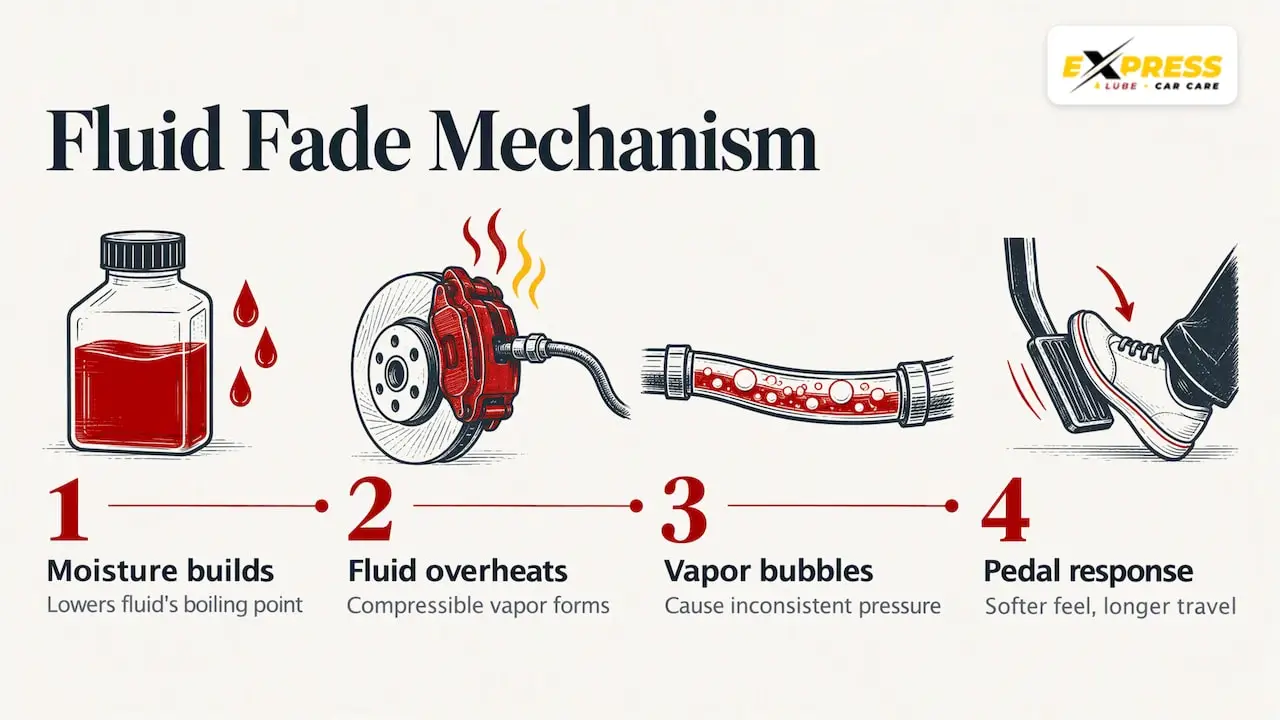
Brake fluid transfers your foot’s force to the calipers. It has to stay liquid to do that, because liquid does not compress and gas does. Fluid also absorbs moisture from the air over time, and Continental explains that moisture lowers the fluid’s boiling point and can create compressible vapor when the fluid gets hot.
That vapor is why fluid fade feels different. SCCA notes that fluid fade typically brings a softer pedal, longer pedal travel and inconsistent pressure as overheated fluid turns into air bubbles. You press, and the pedal sinks toward the floor.
This is the cause you can most easily get ahead of. Old, moisture-laden fluid is a maintenance issue, not a driving-style issue. Our guide to what brake fluid is and why it matters covers why it ages, and the page on brake fluid flushes explains when one makes sense.
Green fade: new pads that haven’t settled in
Fresh pads can release gases from the friction material when they first get hot. That gas can briefly form a thin layer between pad and rotor and cut the grip. Continental describes green fade as temporary off-gassing from new pads.
The fix is proper bedding-in. Audi’s service bulletin on brake surfaces stresses bedding new brakes properly and driving in a way that suits traffic conditions. Follow the pad manufacturer’s procedure, and be gentle with the first stretch of driving after a brake job unless the instructions say otherwise.
Mechanical fade: heat and drum brakes
Drum brakes work from the inside: shoes press outward against a drum. Heat makes the drum expand, so the shoes have to travel farther to make contact. The Georgia handbook notes that drum expansion increases shoe travel and reduces friction. Many modern cars have drums only at the rear, but plenty of trucks and older vehicles lean on them more.
Brakes that are out of adjustment make this worse. Georgia’s guidance on steep downgrades says that out-of-adjustment brakes can fade too.
Quick comparison: which type are you dealing with?
| Type | What overheats | What you may feel | Common trigger |
|---|---|---|---|
| Pad fade | Friction material | Firm pedal, but the car slows less; burning smell | Repeated hard stops, long descents |
| Fluid fade | Brake fluid | Soft, sinking pedal; longer travel | Old fluid plus heavy braking |
| Green fade | New pad surface | Reduced bite, mild smell | Fresh pads not yet bedded in |
| Mechanical fade | Drums and shoes | More pedal travel needed | Hot drums, poor adjustment |
Different types can stack. Worn pads, old fluid and a heavy load together will fade sooner than any one of them alone.
What does brake fade feel like?
Continental lists the common signs: longer stopping distances, a soft or sinking pedal, vibration or pulsation, a burning smell, unusual pedal effort or travel, and discolored rotors.
Car and Driver’s testers describe how it builds. As fade worsens, you may need to push the pedal farther and harder for the same slowing, and severe fade can keep you from making a hard stop even with extreme pedal force.
A few practical clues:
- It creeps up. The first stop on a grade feels fine. By the fourth or fifth, the pedal feels different.
- A smell shows up. A hot, acrid odor after hard braking means the pads and rotors are very hot.
- It goes away when things cool. AutoZone’s guide notes that fade may disappear once the brakes cool, then return under the same demands. That’s why “it’s fine now” isn’t a reason to skip the inspection.
If you’re noticing a pedal that sinks even when you haven’t been braking hard, that is a different problem than fade. Our page on a soft brake pedal covers those causes, and our rundown of brake problem symptoms helps you sort noises, pulling and vibration.
When is brake fade most likely to happen?
Fade needs sustained heat, so it shows up when braking is constant or the load is high:
- Long, steep downgrades. The Georgia DDS handbook says fade is especially likely on long, steep downgrades with heavier vehicles or loads when drivers lean on the service brakes instead of engine braking.
- Towing or hauling. Extra weight means more energy to absorb at every stop.
- Aggressive or high-speed driving. Speed multiplies heat faster than weight does.
- Stop-and-go with worn parts. Thin pads and tired rotors hold less heat and shed it more slowly.
- Old fluid. Boiling happens at a lower temperature, so ordinary hard use can be enough.
What this looks like around Arlington
North Texas is flat, so you won’t be creeping down a mountain pass. But heavy heat loads still happen here. Think of a loaded SUV or pickup coming off I-30 at highway speed into a stack of traffic near Highway 360, followed by a mile of stop-and-go on Brown Boulevard in August heat. Add a boat or utility trailer for a weekend at the lake, or a rideshare driver putting in a 10-hour shift of constant braking, and you have the same ingredients: repeated stops, extra weight, and little time to cool.
If you’re heading out of town toward hill country or the mountains, check your brakes first. Descents there are where fade is most dangerous.
What to do if your brakes start to fade
Stay calm and act early. Continental’s guidance, in short:
- Don’t panic-brake. Without ABS, pump the pedal lightly. With ABS, hold steady pressure.
- Downshift. Use a lower gear so the engine helps slow the car.
- Pull over safely as soon as you can find a good spot.
- Let the brakes cool completely. Do not pour water on hot brakes.
- Get the system inspected before you go back to normal driving.
That last step is the one people skip. Fade that comes from a long hill and a heavy load may only need a driving change. But fade that shows up on ordinary driving points to worn pads, tired fluid, a sticking caliper or a drum out of adjustment.
How to prevent brake fade
Use engine braking on long grades
The Georgia DDS handbook treats engine braking as the main speed control on long, steep downgrades, with the service brakes as a supplement. Its method: pick a safe speed and a low gear before you start down, then slow about 5 mph below that speed, release, and repeat. Brief, firm applications let the brakes cool in between. Dragging them lightly all the way down does not.
Keep the fluid fresh
Because moisture lowers the boiling point, old fluid is a hidden risk. Check your owner’s manual for the manufacturer’s recommended interval for your vehicle. We don’t give a one-size number here, because it differs by make and model.
Keep pads and rotors in good shape
Worn pads have less material to absorb heat. Glazed surfaces, which look shiny and hard, point to heavy thermal loading. The Audi bulletin says glazed friction surfaces indicate strong or excessive thermal loading. If you see discolored rotors or smell burning after normal driving, have a technician look.
For motorsports, SCCA’s time trial safety rules give a useful picture of what “ready” looks like: clean, full brake fluid, no leaks, rotors and drums without cracks or discoloration, and pads or shoes no more than 50% worn at the start of an event. You’re not racing, but the checklist makes good sense for a loaded family trip too.
Bed in new brakes
After new pads or rotors, follow the manufacturer’s bedding procedure. It helps prevent green fade and uneven pad deposits. Our walkthrough of how brake pads work shows why the pad surface matters.
Take care of the rest of your wheel assembly
Tires, wheels and brakes work together, and some basic upkeep helps keep the load on your brakes reasonable. These tips for maintaining wheels and tires are a good complement to a brake inspection.
Don’t overload the vehicle
Stay within your vehicle’s rated weight limits for passengers, cargo and towing. Heavier loads mean more heat on every stop.
Why you shouldn’t just replace parts and hope
It’s tempting to guess. Fade feels like “bad pads,” so you buy pads. But if the real culprit is old fluid, a sticking caliper or a drum out of adjustment, new pads won’t fix it, and you’ve spent money for nothing.
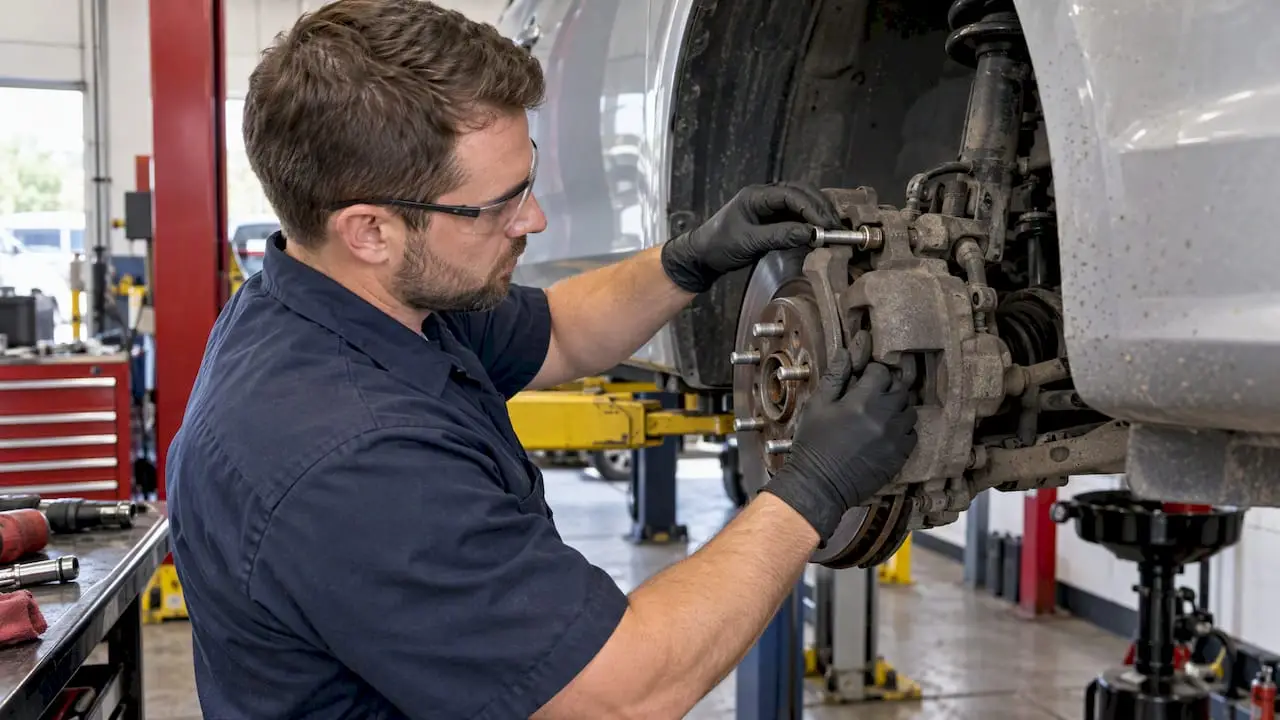
A proper diagnosis looks at the whole system: pad thickness and glazing, rotor condition and heat discoloration, fluid condition and any leaks, calipers and slide pins, and drum adjustment where the vehicle has drums. We would rather find the cause than sell you the first part that might help. A caliper that sticks, for instance, can keep a pad pressed on the rotor and cook both.
If you want to know how often a brake check makes sense, see why brake inspection frequency matters.
Our perspective: fade is a message, not just an event
We see brakes every day, and our view is simple: a brake that fades once has told you something. Sometimes the message is “you drove hard,” and fair enough. Often it’s “this part is closer to its limit than you think.”
What we do about it is look, then explain. Our ASE-certified technicians run a digital vehicle inspection with photos and videos, so you can see the pad thickness, the rotor surface or the fluid condition yourself instead of taking our word for it. We’d rather you leave understanding your brakes than leave with a bigger invoice. Brakes are not the place to gamble, and they are not the place to overspend either.
If we find the system is healthy, we tell you that, and we tell you what to watch for next time.
— Express Lube & Car Care
Brake inspections and repairs at our Arlington shop
We handle everything from brake pads and rotors to calipers, brake fluid service and full diagnostics at our shop on Brown Boulevard in North Arlington. Our brake repair and pad replacement service is the starting point if you suspect fade, and you can see everything else we do on our services page. Qualifying repairs are backed by our 24-month/24,000-mile warranty. Most jobs are same day.
FAQ
How do you fix brake fade?
The fix depends on the cause. If you simply overheated the brakes, pull over, let them cool fully and drive differently next time. If fade came from old fluid, worn pads, glazed rotors or a sticking caliper, those parts need to be diagnosed and repaired. Have a technician inspect the system before you rely on it again.
Does brake fade go away on its own?
Often the symptoms ease once the brakes cool, which is why it is called temporary. But the cause is still there, and it will usually return under the same demands. Don’t treat a recovered pedal as a clean bill of health.
Is brake fade dangerous?
Yes. It cuts your stopping power exactly when you are asking the most of the brakes, and severe fade can keep you from making a hard stop even with heavy pedal force, according to Car and Driver’s testing. If it happens, shift down, pull over safely and get the brakes checked.
Can new brake pads cause brake fade?
They can, briefly. Green fade comes from gases released as new friction material heats up for the first time. Following the pad maker’s bedding procedure reduces the chance of it.
Does brake fluid really matter for fade?
Yes. Fluid absorbs moisture over time, which lowers the temperature at which it boils. Boiling creates vapor, and vapor compresses, which gives you a soft pedal. Follow your owner’s manual for the recommended replacement interval.
Schedule a brake inspection in Arlington
If your pedal has felt soft after heavy braking, you’ve smelled something hot, or you’re about to haul a heavy load, let us take a look. Book online at our appointment page or call us at (682) 248-3416. You’ll find us at 2105 Brown Blvd, Arlington, TX 76006, and you can learn more on our website.
Sources
- Georgia Department of Driver Services, Section 2.16
- Georgia Department of Driver Services, Section 5.4
- Car and Driver: Tested, The Power to Stop Brake Test
- SCCA: How to Know When Your Stock Brake System Isn’t Cutting It
- SCCA Time Trials: Full Safety Rules
- Audi of America Technical Service Bulletin (NHTSA)
- Continental Tires: Brake fade causes, symptoms and prevention
- Delphi Auto Parts: What is brake fade and how to prevent it