
Brake rotor replacement commonly costs between about $250 and $700 per axle depending on parts quality and local labor rates, and most shops recommend replacing pads at the same time for the best results. Skilled DIYers with the right tools can often handle the job in an afternoon, but if you’re not comfortable with a torque wrench and jack stands, book a pro. Labor typically runs 1 to 2 hours per axle, and choosing a shop with qualified technicians and a good reputation gives you a reliable starting point for a fair, safe repair.
TL;DR:
- Replacing brake rotors costs between $250 and $700 per axle, with full repair jobs often ranging from $500 to $950, depending on parts quality and labor.
- Using aftermarket coated rotors with ceramic pads offers a low-maintenance, cost-effective solution suitable for most daily drivers.
- Symptoms like pedal vibration, grinding noises, and rotor grooves indicate the need for a professional inspection, and pad thickness below a quarter inch signals imminent service.
- DIY replacement is feasible within 1 to 2 hours per axle if you have the proper tools, but rusted or seized parts often require professional assistance.
- Request detailed, itemized estimates and compare quotes from qualified shops to ensure transparency and avoid unnecessary or overpriced services.
Table of Contents
- How much does brake rotor replacement actually cost?
- What are the warning signs your rotors need attention?
- Which rotor and pad combination fits your driving?
- Can you replace brake rotors yourself?
- When can a rotor be resurfaced instead of replaced?
- How do you get a fair, honest quote from a shop?
- Our take on balancing safety, cost, and transparency
- Ready to have your brakes inspected the right way?
- Where these cost and safety numbers come from
- Sources
- FAQ
How much does brake rotor replacement actually cost?
Your total bill breaks down into parts and labor, and both swing quite a bit based on what your car needs. RepairPal’s cost estimator separates these two categories so you can see exactly what you’re paying for instead of one vague lump sum. On the low end, economy rotors paired with basic labor might land around $250 per axle. On the higher end, OEM or performance-grade rotors with more involved labor can push past $700 per axle.
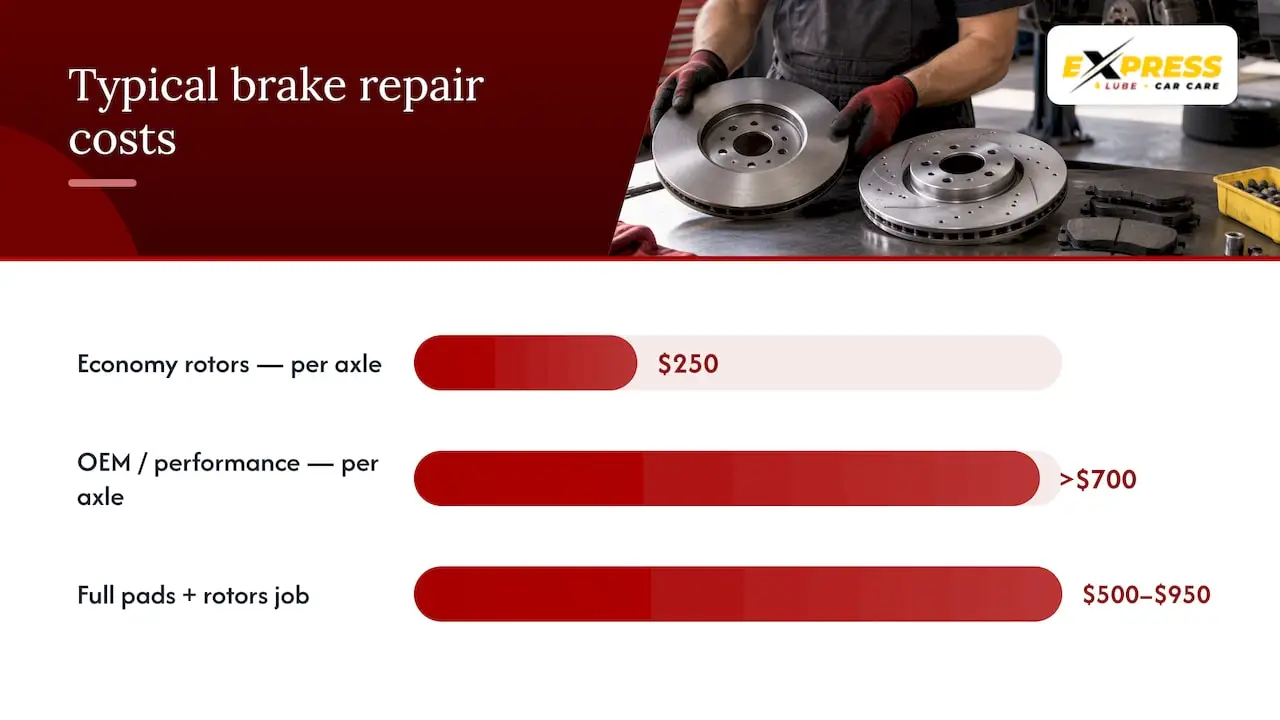
Consumer Reports notes that a full pads-and-rotors job typically falls in the $500 to $950 range for many vehicles, since most shops won’t replace rotors without also swapping worn pads.
A few ways to keep the number reasonable:
- Ask your shop to bundle both front rotors together since labor overlaps and saves you a second visit charge.
- Choose quality aftermarket parts over OEM when your vehicle isn’t under warranty, since the performance gap is often small for everyday driving.
- Request an itemized quote showing rotor brand, pad brand, and labor hours separately so you can compare it against other estimates.
- Watch for add-ons like caliper replacement or a brake fluid flush that can raise your total, and ask whether they’re truly necessary right now.
What are the warning signs your rotors need attention?
Your car usually tells you something’s wrong before it becomes a real problem. Vibration through the brake pedal or steering wheel during stops, grinding metal-on-metal noise, and a high-pitched screech are the big three. AAA lists these symptoms among the clearest signs that your brake system needs a professional look, and recommends inspecting components at every oil change.
- Vibration or pulsing felt in the pedal, especially at highway speeds.
- Grinding or metallic noise that gets louder under braking.
- A visible lip or groove pattern on the rotor’s edge.
- Blue or discolored spots on the rotor surface from overheating.
One practical checkpoint: brake pad thickness below a quarter inch is a widely used industry indicator that service or replacement is due soon, and thin pads accelerate rotor wear fast.
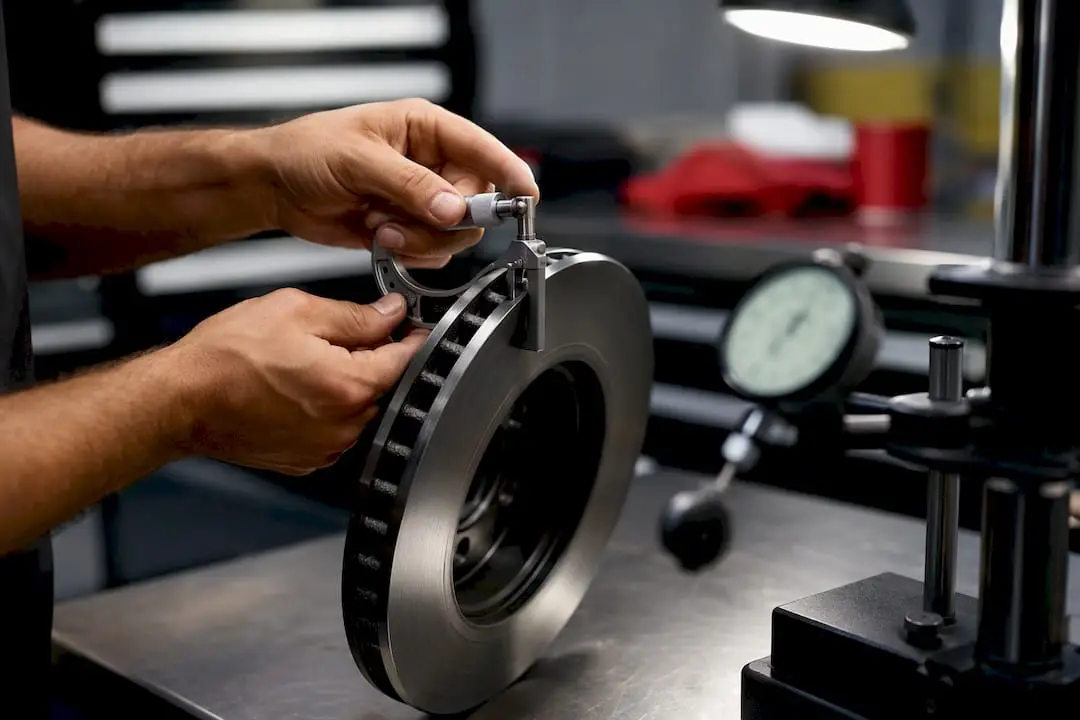
You can spot a lot from the driveway, but technicians measure things you can’t eyeball, like minimum thickness, lateral runout, and thickness variation across the rotor face. If your pedal drops toward the floor or your stopping distance feels noticeably longer, stop driving and get it checked before your next trip.
Which rotor and pad combination fits your driving?
Not all rotors are built the same, and the differences show up in both price and how long the part lasts. Blank, economy rotors are the budget option and work fine for typical commuting. Coated rotors resist rust longer, which matters if your car sits outside. Slotted or drilled rotors help shed heat and gas buildup during hard braking, but they wear faster under normal daily use and cost more upfront. Two-piece rotors, found mostly on performance vehicles, separate the hat from the disc to reduce weight and heat transfer.
Pad material matters just as much as the rotor itself:
- Ceramic pads run quieter and produce less dust, making them a solid pick for daily commuters.
- Semi-metallic pads handle heat better and suit towing or heavier loads but tend to be louder and harder on rotors.
- Performance pads offer stronger bite for spirited driving but often increase rotor wear over time.
For most commuters, a coated rotor with ceramic pads is a sensible, low-maintenance combination.
Can you replace brake rotors yourself?
If you’ve got the tools, the patience, and a safe workspace, replacing rotors is within reach for many DIYers. Here’s the general sequence:
- Loosen the lug nuts, lift the car with a jack, and secure it on jack stands rated for your vehicle’s weight.
- Remove the wheel, then the caliper bolts, and hang the caliper aside with wire so it doesn’t strain the brake line.
- Remove the caliper bracket if needed, then pull the old rotor off the hub.
- Clean the hub surface, install the new rotor, reattach the bracket and caliper, and use a C-clamp to compress the caliper piston before fitting new pads.
- Torque everything to spec, replace the wheel, and repeat on the other side of the axle.
Expect roughly 1 to 2 hours per axle if things go smoothly. They don’t always. Rusted rotors that won’t budge, seized caliper slides, and ABS sensor wiring near the hub trip up plenty of otherwise capable DIYers. Penetrating oil, a rubber mallet, and patience solve most of these, but a caliper that won’t release safely is a sign to call a shop rather than force it.
Pro Tip: After installation, do a series of slow, controlled stops from low speed in an empty lot before driving normally, listening and feeling for vibration or noise that signals a problem, and consider professional cleaning services like those at MK Auto Detail to maintain your brakes’ performance.
When can a rotor be resurfaced instead of replaced?
Resurfacing, or turning, shaves a thin layer off the rotor face to restore a smooth surface. It only works when the rotor has enough material left above its minimum thickness, a spec stamped on the rotor itself.
- Heat cracks or blue discoloration mean replacement, not resurfacing, regardless of remaining thickness.
- Excessive thickness variation across the rotor face, a common cause of pedal pulsation, often can’t be corrected reliably by turning.
- Modern rotors are thinner than older designs, so there’s often little margin to machine before hitting the minimum, which is why many shops now replace rather than turn.
If a shop recommends resurfacing, ask for the actual thickness reading or a photo of the rotor’s minimum-thickness stamp next to a caliper gauge measurement. That’s the only way to confirm it’s a real option and not just a shortcut.
How do you get a fair, honest quote from a shop?
A little preparation turns a vague estimate into an apples-to-apples comparison. Before you approve any work, ask:
- What brand and part number are you using for the rotors and pads?
- Is this OEM or aftermarket, and why do you recommend it for my vehicle?
- How many labor hours are you billing, and at what rate?
- If resurfacing is on the table, can you show me the thickness measurement?
- What’s the warranty on parts and labor?
Look for trust signals like ASE-certified technicians, RepairPal or CarFax recognition, and a documented inspection with photos or video of your actual brake components. Be wary of vague ballpark numbers with no breakdown, pressure to replace parts that weren’t part of your original concern, or a shop that won’t show you measurements when you ask.
Pro Tip: Get at least one comparison quote in writing before authorizing work over a few hundred dollars, since itemized estimates make it easy to spot outliers.
Our take on balancing safety, cost, and transparency
Brakes aren’t the place to cut corners, but that doesn’t mean every quote should be treated as final. We believe a transparent, photographed inspection gives you the information to make a confident call, not just a bill to pay. Our technicians document what they find, reflecting that approach. If you’re unsure whether your rotors need attention, an inspection settles it.
— Express Lube & Car Care
Ready to have your brakes inspected the right way?
If you’re weighing DIY against a shop visit, our brake repair and pad replacement services provide technicians and a digital inspection with photos, so you see exactly what’s happening at each wheel before you approve anything.

- Book an inspection through our brake repair and pad replacement service page.
- Use our $20 off brakes coupon toward your service.
- Ask for a written, itemized estimate before any work begins, so you know exactly what you’re paying for.
Where these cost and safety numbers come from
- Consumer Reports on inspection intervals and typical job costs.
- RepairPal for parts-versus-labor cost estimates.
- AAA on warning signs and inspection timing.
- SAE research on rotor runout and thickness variation.
Sources
- 11 ways to know you may need new brakes | AAA
- Brake Rotor Replacement Cost Estimate | RepairPal
- Your car maintenance checklist | Consumer Reports
- Interactive effects of thermal deformation and wear on lateral runout and thickness variation of brake disc rotors — SAE
FAQ
How much does it usually cost to replace rotors?
Brake rotor replacement typically runs between $250 and $700 per axle depending on parts quality and labor rates, and a full pads-and-rotors job often falls in the $500 to $950 range for many vehicles. Ask for an itemized quote to see exactly how parts and labor break down for your car.
Can I replace my rotors by myself?
Yes, if you have jack stands, a torque wrench, a C-clamp, and experience working safely under a vehicle. Rusted rotors, seized calipers, and ABS sensor wiring near the hub trip up many DIYers, so stop and call a shop if something won’t budge safely.
How do I know if my rotors need replacing?
Watch for pedal vibration, grinding or screeching noises, and a visible lip or grooves on the rotor edge, all symptoms AAA flags as reasons for a professional inspection. A technician confirms this with measurements like minimum thickness and runout that aren’t visible to the eye.
Can I still drive if my rotors are bad?
Driving on worn or damaged rotors increases your stopping distance and risks further damage to your calipers and brake lines. If your pedal feels soft, drops toward the floor, or you hear grinding, stop driving and have the car inspected before your next trip.