
If your oil level keeps dropping and you’re spotting bluish smoke from your tailpipe, your engine is likely burning oil, and the usual suspects are worn piston rings, failing valve stem seals, or a malfunctioning PCV system. Keep an eye on your dipstick, skip long highway trips until you know more, and get it looked at soon if the smoke thickens or the oil loss speeds up.
TL;DR:
- Smoke that appears only at startup and fades within a minute points toward valve seals; smoke under acceleration suggests rings, PCV trouble, or turbo seals.
- Record dated dipstick readings, smoke timing, and mileage, then check for puddles, oily spark plugs, and a stuck PCV valve before the appointment.
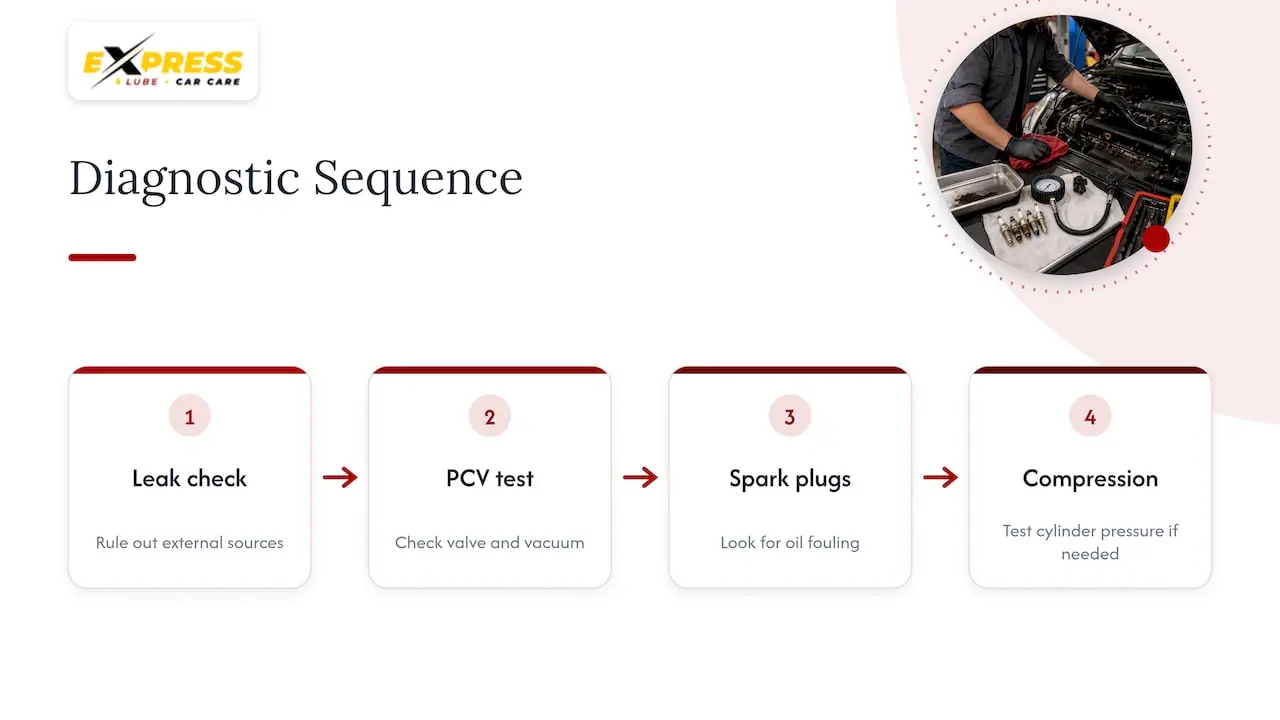
- Shops typically rule out external leaks and test the PCV system and plugs before using compression tests or pressure loss tests to locate internal wear.
- A failed PCV valve may be replaced that day, while worn rings can require an engine rebuild, and burned oil can damage the catalytic converter.
Table of Contents
- 1. What’s Actually Causing Your Engine to Burn Oil?
- 2. Symptoms That Point to Burning Oil, Not a Leak
- 3. A Simple Checklist Before You Call the Shop
- 4. What Happens at the Shop: Diagnosis, Repairs, and Timelines
- 5. Habits That Lower Your Risk of Oil Consumption
- 6. How We Diagnose Oil-Burning Cases
- 7. A Technician’s Take on Catching Oil Burning Early
- Book a Diagnostic for Your Oil Consumption Concerns
- FAQ
- Sources
1. What’s Actually Causing Your Engine to Burn Oil?
Oil doesn’t just vanish. When your engine burns it, oil is finding a way into the combustion chamber where it has no business being, and it’s getting torched along with your fuel. A few different mechanical paths lead there, and figuring out which one applies to your car changes everything about the fix.
Piston rings and cylinder wear are the classic culprit, especially in older or high-mileage engines. Your piston rings are supposed to scrape oil off the cylinder walls and keep it below the piston, out of the combustion zone above. When rings wear down, lose tension, or the cylinder walls themselves wear into an irregular shape, oil slips past during the compression and power strokes. Engineers call part of this phenomenon ring flutter or reverse blow-by, where rapid pressure changes actually let oil travel backward past a ring that’s supposed to block it. Research on oil consumption sources in spark ignition engines found this cylinder-piston-ring pathway is typically the largest single source of internal oil consumption, since it’s where oil clinging to cylinder walls gets consumed during the combustion stroke.
Valve stem seals and guides tell a different story. These small seals keep oil in the valve train from dripping down into the intake ports. When they harden, crack, or wear with age, oil seeps past and pools in the intake manifold or sits on the valve stems. The telltale clue: smoke that’s heavy on cold startup, then clears up or lessens once the engine warms and oil thins out enough to stop pooling as easily. That startup-versus-running distinction is one of the more useful diagnostic signals you have.
A faulty PCV system is sneakier because it doesn’t look like a leak at all. Your Positive Crankcase Ventilation system is designed to route crankcase vapors back into the intake for combustion, but when the valve sticks open or clogs, it can pull liquid oil along with those vapors instead of just vapor, feeding oil straight into your intake tract.
Other contributors worth ruling out:
- Overfilled crankcase or wrong oil viscosity: excess oil sits high enough to get whipped into foam and consumed faster, and EPA guidance on crankcase maintenance notes that overfilling increases friction and consumption, so only add what’s needed.
- Turbocharger seals: on turbocharged engines, worn turbo shaft seals let oil migrate into the intake or exhaust housing, often producing smoke under boost or acceleration specifically.
- Head gasket or cylinder head damage: a breached gasket or cracked head can open a path for oil into the combustion chamber or exhaust, often alongside coolant loss or overheating.
2. Symptoms That Point to Burning Oil, Not a Leak
The clues your car gives you usually point in one direction once you know what to look for. The challenge is that oil burning and oil leaking share a few symptoms, so it helps to separate them early.
- Bluish or gray exhaust smoke is the headline symptom. Smoke right at startup that fades as the engine warms usually points to valve seals, while smoke that persists or worsens under acceleration suggests ring wear or a turbo seal issue.
- A dipstick that keeps reading low with no puddles underneath is one of the clearest signs of internal consumption rather than an external leak, according to AAA guidance on oil loss, which flags a falling level with no visible drip as a strong internal-burning signal.
- A faint burning smell, sometimes with oily residue near the exhaust tip or undercarriage, often shows up alongside smoke.
- Fouled spark plugs and rough running happen when oil coats the plug tips, interfering with the spark and causing misfires or a noticeable loss of power.
- A check-engine light with misfire or catalyst-related codes can appear once enough oil has passed through the exhaust system and started affecting the catalytic converter’s efficiency.
Pay attention to when smoke shows up. Startup-only smoke that clears within a minute or two leans toward valve seals, while smoke that comes and goes with acceleration or load leans toward rings or a turbo seal.
3. A Simple Checklist Before You Call the Shop
You don’t need a lift or a scan tool to gather useful clues. A few minutes with a flashlight and your dipstick can tell a mechanic a lot before you even make the appointment.
- Check your oil level the right way. Park on level ground, let the engine sit for a few minutes after driving (or check it cold before a morning start), pull the dipstick, wipe it clean, reinsert fully, then read the level. Write the number and date down so you can track how fast it’s dropping.
- Look under the car and around the engine for leaks. Check the ground where you usually park for fresh spots, then inspect the valve cover gasket, oil pan gasket, and drain plug area for wet residue or grime buildup that suggests a slow seep.
- Pull a spark plug if you’re comfortable doing so. Oily, wet, or fouled plug tips point toward oil reaching the combustion chamber internally, which narrows things toward rings, guides, or seals rather than an external leak.
- Note the smoke’s color and timing. Blue-gray smoke only at startup suggests valve seals; smoke that shows up or thickens during acceleration suggests rings, a PCV fault, or a turbo seal.
- Do a quick PCV check. With the engine off, pull the PCV valve and give it a shake. It should rattle freely; one that’s stuck, gummed up, or silent is worth having tested properly.
- Compare your findings against a cold-start smoke test. If white vapor is your main concern rather than blue smoke, our guide to white exhaust smoke walks through how to tell steam from oil smoke.
Pro Tip: Snap a photo of your dipstick reading next to a date stamp every time you check it. A simple photo log makes the consumption rate obvious to a technician in seconds, instead of relying on memory.
Once you’ve gathered this information, resist the urge to dig further on your own. Compression testing and leak-down testing require specialized tools and training to interpret correctly, and misreading them can send you chasing the wrong repair. Bring your mileage log, smoke observations, and any spark plug photos to your appointment. If you’ve already noticed a low oil pressure warning alongside these symptoms, our guide on what to do when that light comes on covers the immediate steps worth taking first.
4. What Happens at the Shop: Diagnosis, Repairs, and Timelines
A thorough shop visit for suspected oil burning usually follows a logical sequence rather than jumping straight to disassembly.
- Visual leak inspection rules out external sources first, since a gasket leak can masquerade as internal consumption if oil blows back onto the undercarriage while driving.
- PCV system testing checks valve function and vacuum readings to confirm or rule out that pathway.
- Spark plug inspection looks for oil fouling patterns that hint at which cylinders are affected.
- Compression and leak-down testing measure how well each cylinder holds pressure, which is the most reliable way to pinpoint ring or valve-related wear.
Repair scope varies enormously depending on what those tests reveal. A clogged or failed PCV valve is a straightforward part swap, usually finished same day. Valve stem seals require removing the cylinder head or, on some engines, working through the valve train with specialized tools without a full head removal, putting that job in the moderate range. Valve guide service and head gasket replacement are more involved, often requiring a day or more of shop time. Piston ring or cylinder wear is the most invasive, frequently meaning a top-end rebuild or, in severe cases, a full engine rebuild or replacement. Turbo seal service falls somewhere in the middle, depending on turbo accessibility.
Cost ranges for these repairs vary widely based on your specific vehicle, labor rates, and parts availability, so any estimate you see online should be treated as a rough planning reference rather than a quote. Your shop should give you an itemized estimate once diagnostics confirm the cause.
One more reason not to let this linger: oil reaching your catalytic converter over time can coat and damage it. SAE research on catalyst deposits found that oil passing through the intake valve pathway is more likely to cause severe catalyst poisoning than oil consumed via the PCV system or piston rings, which means a valve-seal issue left unaddressed carries extra urgency for your exhaust system, not just your oil level.
5. Habits That Lower Your Risk of Oil Consumption
Most oil-burning problems build slowly, which means a little routine attention goes a long way toward catching them early or avoiding them altogether.
- Stick to your manufacturer’s recommended oil grade and change interval, found in your owner’s manual, since the wrong viscosity can accelerate wear on rings and seals over time.
- Add only what’s needed when topping off. Overfilling doesn’t give your engine extra protection. EPA guidance notes it can be consumed rapidly and increase friction instead.
- Have your PCV valve and major gaskets checked during routine service, particularly once your vehicle passes the 100,000-mile mark, since both tend to degrade gradually rather than fail all at once.
- Check your oil at every fuel stop if you’re driving a high-mileage vehicle. AAA recommends this habit specifically for older cars so you catch a drop before it becomes a crisis.
- Don’t skip scheduled oil changes. Fresh oil keeps rings and cylinder walls properly lubricated, and our guide on what happens when you delay oil changes breaks down how neglect accelerates wear.
Pro Tip: Keep a small notebook or phone note with your mileage and oil level each time you check it. A pattern of steady loss, even a small one, is far easier to explain to a technician than a vague “it seems low.”
6. How We Diagnose Oil-Burning Cases
When a vehicle comes in for suspected oil consumption, we follow a clear diagnostic sequence rather than guessing: visual inspection for external leaks, PCV system testing, spark plug inspection, and compression or leak-down testing when internal wear is suspected.
- Bring any mileage logs, dipstick photos, or notes on when smoke appears. The more detail we start with, the faster we can narrow down the cause.
7. A Technician’s Take on Catching Oil Burning Early
One pattern we see often: a driver notices the oil light flicker or a faint burning smell, puts off the visit for a few months, and comes in once the smoke is impossible to ignore. In many of these cases, a PCV valve or a set of valve seals could have solved the problem months earlier, before oil had a chance to foul the catalytic converter. Catching it early almost always means a smaller repair bill and a converter that doesn’t need replacing alongside the original issue. If you’re noticing any of the symptoms we’ve covered, write them down and bring them in. That single habit makes the whole diagnostic process faster and cheaper for you.
— Express Lube & Car Care
Book a Diagnostic for Your Oil Consumption Concerns
If your oil level keeps dropping and you’re not sure why, we’d rather find the answer now than let it turn into a bigger repair later. Our ASE-certified technicians run the full diagnostic sequence, visual leak check, PCV testing, spark plug inspection, and compression or leak-down testing when needed, and document everything with photos and video so you know exactly what’s going on under the hood.

Depending on what we find, the fix might be as simple as a PCV valve replacement or oil change, or it might call for valve seal work, engine repair, or more involved engine removal and reinstallation.
Bring your mileage log, any dipstick photos, and notes on when smoke appears. Visit our services page to book your diagnostic appointment, or explore our full maintenance services to keep this from becoming a repeat problem.
FAQ
Why Do I Burn so Much Oil?
Excess oil consumption usually traces back to worn piston rings, hardened valve stem seals, or a PCV system that’s drawing oil instead of just vapor into the intake. Overfilling the crankcase or using the wrong oil viscosity can also increase how fast you burn through a quart.
Why Is My Oil Disappearing but No Leak?
When your dipstick reads low with no puddles or wet spots underneath the car, the oil is most likely burning internally rather than leaking externally. AAA guidance points to piston rings, valve seals, or PCV issues as the most common internal causes behind this pattern.
Do Oil Burns Ever Go Away?
Oil burning caused by worn mechanical parts, like rings or valve seals, doesn’t resolve on its own and typically worsens over time without repair. A PCV valve replacement is the one exception that can fully fix the issue since it’s a simple part swap rather than internal wear.
What Happens to Oil When You Burn It?
When oil reaches the combustion chamber, it ignites along with your fuel, producing the bluish or gray smoke you see at the tailpipe. Over time, this oil residue can also coat spark plugs and damage your catalytic converter, especially when it travels through the intake valve pathway.
Sources
- The contribution of different oil consumption sources to total oil consumption in a spark ignition engine
- Car losing oil? These are potential causes | AAA Club Alliance
- EPA guidance excerpt on not overfilling oil