
Cleaning a throttle body removes carbon and oil deposits that commonly cause rough idle and sluggish throttle response, and a proper clean often fixes those symptoms in a single session. If the buildup is light to moderate and you can reach the throttle body without a wrench fight, this is a solid weekend DIY job. Heavy coking, a throttle body that needs full removal, or a car that requires a scan-tool relearn afterward is where calling a shop stops being optional and starts being the smarter move.
TL;DR:
- Light to moderate buildup can be cleaned in place, but heavy coking or the need for a relearn typically requires professional service.
- Using non-sensor-safe cleaners like brake or carburetor solvent risks damaging throttle bore coatings and electrical components.
- Symptoms such as rough idle, hesitation, and stalling often improve after cleaning, but persistent issues may indicate other underlying problems.
- A proper relearn procedure is essential if idle remains irregular after cleaning, and most shop costs range from $90 to $300 depending on job complexity.
- Regular maintenance, including air filter changes and PCV system checks, helps prevent carbon buildup that causes throttle response issues.
Table of Contents
- What Does Throttle Body Cleaning Actually Fix?
- Tools and Materials You’ll Need Before You Start
- How Do You Clean a Throttle Body Step by Step?
- Choosing a Cleaner That Won’t Damage Sensors or Coatings
- How Do You Know the Cleaning Worked?
- DIY vs. Professional Service: What Will It Actually Cost You?
- How Often Should You Clean a Throttle Body?
- Common Mistakes That Keep the Problem Coming Back
- How Our ASE-Certified Techs Approach Throttle Body Service
- Ready to Have a Pro Handle Your Throttle Body?
- Sources
- FAQ
What Does Throttle Body Cleaning Actually Fix?
A throttle body is the valve that controls how much air enters your engine when you press the gas. Over time, oil vapor from the crankcase mixes with road dust and bakes onto the throttle plate and bore walls, forming a sticky, tar-like coating. That coating narrows the air path and makes the throttle plate stick or hang up in the wrong position.
The symptoms are hard to miss once you know what you’re looking for. A dirty throttle body typically shows up as rough idle, occasional stalling when you come to a stop, hesitation when you first hit the gas, idle that surges up and down on its own, and sometimes a check-engine light tied to idle or throttle position codes. If your car feels like it’s thinking about stalling every time you sit at a red light, this is usually where to look first, right alongside your check engine light diagnosis if a code has already popped up.
Here’s the part most guides skip: cleaning doesn’t just scrub away grime for cosmetic reasons. It restores the precise airflow measurements your engine’s computer relies on to set idle speed and fuel trim. A gunked-up throttle plate that can’t close all the way confuses that calibration, and that’s exactly why rough idle throttle body complaints and hesitation go hand in hand.
Tools and Materials You’ll Need Before You Start
Gather everything before you crack open the intake. Nothing kills momentum on a DIY job faster than realizing your short a tool halfway through.
- A throttle-body-safe aerosol cleaner (check the label specifically, not just any solvent in your garage)
- A soft nylon brush or an old toothbrush for scrubbing carbon out of corners
- Microfiber cloths and cotton swabs for wiping and detail work
- Nitrile gloves and eye protection
- Basic hand tools: screwdrivers, a socket set, and hose clamp pliers
- A flashlight to actually see what you’re cleaning
- Optional: a torque driver for reassembly and a scan tool if you’ll need a relearn
Work with the engine cold, in a ventilated space, away from open flames or sparks. Throttle body cleaner is flammable, and you’ll be spraying it near an open intake. Dispose of soaked rags properly instead of balling them up in a trash can, where they can smolder.
Pro Tip: Buy one extra can of cleaner than you think you’ll need. Running out mid-job with a half-disassembled intake sitting open is not where you want to be.
How Do You Clean a Throttle Body Step by Step?
Start with prep work regardless of which method you use:
- Park on level ground and let the engine cool completely.
- Check your service manual to see if disconnecting the battery is recommended for your model.
- Label every hose and clamp as you remove it. Phone photos work great here.
- Inspect the mass airflow sensor and intake boots while things are open. You’re already in there.
On-car cleaning (best for light to moderate buildup):
- Loosen the clamp and remove the intake duct to expose the throttle plate.
- Spray cleaner onto a rag rather than directly into the throttle bore.
- Wipe both sides of the plate in small arcs, working the carbon loose gradually.
- Never force the plate open past its resting position. Electronic throttle motors are not built for manual pressure.
- Keep loose residue from dripping into the intake manifold below.
Removing the throttle body (needed for heavy coking):
- Disconnect the electrical connector and any coolant lines, then unbolt the throttle body from the intake.
- Once it’s on the bench, spray cleaner into a shop rag and scrub every surface, including the backside of the plate where deposits often hide.
- Always replace the mounting gasket rather than reusing the old one. A compressed gasket is a near-guaranteed vacuum leak waiting to happen.
- Reinstall using the torque spec in your manual, then check for leaks by listening for hissing at idle.
After reassembly, don’t panic if idle feels slightly off for the first minute or two. A brief stumble or a temporarily high idle is normal while the ECM relearns the throttle’s resting position.
Choosing a Cleaner That Won’t Damage Sensors or Coatings
Reaching for carburetor cleaner or brake cleaner because it’s what’s already on the shelf is one of the most common and costly DIY mistakes. Those solvents are formulated to be aggressive, and aggressive solvents can strip the coatings off modern throttle bores and eat away at plastic components and electrical connectors.
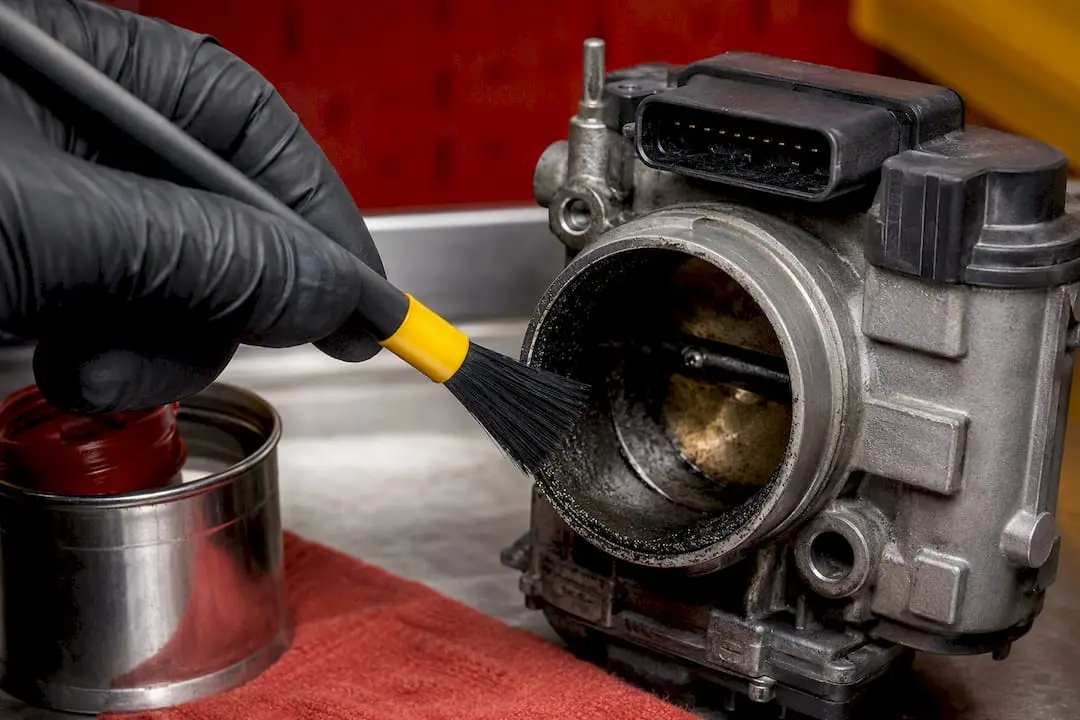
“Throttle-body-safe” on a label means the formula is designed to dissolve carbon without attacking anodized or coated bore surfaces. Look for that exact phrase or a callout that it’s safe for electronic throttle control (ETC) systems.
A few habits protect the expensive parts around the throttle body:
- Spray cleaner onto your cloth first, then wipe. Don’t blast it directly into the bore.
- Blot drips immediately rather than letting them run toward the sensor housing.
- Never point cleaner directly at the throttle position sensor or the electronic motor.
- Keep overspray away from the mass airflow sensor’s wiring and element.
How Do You Know the Cleaning Worked?
Start the engine and let it idle steady for a few minutes without touching the gas. A healthy throttle body settles into a smooth, consistent idle speed once the ECM adjusts. Take it for a short test drive afterward and pay attention to throttle response at low speed and from a stop.
Most cars self-correct within a few minutes of driving. But a relearn becomes necessary when idle stays stubbornly high, hunts up and down, or the check-engine light returns. Some manufacturers spell out a specific procedure in their service documentation, and skipping it is a common reason DIY jobs don’t fully resolve.
- Idle smooths out on its own: you’re done.
- Idle hunts or stays elevated after 10 minutes of driving: a relearn is likely needed.
- Code returns immediately: something else may be at play.
Shops handle this with scan tools that command the throttle through its full range and reset idle parameters directly, which is exactly why professional relearn procedures exist as a service line item rather than an afterthought.
DIY vs. Professional Service: What Will It Actually Cost You?
Doing it yourself runs $8 to $25 in supplies, and an on-car clean takes 30 to 90 minutes for most people working through it for the first time. Bench removal with gasket replacement adds real time, especially if access to your throttle body is tight.
By the numbers: Shop labor for a throttle body clean typically runs 0.5 to 1.2 hours, with total cost landing between $90 and $300 depending on whether removal, a relearn procedure, or additional diagnostics are involved. More complex jobs with full removal and adaptation can push toward $200 to $350.
A few honest questions help you decide which route fits:
- Can you actually reach the throttle body without removing half the intake system?
- Is the buildup light grime or thick, tar-like coking that needs a bench clean?
- Does your vehicle require a scan-tool relearn to fully resolve symptoms?
- Are there existing check-engine codes that suggest a deeper issue than dirt alone?
If you answered “not sure” to more than one of those, a diagnostic visit upfront saves you from guessing.
How Often Should You Clean a Throttle Body?
Interval guidance varies by engine design. Port-injection engines generally go 60,000 to 100,000 miles between services, while many direct-injection engines need attention every 30,000 to 40,000 miles because they’re more prone to carbon buildup overall. Check your owner’s manual for the manufacturer’s specific recommendation rather than assuming.
A few preventive habits stretch that interval further:
- Replace clogged air filters on schedule. A restricted filter pushes more oil vapor through the intake.
- Inspect the PCV valve and intake boots for leaks, since a failing PCV system is often the root cause of recurring deposits.
- Address any oil-control issues (worn valve seals, excessive blow-by) instead of just cleaning around them.
Bundling a throttle body service with an air filter swap or a broader fuel system inspection saves both time and labor cost, since the intake is already open.
Common Mistakes That Keep the Problem Coming Back
Most repeat complaints trace back to the same handful of errors: using the wrong cleaner, forcing the throttle plate open by hand, reusing an old gasket, spraying solvent directly onto sensors, or skipping the relearn step entirely.
If idle stays rough after a clean, work through this checklist:
- Inspect intake boots and hoses for cracks that could be pulling in unmetered air.
- Test or clean the mass airflow sensor, since a dirty MAF can mimic throttle body symptoms.
- Pull codes with a scanner rather than guessing.
- Check the PCV valve and ignition components, since misfires can feel identical to a rough idle from the throttle.
Pro Tip: If cleaning didn’t change anything at all, the problem probably was never the throttle body. Vacuum leaks and failing sensors love to disguise themselves as carbon buildup.
How Our ASE-Certified Techs Approach Throttle Body Service
We inspect before we clean. That order matters because a throttle body that looks dirty sometimes isn’t the actual source of a rough idle, and cleaning it without checking the intake boots or PCV system just delays the real fix.
When we remove a throttle body, the gasket gets replaced every time, sensor-safe cleaners are the only ones that touch the bore, and a relearn procedure runs whenever the vehicle calls for one. Our technicians are ASE-certified, Express Lube & Car Care is a RepairPal Certified Shop, and we’ve been recognized as a CarFax Top-Rated Service Center. That combination is what keeps comeback rates low.
— Hassan
Ready to Have a Pro Handle Your Throttle Body?
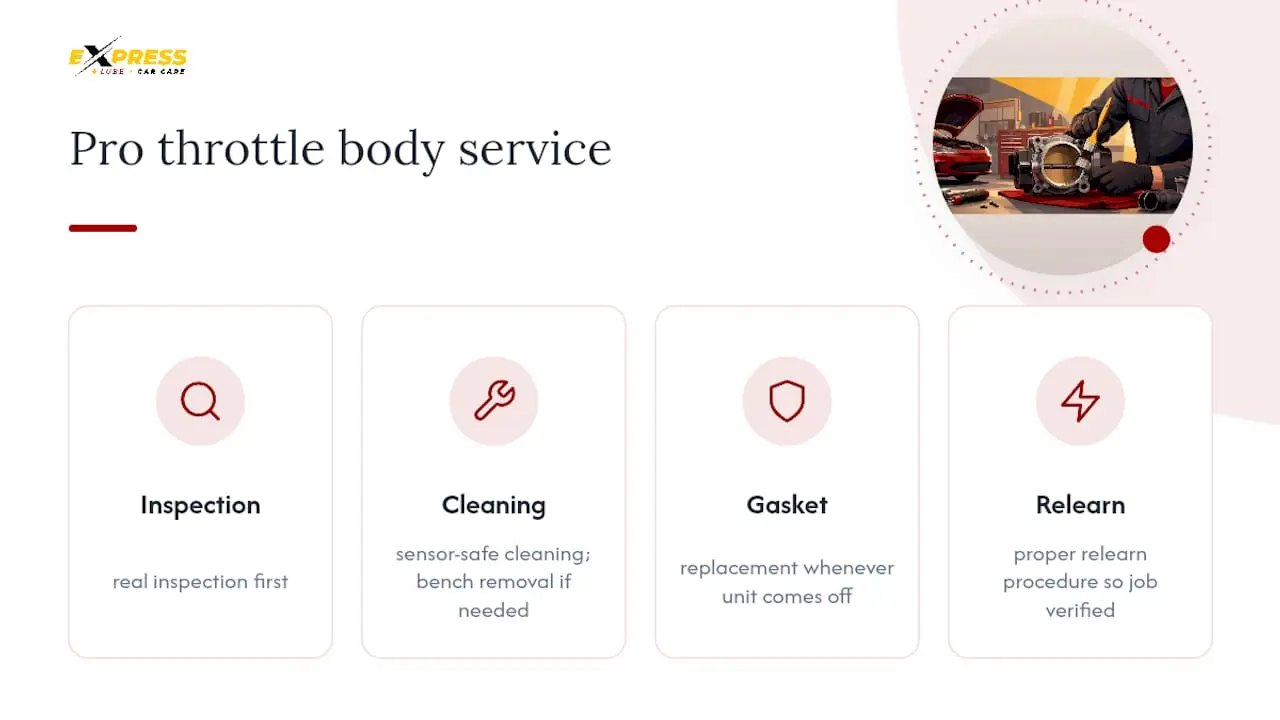
If the idea of removing your intake duct on a Saturday afternoon doesn’t sound appealing, you’re not alone, and that’s exactly the gap Express Lube & Car Care fills. Our full-service throttle body service includes a real inspection first, sensor-safe cleaning (with bench removal when the buildup calls for it), gasket replacement whenever the unit comes off, and a proper relearn procedure so you’re not guessing whether the job actually worked.
Every repair we perform is backed by a 24-month, 24,000-mile warranty, and our ASE-certified technicians run a digital vehicle inspection so you can see exactly what’s happening under the hood before you approve any work. Being a RepairPal Certified Shop and a CarFax Top-Rated Service Center isn’t a coincidence. It’s how we’ve built trust with drivers across Arlington who’d rather not spend their weekend elbow-deep in an intake manifold.
If your idle has been rough or your throttle response feels sluggish, request a line-item quote and we’ll tell you exactly what your vehicle needs, no surprises. You can also grab $45 off your next mechanical repair when you book with us this month.
Sources
Guidance on cleaner selection and sensor safety came from CRC Industries; cost estimates from Jerry; gasket and bench-clean technique from Castrol; and root-cause inspection advice from Car and Driver. For safe engine-bay cleaning practices around the throttle body, see this engine bay cleaning guide.
- How to Clean a Throttle Body: Save Money & Boost Performance
- How Much Does a Clean Throttle Body Replacement Cost? – Jerry
- How to Clean a Throttle Body | Castrol
FAQ
Can I Clean a Throttle Body Without Removing It?
Yes, for light to moderate buildup you can clean it in place by removing the intake duct and wiping the plate with a throttle-body-safe cleaner on a rag. Heavy, tar-like coking usually needs full removal for a proper bench clean.
Is Throttle Body Cleaning Safe to Do Myself?
It’s safe as a DIY task if you use a sensor-safe cleaner, avoid forcing the throttle plate, and follow basic precautions like working with a cold engine in a ventilated space.
What Happens if I Use the Wrong Cleaner?
Carburetor or brake cleaner can strip coatings off the throttle bore and damage plastic components or electrical connectors, potentially causing worse problems than the original buildup.
Do I Need a Relearn After Cleaning?
Not always. Idle usually smooths out within a few minutes of driving, but if idle stays high or hunts up and down, a scan-tool relearn resolves it, and shops like Express Lube & Car Care perform this as standard practice on removal jobs.
How Much Does Professional Throttle Body Cleaning Cost?
Shop labor typically runs 0.5 to 1.2 hours, with total cost between $90 and $300 depending on whether removal, gasket replacement, or a relearn procedure is involved.