
A slipping transmission feels like the engine is working harder than the car is moving. The RPMs climb, the car lags, and it can seem like the transmission dropped out of gear for a moment. Other signs include hesitation, jerky or late shifts, whining or grinding noises, a burning smell, and fluid under the car. Slipping rarely goes away by itself, so the smart move is a proper diagnosis before anything gets replaced.
This guide explains what slipping actually feels like, what else gets mistaken for it, the usual causes, and what to do on the day you notice it. We wrote it from the shop floor perspective, the way we’d talk it through with a customer pulling in off Brown Blvd.
TL;DR
- The classic sign: the engine revs but the car does not accelerate the way it should, as if it is not engaging a gear.
- Other signs: delayed or harsh shifts, jerking, whining or humming noises, a burning smell, and red or brown fluid leaks.
- Common causes: low or leaking fluid, burnt fluid, worn clutches, solenoid trouble, and torque converter problems.
- Not always a failure: some CVTs and hybrids rev in ways that feel like slipping but are normal.
- Next step: check fluid per your owner’s manual if you can do it safely, then book a professional diagnosis before replacing parts.
Table of Contents
- What does a slipping transmission feel like?
- Slipping transmission signs, one by one
- Slipping or delayed engagement?
- What can be mistaken for a slipping transmission?
- Why is my transmission slipping? Common causes
- Is it safe to keep driving?
- How a shop diagnoses transmission slipping
- What we do about it at Express Lube & Car Care
- Service for slipping, shuddering, and shifting problems in Arlington
- How to prevent slipping
- Frequently asked questions
- Schedule a transmission check in Arlington
- Sources
What does a slipping transmission feel like?
Think of it like running on ice. You press the gas, the engine responds, and the car doesn’t. The connection between engine power and the wheels loosens, so you hear power without feeling it.
AAA’s description is simple: slipping is when the engine revs but the car does not accelerate as it should. Most drivers notice it in one of these moments:
- Merging onto I-30 or Highway 360. You floor it to join traffic, the engine screams, and the car takes its time catching up.
- Pulling away from a light. The RPMs jump, then the car lurches forward.
- Going up a grade or towing. Load exposes weak clutches and low pressure first, so slipping shows up here before it shows up anywhere else.
- Shifting between gears. The engine flares between gears instead of settling smoothly.
I’d put it plainly: if the tachometer and the speedometer stop agreeing with each other, pay attention.
Slipping transmission signs, one by one
No single sign proves a failing transmission. A pattern does. Here is what to log, because a clear description helps a technician narrow things down fast.
Engine revs without matching speed
This is the headline symptom. The engine note rises, but speed stays flat or climbs slowly. In an automatic, you may also feel a brief “neutral” moment mid-shift, then a bump when the gear finally grabs.
Hesitation, jerking, or trouble shifting
AAA lists jerking or hesitation and trouble shifting into or between gears among the common signs. If your car jerks when you shift into Drive, or hangs on a gear too long before changing, write down when it happens: cold start, hot, uphill, or all the time.
Whining, humming, or grinding noises
The same AAA guidance points to unusual whining, humming, or grinding. A noise that changes with gear selection rather than engine speed is a stronger hint the transmission is involved.
Burning smell and leaking fluid
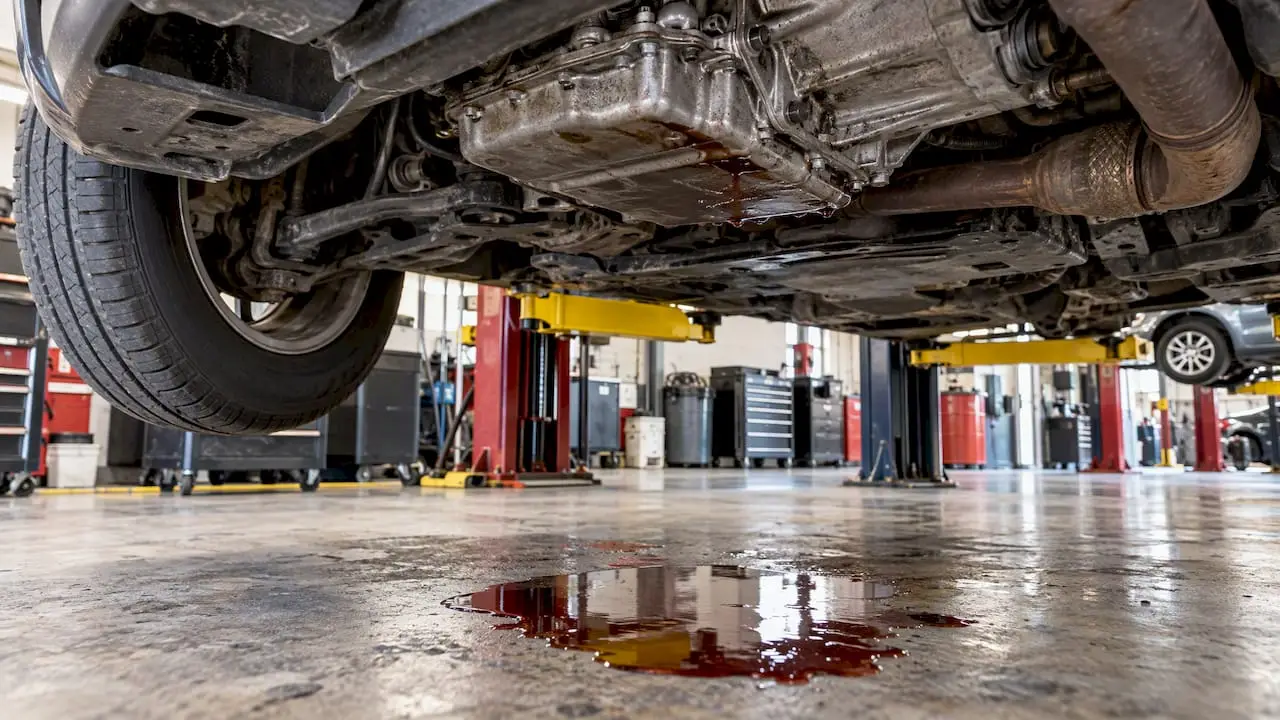
Overheated or worn fluid can smell burnt. Fluid on your driveway is its own warning. If you spot a puddle, our quick checks for a transmission fluid leak walk you through what color and location can tell you.
Shudder when accelerating
A shake under light throttle, often somewhere in the middle speeds, can point to the torque converter or to fluid trouble. We cover that pattern in detail in our guide to torque converter symptoms and the mid-speed shudder.
Warning lights
A check engine light can come on with transmission faults, since the computer watches gear ratios and shift behavior. A light plus any symptom above means it’s time for a scan and an inspection.
Slipping or delayed engagement?
These get confused constantly, and the difference matters for diagnosis.
Delayed engagement happens when you shift from Park into Drive or Reverse and the car waits before it moves. A manufacturer bulletin filed with NHTSA says drivers may describe it as the vehicle delaying into gear, or feeling as though the transmission is slipping, sometimes with a harsh engagement after the delay, often after sitting for several hours or overnight. A separate GM bulletin defines it with a number: under its specified test conditions, more than 3 seconds counts as delayed engagement. That is a test condition for those GM vehicles, not a rule for every car, so don’t time your own driveway and call it a verdict.
A simple way to separate them:
| What you notice | Points toward |
|---|---|
| Delay or clunk right after selecting Drive or Reverse from a stop | Delayed engagement |
| Revs flare while already moving or accelerating | Slipping under load |
| Worse after the car sits overnight | Fluid pressure or fill problems, worth reporting |
| Worse uphill, towing, or on the highway | Slipping under load |
Some cars, especially European models with dual-clutch automatics, have their own behaviors and maintenance needs. If you drive one, this DSG transmission maintenance guide gives useful background on why service on those units matters. Either way, tell your technician exactly which of the two you feel.
What can be mistaken for a slipping transmission?
Not every rev is a repair bill. AAA notes that in cars with CVTs or some hybrids, the engine may rev without the car accelerating right away, even when nothing is wrong. A CVT has no fixed gears, so it can hold RPMs while the car catches up. That can feel like slipping if you expect a traditional automatic.
Here is how to tell normal from worrying:
- Normal CVT or hybrid behavior is smooth, consistent, and the same every day.
- Worrying behavior is new, changes with temperature or load, comes with a shudder, whine, burning smell, or warning light, or feels like a sudden loss of drive.
Other issues that can feel similar include a misfire, a dragging or weak engine, a clutch problem in a manual, or a failing sensor. That is exactly why guessing at the transmission can waste money. A scan and a road test sort these apart.
Why is my transmission slipping? Common causes
Slipping is a symptom, not a diagnosis. Automotive references list a short set of usual suspects: low or leaking fluid, burnt or incorrect fluid, worn gears, faulty solenoids, clutch issues, and torque converter problems. Here is what each one means in the real world.
Low or leaking fluid
Transmission fluid does two jobs: it creates the hydraulic pressure that applies the internal parts and it carries heat away. A leak from a pan gasket, cooler line, or seal drops the level, pressure falls, and clutches slip. Ford’s U.S. owner guidance says to check the fluid level if the transmission slips, shifts slowly, or leaks. Level is the first and cheapest thing to rule out.
Burnt, old, or wrong fluid
Heat breaks fluid down. Stop-and-go traffic on Division Street, summer Texas afternoons, and towing all add thermal stress. Worn fluid loses its grip and its cooling ability. Using a fluid the manufacturer doesn’t specify can also cause shifting problems, so match the spec in your owner’s manual. For more on why fresh fluid matters, see our look at transmission fluid change benefits.
Worn clutches and bands
Inside an automatic, clutch packs apply and release to select gears. When the friction material wears, they can’t hold, and you get flare between gears. That wear is usually progressive: slight at first, then obvious.
Solenoids and valve body
Solenoids are electrically controlled valves that direct fluid. If one sticks or fails, a gear may engage late, harshly, or not at all. Electrical faults and debris in the valve body can cause the same thing.
Torque converter trouble
The torque converter couples engine and transmission. A failing lockup clutch or damaged internals can cause shudder, slipping feel, and overheating.
Worn gears or internal damage
This is the least welcome cause. Grinding noises and metal in the fluid point here, and the repair gets bigger.
Is it safe to keep driving?
Short answer: treat it as a stop-and-get-it-checked situation, not a wait-and-see one. AAA’s advice is direct: transmission problems typically don’t fix themselves and can get worse over time, so get a suspected problem looked at sooner rather than later.
Here is how we’d sort the decision:
- Pull over and call for help if the car loses drive, you smell something burning, the transmission won’t hold a gear on the highway, or a warning light is flashing. Driving on can turn a repair into a replacement.
- Book the next available appointment if the slipping is occasional, mild, or only shows up on hard acceleration.
- Check the fluid first if you can do it safely, following the procedure in your owner’s manual. Some vehicles have no dipstick at all and need a shop to check the level.
Ford’s owner guidance for the vehicle it covers also warns not to drive if the dipstick shows no fluid when the ambient temperature is above 50°F (10°C). The same guidance says to check fluid at normal operating temperature and that overfilling can cause shift or engagement concerns and possible damage. So don’t just top it off with whatever is on the shelf. Follow your own manual’s procedure and fluid type.
How a shop diagnoses transmission slipping
This is where we recommend patience: diagnose first, replace later. A transmission is expensive, and the symptom can come from the engine, a sensor, or something as simple as a low fluid level. A sound diagnostic process usually looks like this:
- Listen to you. When does it happen? Hot or cold? Uphill? Did it start after a fluid change, a trip, or towing?
- Check fluid. Level, condition, color, smell, and signs of leaks, at the temperature and procedure your manufacturer specifies.
- Scan for codes. Stored trouble codes can point to solenoids, sensors, or gear ratio faults.
- Road test. A technician feels the shift quality and watches live data for RPM against speed.
- Inspect for leaks and external causes. Cooler lines, pan, seals, mounts, and wiring.
- Recommend the least invasive fix that addresses the cause. Sometimes that’s a leak repair and fluid service. Sometimes it’s a solenoid. Sometimes it’s a deeper repair.
If the findings do lead to major work, we’ll explain the difference between rebuilding and replacing, which we lay out in our transmission rebuild guide.
A practical example
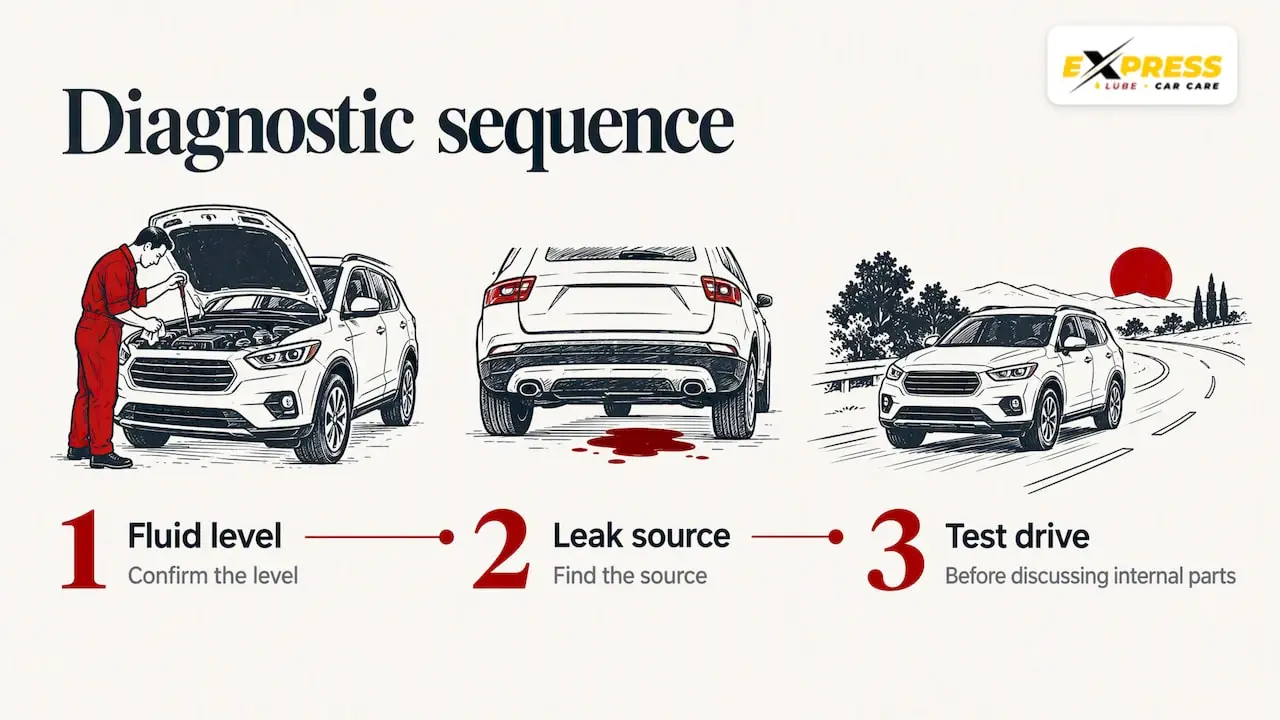
Say your SUV starts flaring between second and third on the way up the I-30 ramp, and there’s a faint reddish spot on the garage floor. That combination points us toward a leak and low fluid before anything else. We’d confirm the level, find the source, and test drive before talking about internal parts. If instead the fluid is fine, smells burnt, and the scan shows a solenoid code, the plan changes. Same symptom, different repair. That’s the whole argument for diagnosing first.
What we do about it at Express Lube & Car Care
We see slipping complaints turn out to be very different problems: a slow leak, tired fluid, a bad solenoid, a converter issue, or a normal CVT that just felt unfamiliar. Our rule is to find the cause before recommending a part. Our ASE-certified technicians check fluid condition and level, scan for codes, road test the car, and share what they find through a digital vehicle inspection with photos and videos, so you can see what we see. We follow your manufacturer’s recommendations for fluid type and service timing rather than a one-size-fits-all mileage number, and we’d rather tell you a simple fix is enough than sell you a bigger job.
— Express Lube & Car Care
Service for slipping, shuddering, and shifting problems in Arlington
We’re a full-service shop, so a transmission concern doesn’t get bounced around. Our transmission repair and drivetrain service covers diagnosis and repair, and the related fluid, electrical, and engine work lives under one roof. Most jobs are same-day, and qualifying repairs carry a 24-month/24,000-mile warranty.
If a repair is bigger than you planned for, ask us about third-party repair financing through Snap Finance, which is subject to the provider’s approval and terms. For the full list of what we handle, from brakes to cooling to electrical, see our auto repair services, or start at the Express Lube & Car Care homepage.
How to prevent slipping
You can’t promise a transmission will last forever, but you can stack the odds.
- Follow the manufacturer’s schedule. Your owner’s manual lists the fluid type and service recommendations for your vehicle. Our fluid replacement schedule guide explains how to read them.
- Fix leaks early. A small drip becomes a low-fluid problem.
- Ease up on heat. If you tow or sit in heavy traffic often, ask whether your manual lists a severe-service schedule.
- Don’t ignore the first flare. A slight symptom is the cheapest time to diagnose.
- Use the right fluid. Wrong fluid can hurt shifting even if the level is perfect.
Frequently asked questions
What are the first signs of a slipping transmission?
Usually it’s the engine revving higher than normal without the car picking up speed. You may also feel hesitation, jerky shifts, or hear whining or humming. Write down when it happens and tell your technician.
Can low transmission fluid cause slipping?
Yes. Fluid builds the hydraulic pressure that applies clutches and also cools the transmission, so a low level can cause slipping and heat damage. Check the level using your owner’s manual procedure, and have a shop find the leak rather than just topping off.
Why does my car jerk when I shift into Drive?
A jerk or clunk right after you select Drive can be harsh or delayed engagement, often tied to fluid, pressure, or internal wear. It can also be an engine or mount issue. A road test and scan are the way to tell them apart.
Can a CVT feel like it is slipping when it isn’t?
Yes. In CVT and some hybrid vehicles the engine may rev without the car accelerating right away, even with no actual problem. If the behavior is new, inconsistent, or comes with noise, smell, or warning lights, get it inspected.
Can I keep driving with a slipping transmission?
We advise against it. Slipping tends to worsen and can cause heat damage, so stop driving if the car loses drive or smells burnt, and schedule an inspection soon for milder cases.
Schedule a transmission check in Arlington
If your car is revving without going, shuddering, or hesitating, let’s find out why before it gets expensive. Schedule service online, call us at (682) 248-3416, or stop by Express Lube & Car Care at 2105 Brown Blvd, Arlington, TX 76006. We’ll road test it, check the fluid, and tell you what we find in plain English.
Sources
- How to Catch Transmission Problems Before They Get Expensive (AAA)
- Delayed Engagement After Sitting With Engine Off (NHTSA technical service bulletin)
- GM bulletin 20-NA-187 on delayed engagement (NHTSA)
- Automatic Transmission Fluid Check (Ford owner manual)