

The classic blend door actuator symptoms are a clicking or tapping noise behind the dashboard, air that won’t match the temperature you set, heat on one side of the cabin and cold on the other, and vents that ignore your mode selection. If your Arlington summer commute just turned into a sauna or a freezer, one small plastic-geared motor may be the culprit.
Here’s how to tell if it’s really the actuator, what you can check yourself in ten minutes, and when it’s smarter to let a shop handle it.
TL;DR
- A failing blend door actuator usually announces itself with clicking or ticking behind the dash, wrong-temperature air, or one side of the cabin out of sync with the other.
- The same symptoms can come from a lost calibration, a blown fuse, low refrigerant or a bad control module, so diagnose before you buy parts.
- Nationally, replacement typically runs $200 to $600, mostly because of the labor to reach the part behind the dash.
- Dashboards hide airbags and wiring. Skip the universal repair kits and the dash teardown unless you know the vehicle well.
- Want a pro to check it? Our A/C & heating team can inspect it and show you what we find.
Table of Contents
- What a Blend Door Actuator Actually Does
- The Most Common Blend Door Actuator Symptoms
- Is It the Actuator? Symptoms That Look the Same
- Why Blend Door Actuators Fail
- Quick Checks You Can Do in Ten Minutes
- Where Is the Blend Door Actuator Located?
- What Does Replacement Cost?
- Why We Don’t Recommend the DIY Dash Teardown
- How a Shop Diagnoses It
- Our Perspective: Diagnose First, Then Decide
- When to Book a Visit
- FAQ
- Sources
What a Blend Door Actuator Actually Does
Your climate system has a heater core (hot) and an evaporator (cold). Behind the dash, small doors swing to decide how much air flows past each one, and where that air ends up. The actuator is the little electric motor that moves each door when you turn the dial or tap the screen.
As RepairPal explains, the blower pushes air through the heater core when you want heat, and the actuators steer airflow away from it when you don’t. Some actuators handle temperature. Others handle mode (defrost, vents, floor) or fresh air versus recirculation. Many vehicles have several, and dual-zone systems usually have more than one for temperature alone.
Those motors drive plastic gears. Plastic gears wear, strip and jam. That’s the whole story behind most failures.
The Most Common Blend Door Actuator Symptoms
Think of these as the actuator sending up a flare. You might see one or several.
Clicking, ticking or knocking behind the dash
This is the big one. When a gear is stripped, the motor keeps trying to move a door it can’t move, and you hear a repeating click or knock. It usually happens when you start the car or change the temperature setting. On some models the Equinox’s repair estimate page notes the same clicking from behind the dash alongside poor temperature or airflow output.
Where you hear it helps. Noise from behind the glove box often points to a passenger-side actuator. Noise near the center stack or under the steering column points elsewhere.
Air temperature doesn’t match the setting
You dial in cold and get lukewarm. You ask for heat on a January morning and get air that never really warms up, even though the engine is at normal temperature. The door is stuck partway, so hot and cold air never mix the way the controls say they should.
Hot on one side, cold on the other
On dual-zone systems, if the driver’s side is perfect and the passenger side blasts the wrong temperature, that points at one zone’s actuator rather than your refrigerant or your heater core.
Air comes out of the wrong vents
You select defrost and the air goes to your feet. You pick floor and it hits your face. A stuck mode door or a dead mode actuator does this.
Temperature that drifts or flips on its own
Sometimes the temperature swings as you drive, or the setting works one day and not the next. An actuator with a failing motor or a bad position signal can move erratically.
Controls that feel dead
You turn the dial and nothing changes. No click, no shift in air, no response. A fully dead actuator, or no power reaching it, can do this.
Is It the Actuator? Symptoms That Look the Same
This is where drivers lose money. Several different problems fake blend door actuator symptoms.
| What you notice | Could be the actuator | Could also be |
|---|---|---|
| Weak or warm A/C | Cold door stuck toward heat | Low refrigerant, leak, compressor or clutch problem |
| No heat | Door stuck toward cold | Low coolant, thermostat stuck open, clogged heater core |
| No air at all from vents | Rarely | Blower motor, resistor, fuse or relay |
| Clicking | Very likely | Blower debris, a loose item in the ducts |
| Controls dead | Possible | Blown fuse, control module or wiring |
| Musty smell | Not the actuator | Moisture or buildup in the HVAC box or cabin filter |
If the only complaint is warm A/C and there’s no clicking, start with our guide on three causes your car’s A/C isn’t cold. If the compressor clutch isn’t kicking in, the A/C clutch checks are a better first stop.
If nothing in the climate system responds at all, the cause may be electrical. Our blown fuse symptoms guide walks through how to spot that.
A musty smell is a different problem altogether. If your vents smell like a damp basement, this guide to dealing with mould in a car interior explains why it comes back and how to approach it safely. It’s a UK page, so ignore the local product references, but the cleaning principles carry over.
Why Blend Door Actuators Fail
There are really only a few ways it goes wrong:
- Stripped or broken gears. The most common cause, and the source of the clicking. Plastic teeth wear down over thousands of cycles.
- Electrical faults. A failed motor, a corroded connector or damaged wiring keeps the actuator from moving at all.
- A jammed door. Sometimes the actuator is fine and the door is stuck, warped by heat or blocked by debris.
- Lost calibration. The control module forgets where the doors are. The actuator is healthy, but the system is confused.
That last one matters more than most people realize. A technical service bulletin about HVAC doors that are stuck or moving to the wrong position warns that many technicians diagnose a bad actuator when the real issue is a calibration problem, and that a proper reset may be needed rather than just cycling the ignition. That bulletin covers specific vehicles, so it isn’t a universal procedure, but the lesson applies broadly: confirm the diagnosis before replacing the part.
Quick Checks You Can Do in Ten Minutes
These cost nothing and won’t put you near an airbag.
- Listen with the engine off and the key on. Sit still, turn the key to ON, and switch between hot and cold. Clicking from the same spot every time is a strong hint.
- Cycle every setting. Go through each mode (face, floor, defrost) and each temperature extreme. Write down what changes and what doesn’t. That list is gold for a technician.
- Check both sides. On a dual-zone car, compare driver and passenger vents with a hand or a thermometer.
- Test the blower. If air volume is weak on every setting, think blower motor, resistor or cabin air filter before the actuator.
- Check the fuse. Your owner’s manual shows the HVAC fuse. A blown one is cheap to confirm.
- Try a reset, if your vehicle has one. Some vehicles can relearn door positions after a battery disconnect or fuse pull. For example, one guide says some 2016 F-150 owners pull the HVAC module fuse, turn the ignition on and let the system cycle for a few minutes, then reinstall the fuse. Fuse locations and procedures differ by make, model and year, so confirm yours in the owner’s manual first. Don’t assume what works on a truck works on your sedan.
If a reset clears the problem for a while and it comes back, the actuator is probably wearing out and the reset only bought you time.
Where Is the Blend Door Actuator Located?
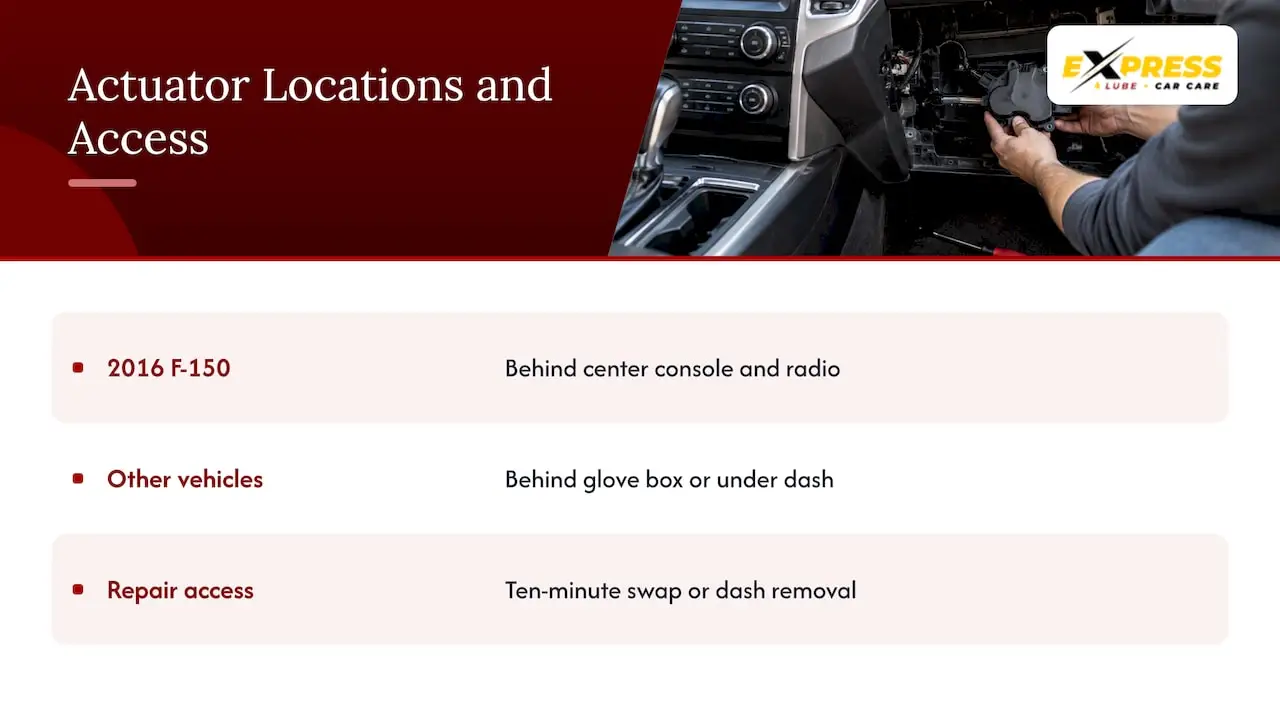
It depends on the vehicle, and that’s exactly why labor costs vary so much. On the 2016 F-150, for instance, one guide places the actuator assembly behind the center console and radio, which takes real disassembly to reach. Other vehicles tuck an actuator behind the glove box or under the dash on the passenger side, where it’s easier.
For a 2015 Nissan Pathfinder or any specific vehicle, check the factory service information for your exact trim. Component locations change between model years and between single-zone and dual-zone setups. Your owner’s manual usually won’t show it.
Some actuators are a ten-minute swap. Others mean pulling the dash. You often won’t know which you have until a technician looks at your vehicle.
What Does Replacement Cost?
Here are the published numbers, with the caveat that they’re national figures and not an Express Lube quote.
- Data on RepairPal’s estimator puts the national range at roughly $200 to $600, with typical averages falling between $452 and $592.
- By model, the same source shows Ford F-150 estimates of $330 to $441, while the Chevrolet Equinox can come in far lower, in the $124 to $175 range.
The part itself is often modest. The labor is the bill. An actuator that sits behind an easy panel costs a fraction of one that needs the dash loosened.
That’s also why a clear diagnosis matters. Paying for dash labor to replace a part that wasn’t the problem is the expensive mistake.
Why We Don’t Recommend the DIY Dash Teardown
We love a driver who wants to learn how their car works. Most of what’s in this guide you can do yourself. But reaching a buried actuator is a different level of job.
- Airbags and electronics. Modern dashboards house airbags, sensors and wiring. Repair shops caution that attempts to access buried actuators can be dangerous or compromise safety systems when the removal and reinstallation isn’t done properly.
- Universal repair kits. Kits that have you cut into the factory HVAC housing and swap in generic parts often replace a reliable original piece with something that may not last. Professionals generally advise against them, per the same RepairPal page.
- Hidden fasteners and brittle plastic. Old dash trim cracks. A rattle you create is worse than the click you started with.
If you do tackle an easy-access actuator, disconnect the battery according to your owner’s manual, wait the time it specifies before touching airbag components, and stop the moment you’re unsure.
How a Shop Diagnoses It
A proper diagnosis isn’t guesswork. According to RepairPal, the technician tests each vent position and temperature range, noting airflow and temperature at every setting. If nothing changes between settings, the blend door or its actuator becomes the suspect.
A good shop then separates the actuator from lookalikes: checking fuses and power at the connector, looking at refrigerant and coolant, and considering whether a recalibration is the right first move.
Our Perspective: Diagnose First, Then Decide
We see the same story a lot. A driver comes in after being told the A/C “needs a blend door actuator,” or after a part has already been replaced and the problem is still there. Blend door symptoms overlap with refrigerant, coolant, electrical and blower problems, so the symptom alone doesn’t tell you the cause.
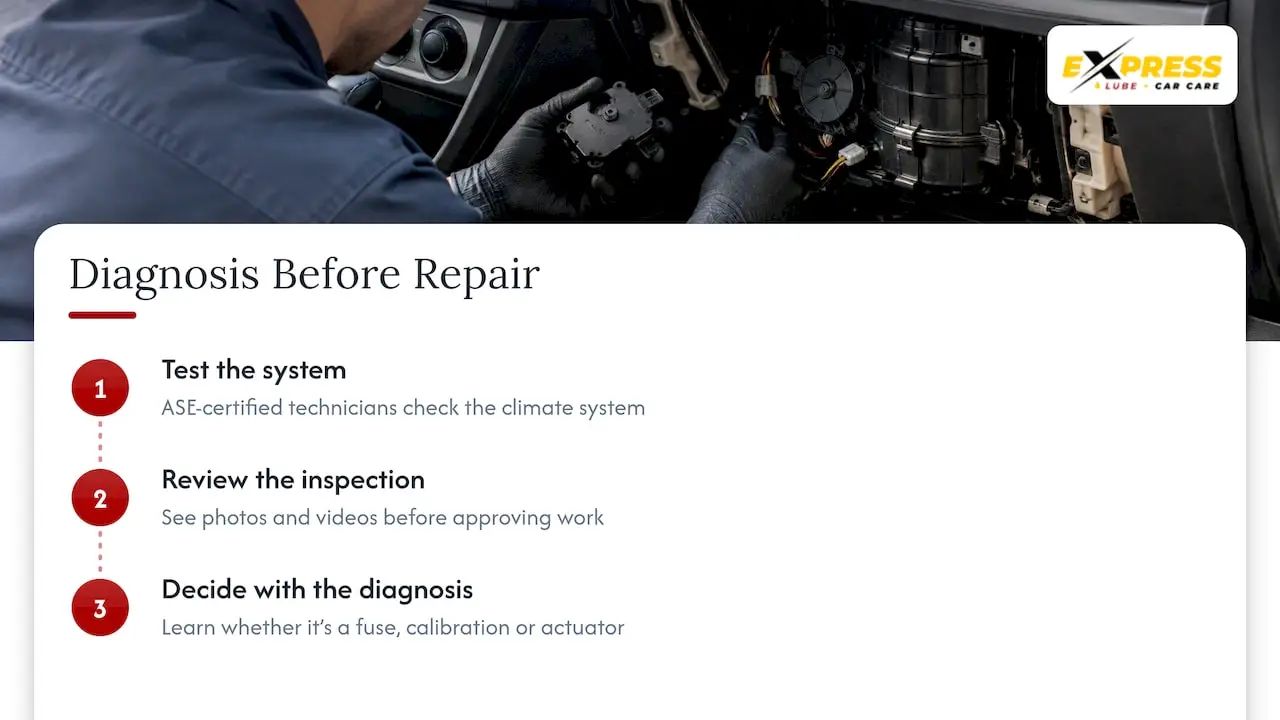
Our approach is simple. Our ASE-certified technicians test the system, and our digital vehicle inspections include photos and videos, so you can see what we see before you approve anything. If it’s a calibration issue or a blown fuse, you hear that. If it’s a worn actuator, you hear that too, along with what it takes to reach it on your vehicle.
One more piece of advice for Arlington drivers: don’t wait for a hot spell. A clicking actuator in October is an annoyance. The same stuck door in July, when the door is parked on heat, is a real comfort and safety issue, and defrost problems in a cold snap can limit your visibility.
— Express Lube & Car Care
When to Book a Visit
Come in if you notice any of the following:
- Clicking or knocking behind the dash that repeats whenever you change settings
- Heat or cold stuck on one setting
- Air that won’t switch to defrost, which is a visibility concern
- A/C or heat that works only after a restart
- A reset that fixed it, but only for a day or two
We’re a full-service shop, so we can look at the whole picture, from the actuator to the refrigerant, fuses and electrical system. Book A/C & heating service and tell us what you’ve noticed, or see everything we handle on our services page. Running a fleet? We also take care of fleet vehicles, because a driver who can’t defrost a windshield shouldn’t be on the road.
FAQ
How do I know if my blend door is broken?
Listen for repeated clicking or knocking behind the dash and watch for air that doesn’t match your setting. Cycle through every temperature and mode, and note which ones don’t change. If nothing responds, check the fuse before assuming the actuator is dead, because a calibration or power problem can look identical.
Can I drive with a bad blend door actuator?
Usually, yes, because the car still runs. But a stuck door can leave you without defrost or with the wrong temperature at the wrong time. If you can’t clear the windshield, get it checked before you drive in rain or cold.
Can a blend door actuator be reset?
Sometimes. Certain vehicles can relearn door positions after a fuse pull or battery disconnect, and the steps are specific to the make, model and year. Check your owner’s manual for the right fuse. If the problem returns, the actuator itself is likely worn.
How much does it cost to replace a blend door actuator?
Nationally, estimates run about $200 to $600, depending heavily on how hard the part is to reach. The labor often costs more than the part. A technician needs to inspect your vehicle to give a real number.
Sources
- RepairPal: HVAC blend door actuator replacement cost estimate
- RepairPal: 2025 Chevrolet Equinox blend door actuator replacement estimate
- RepairPal: Ford F-150 blend door actuator replacement estimate
- Auto Almanac: Ford F-150 blend door actuator reset guide
- Technical service bulletin on HVAC doors stuck or in incorrect positions