
A tire humming noise usually comes from one of three places: tread that has worn unevenly, a tire that is out of balance, or a wheel bearing that is starting to fail. The first two are common and fixable. The third is a safety item you don’t want to ignore. The trick is figuring out which one you have, and you can learn a lot with a few minutes and a safe, quiet road.
We’re a full-service shop in Arlington, TX, and we hear this question constantly: “Is it my tires, or is something worse going on?” Let’s walk through it together.
TL;DR
- A hum that rises and falls with vehicle speed (not engine speed) points to the tires, wheels or wheel bearings.
- If the noise changes pitch or volume when you steer gently left or right at speed, a wheel bearing is a likely suspect.
- Run your hand over the tread. A sawtooth feel means cupping or scalloping, often tied to worn shocks or struts or poor balance.
- Humming plus vibration, a clunk, grinding or a loose-feeling wheel means stop guessing and get it inspected soon.
- We can inspect it and show you photos and video of what we find. Book a visit and we’ll track the noise down.
Table of Contents
- What a tire hum actually sounds like
- The main causes of a humming tire noise
- Tire noise or wheel bearing noise? A quick comparison
- A five-minute check you can do in the driveway
- Is it safe to drive with a humming tire?
- What we do when you bring us a humming car
- Our perspective: don’t chase the noise, chase the cause
- Book a humming-noise check in Arlington
- Preventing tire hum down the road
- FAQ
- Sources
What a tire hum actually sounds like
Picture a low drone, somewhere between a distant airplane and a wet finger circling a glass rim. It usually builds as you speed up and often becomes obvious somewhere in the highway range. On I-30, I-20 or Highway 360, that’s exactly where you notice it.
Two details help you sort the cause:
- Does it follow speed or engine revs? Shift into neutral on a safe, clear stretch (or just note whether it stays the same when you ease off the gas). A hum that tracks road speed is a rolling-parts problem. A hum that tracks RPM is more likely engine, transmission or exhaust.
- Does it change on different pavement? Tire noise shifts a lot with road surface. Coarse chip-seal and grooved concrete make almost any tire louder. Bearing noise doesn’t care much what you’re driving on.
That second point matters if you searched for road noise from tires. Some of it is simply how rubber meets pavement. A hum that is new, getting louder, or paired with other symptoms is a different story.
The main causes of a humming tire noise
Uneven tread wear and cupping
This is the classic. Cupping, sometimes called scalloping, creates alternating high and low spots around the tread. Each high spot slaps the pavement and the repeating rhythm becomes a hum. Bridgestone notes that this pattern is often caused by worn shock absorbers, loose suspension components or improper wheel balancing.
The hand test is easy. With the car parked and the wheels straight, run your palm around the tread, front to back and then side to side. Smooth means smooth. If it feels like saw teeth, the tire is likely scalloped. Be careful to check by feel only on a cool tire, and never reach under a car that isn’t on a lift or proper stands.
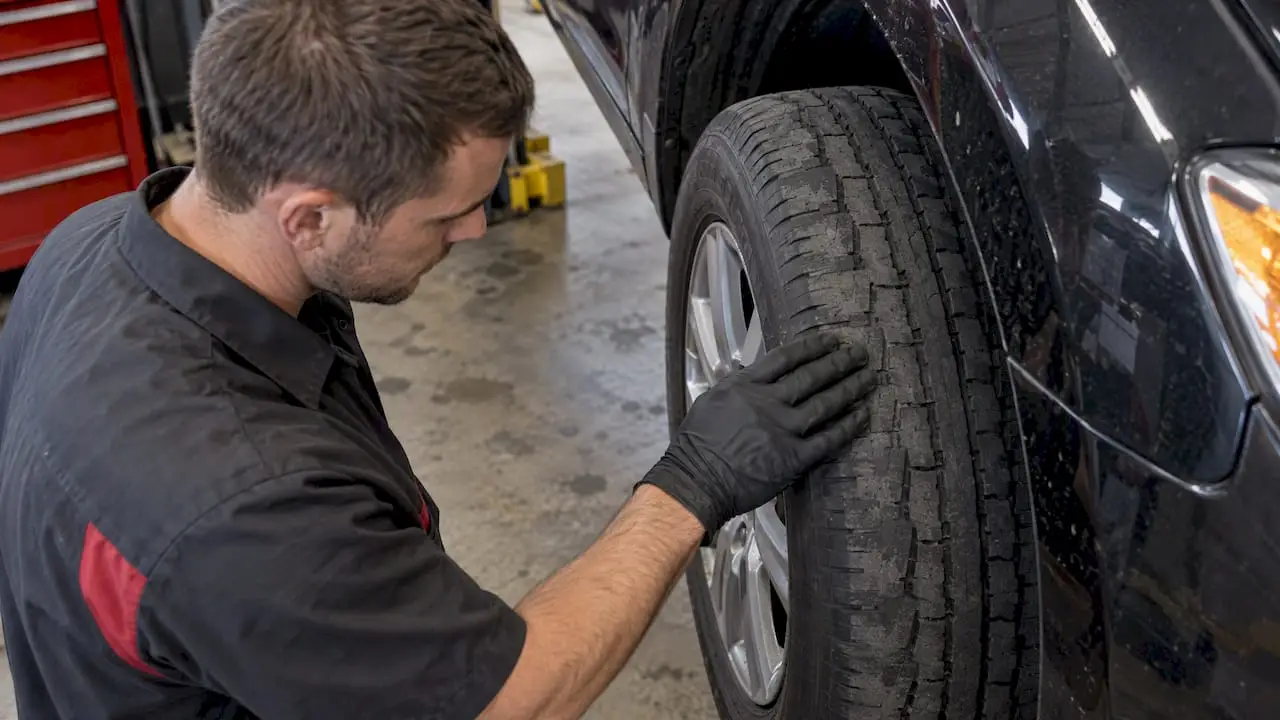
AAA’s Car Doctor says drivers often blame the suspension for tire noise, but when the tread feels scalloped, the tires are almost certainly the source. The catch: once the tire is scalloped, replacing it without fixing what caused the wear just starts the clock again. That’s why we look at shocks, struts and related parts at the same time. If you’ve noticed a bouncy ride too, our shocks and struts service is a natural next stop.
Tires out of balance
Every tire and wheel assembly has heavy and light spots. Small weights on the wheel even them out. When a weight falls off, or the tire wears unevenly, the assembly starts to pulse as it spins. AAA lists an out-of-balance tire among the causes of unusual vibration or thumping noise while driving.
Imbalance often shows up as a hum plus a shake in the steering wheel or the seat. If your wheel shimmies in a certain speed window, our guide to steering wheel vibration and the ASE diagnostic map walks through the likely culprits.
Low or uneven tire pressure
An under-inflated tire flexes more, runs hotter and wears faster on the shoulders. It can also change how the tire sounds. Check pressure when the tires are cold, using the number on the sticker in your driver’s door jamb, not the number molded into the tire sidewall. Texas heat swings pressure more than you’d think, so check monthly.
Tire age and hardened rubber
Sometimes the tread looks fine and the car is still loud. AAA’s Car Doctor points out that original tires nearing the 10-year mark can have rubber that hardens and degrades, adding road noise even with tread left. Look for the four-digit date code on the sidewall (the first two digits are the week, the last two the year) if you don’t know how old your tires are.
Aggressive tread patterns
All-terrain and mud-terrain tires on pickups and SUVs are built with big, widely spaced tread blocks. They hum more than a touring tire, even when brand new. If the noise started the day you installed them and nothing else feels wrong, that may simply be the tire’s character. Still, a quick balance check is cheap peace of mind.
Worn wheel bearings
This is the one to take seriously. A wheel bearing lets the wheel spin freely on its hub. When it wears out, it typically growls or hums, and the noise grows with speed. According to a bearing manufacturer’s guide, a noise that gets louder or changes pitch when you steer slightly is likely a bearing. Tire noise, by contrast, stays steady through those little steering inputs and often comes with steering wheel vibration.
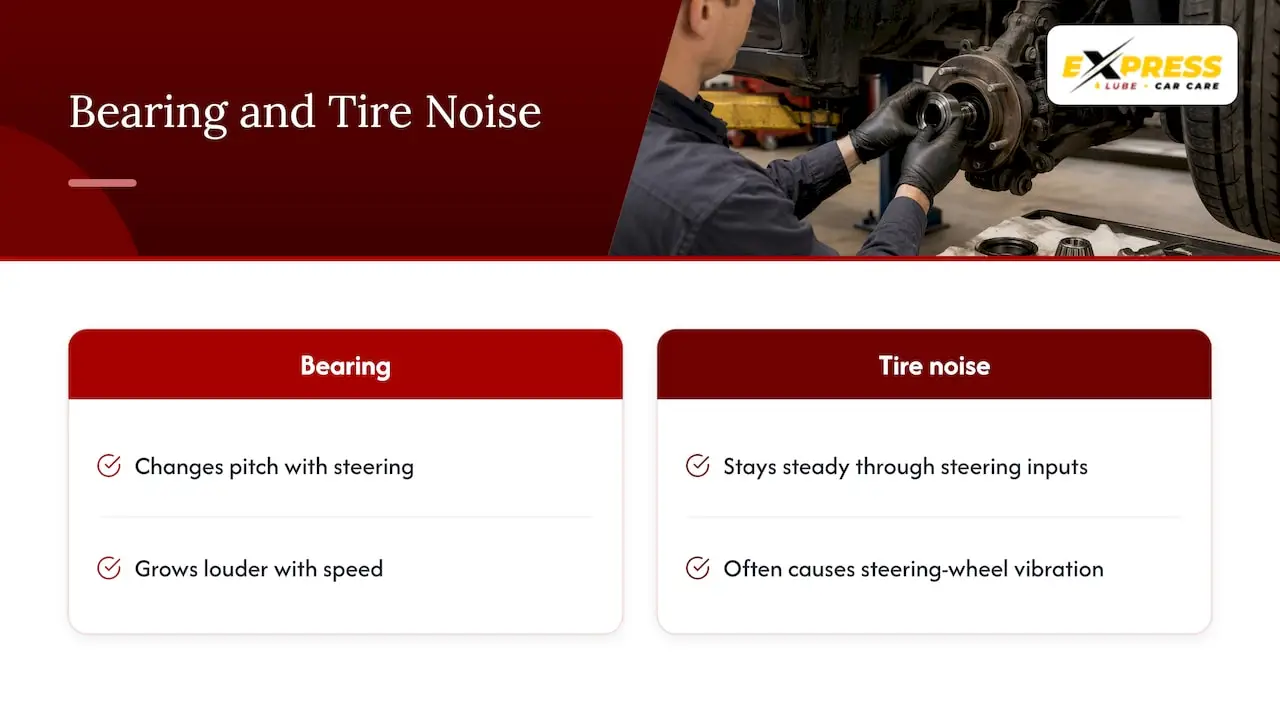
Here’s the logic: steering shifts weight from one side of the car to the other. Weight on a bad bearing makes it louder. Weight off it quiets it. If you hear the hum get louder when you drift gently left and quieter when you drift right, the bearing on the opposite side deserves a look. It’s not a perfect test, but it’s a good flashlight.
Other things that get mistaken for tire hum
- Exhaust drone. A loose or damaged exhaust can drone at certain speeds. If you’re curious how exhaust sound problems differ, here is a guide to common exhaust sound issues written around performance cars. For everyday vehicles, our service list includes muffler work.
- Differential or drivetrain noise. These often change when you accelerate or coast, which tires don’t do.
- Worn steering or suspension parts. These tend to clunk or knock rather than hum. See our write-ups on ball joint failure symptoms and tie rod end warning signs.
Tire noise or wheel bearing noise? A quick comparison
| Clue | More likely tires | More likely wheel bearing |
|---|---|---|
| Changes when steering gently at speed | Usually stays about the same | Gets louder or changes pitch |
| Different road surfaces | Noise changes a lot | Stays fairly consistent |
| Steering wheel or seat vibration | Common with balance issues | Less typical early on |
| Tread feels like saw teeth | Yes, points to cupping | Not related |
| Grinding, clicking or looseness | Rare | More common as wear advances |
| Started right after new tires | Likely tire character or balance | Unlikely unless a bearing was already worn |
Use the table as a guide, not a verdict. Several problems can happen at once, and noises travel through the body of a car in confusing ways. A technician with the wheels off the ground can confirm in minutes what’s hard to confirm at 70 mph.
A five-minute check you can do in the driveway
- Walk around the car. Look for bulges, cuts, cracks or tread that is worn on one edge. NHTSA’s TireWise page lists physical damage and irregular wear as reasons to stop using a tire.
- Do the hand test. Feel for scalloped or sawtooth tread, as described above.
- Check the tread depth. Our guide to minimum tire tread depth explains the 4/32 mark we recommend Arlington drivers act on. NHTSA also describes the penny test.
- Check pressure cold. Match the door jamb sticker.
- Look at your rotation history. If it has been a long time, see our tire rotation interval guide. Skipped rotations let front and rear tires wear differently, which is a recipe for noise.
- Check the lug nuts visually. Look for anything that seems loose, missing or damaged around the wheel studs.
That last step is not a throwaway. AAA’s guidance on wheel installation says loose or incorrectly torqued fasteners are a real risk, and recommends regular visual checks of your wheels, especially for high-mileage commuters and fleet drivers. A hum plus a clicking or wobbling wheel after recent tire work means stop and have it checked right away.
Is it safe to drive with a humming tire?
It depends on the cause, and that’s exactly why it’s worth checking.
- Mild hum, steady, no vibration, tires look fine: usually okay to drive to the shop soon. Don’t wait months.
- Hum with vibration or a shaky steering wheel: get it looked at this week. Balance and wear problems get worse, and so does tire damage.
- Hum with grinding, a loose or wandering feeling, a burning smell near a wheel, or a tire with bulges or exposed cords: pull over somewhere safe and don’t keep driving at highway speed. Call a shop or roadside service.
A failing wheel bearing is the situation where waiting costs you most. Bearings don’t announce an exact deadline. We can’t tell you how many miles you have left on a humming one, and anyone who gives you a number over the phone is guessing. If a bearing fails badly, the wheel can become unstable, and that’s not something to gamble on in DFW traffic.
What we do when you bring us a humming car
We’re ASE-certified technicians, and we treat a noise complaint like detective work. Here’s how a typical visit goes:
- We listen to your story. When does it hum? What speed? Did anything change recently, like new tires, a pothole hit or a recent repair?
- We inspect the tires and wheels. Tread wear pattern, tire condition, pressure and signs of damage.
- We check the parts that influence tire wear. Shocks, struts and other suspension and steering components.
- We evaluate the wheel bearings and surrounding hardware.
- We document it. Our digital vehicle inspections include photos and videos, so you see what we see instead of taking our word for it.
Then we tell you what’s urgent, what can wait and what’s fine. You decide. If it turns out the tire noise is just the character of your tires, we’ll say so.
If you drive for Uber, Lyft or deliveries, a noisy tire hurts twice: it’s a safety issue and it cuts into your earning time. Same goes for company vehicles. Our fleet services are set up for operators who need vehicles back on the road quickly, and daily wheel walk-arounds are exactly the habit AAA’s guidance recommends for fleet drivers.
Our perspective: don’t chase the noise, chase the cause
Most drivers who come in with a humming noise have already tried something. New tires, a rotation, maybe a guess at the bearing. Sometimes that works. Often it doesn’t, because the hum was a symptom of something upstream.
Here’s how we see it. A cupped tire is a message from the suspension. A tire out of balance is a message that weights have shifted or the tire is wearing oddly. A bearing hum is a message that a rotating part is near the end of its life. Replacing the tire fixes the sound for a while, but if worn shocks caused the cupping, the new tire will start cupping too.
That’s why we like to start with an inspection rather than a parts list. We’d rather show you a photo of the real cause than sell you a part that doesn’t cure the noise. And because we handle tires, brakes, suspension, steering and general repair under one roof, we don’t have to send you from shop to shop to find out which one is at fault.
One more thing: tire noise often gets ignored because the car still drives. Then it becomes vibration, then uneven wear, then a bigger bill. A hum is the cheapest warning you’ll ever get.
— Express Lube & Car Care
Book a humming-noise check in Arlington
If your car hums, drones or vibrates at highway speed, stop by Express Lube & Car Care and we’ll inspect the tires, wheels, suspension and bearings, then show you what we find with photos and video. Most jobs can be done the same day. Browse our full list of services, including shocks and struts, brakes and state inspection, or head to our home page to schedule an appointment. For a broader once-over while you’re here, our car inspection checklist shows what we look at.
Preventing tire hum down the road
- Rotate on schedule. Roughly every 5,000 to 8,000 miles, per our rotation guide.
- Keep pressure right. Cold, monthly, and before long road trips.
- Replace worn shocks and struts. They keep the tire planted, which helps prevent cupping.
- Watch your tread depth. Don’t wait for the legal minimum.
- Have tires balanced when you buy them and again if you feel vibration.
- Mind the tire’s age. Even good-looking tread ages out.
- Fix noises early. Hum is easier and cheaper to diagnose than a failed part.
For regular upkeep that catches these issues early, see our maintenance services.
FAQ
Why do my tires hum when I drive?
The usual causes are uneven tread wear such as cupping, tires that are out of balance, low pressure, old hardened rubber, or a worn wheel bearing. The hum comes from the tread or bearing creating a repeating rhythm as the wheel spins faster. A hands-on inspection is the quickest way to tell which one it is.
How can I tell tire noise from wheel bearing noise?
Try steering gently left and right at a steady highway speed on a safe, open road. If the hum changes pitch or volume, a bearing is more likely. If it stays steady and the tread feels scalloped, the tires are the better suspect. Because the sounds are so similar, have a technician confirm it.
Is it safe to drive with a humming wheel bearing?
A mildly humming bearing may get you to a shop, but it’s not something to keep driving on for weeks. It can wear quickly and a badly failed bearing can make the wheel unstable. If you also hear grinding or feel looseness, stop driving and call for help.
Can new tires make a humming noise?
Yes. Some tread designs are simply louder, especially on trucks and SUVs, and a tire that needs balancing can hum too. If the noise is new with the tires and comes with vibration, bring the vehicle back to be checked. If the noise was there before the tires went on, a bearing or suspension issue is possible.
Why does my car hum over 60 mph?
At higher speed, imbalance, cupped tread and bearing wear all get louder, so a hum often becomes noticeable there first. If you also feel a shake, see our guide to shaking at 55 to 65 mph. Either way, an inspection will separate tire problems from mechanical ones.
Sources
- Tire Safety Ratings and Awareness | TireWise | NHTSA
- Tire Tread Wear & Causes | Bridgestone
- Q&A With AAA’s Car Doctor: March 2025
- Tire Safety and Maintenance | AAA Exchange
- Wheel Installation and Inspection Tips | AAA Auto Repair
- Wheel Bearing Noise vs Tire Noise | GMB