
A power window that will not respond usually comes down to one of five culprits: a blown fuse, a worn switch, a failed motor, a broken regulator, or a wiring problem. Before you assume the worst, check whether the child lock is engaged and test the fuse or the driver’s master switch. That quick check alone solves the problem more often than you would think.
TL;DR:
- A humming motor with stationary glass points to a regulator or stripped gears, while voltage at the motor connector with no movement implicates the motor.
- If one window fails while others work, test its switch and wiring; faults after a door slam often point to a loose connector or ground.
- Fuse replacement, track cleaning, and child lock checks are reasonable home fixes, but motor, regulator, or wiring repairs usually require shop tools and experience.
- A straightforward shop diagnosis typically takes 30 to 90 minutes; ask for resistance checks and live scan tool data before approving an expensive replacement.
Table of Contents
- Common causes of power window failure, with symptoms to watch for
- Step-by-step quick checks you can do safely at home
- How to tell the motor, regulator, or switch is the problem
- When to call a shop, what diagnostics they run, and timeline expectations
- What our ASE technicians check: our diagnostic approach
- A short note on safety and getting a fair repair
- Schedule a window repair or diagnostic with us
- FAQ
- Sources
Common causes of power window failure, with symptoms to watch for
Most power window trouble falls into a handful of patterns, and the symptoms usually point you in the right direction before you ever touch a tool.
A blown fuse is the simplest fix and the most common cause of a window that does nothing at all. You will find the power window fuse listed in your owner’s manual or on the fuse box cover, usually in a panel under the dash or in the engine bay.
A faulty switch behaves differently depending on which one fails. If the driver’s master switch dies, you may lose control of every window in the car. If a single door switch fails, only that window stops responding while the others work fine from the master panel.
Motor failure often announces itself with sound. A humming or clicking noise with no glass movement suggests the motor is struggling or has already given out. Slow, labored movement can mean a motor on its way out.
A broken regulator shows up as glass that drops suddenly, sits crooked in the track, or grinds when you try to move it. The cables, clips, and rollers inside the regulator wear out over time and eventually let go.
Wiring, connectors, and water damage cause intermittent faults rather than a total failure. A window that works sometimes, especially after you slam the door, often points to a loose connector or corroded ground wire rather than a dead motor.
Some vehicles also use anti-pinch or limit switches that need a quick reset after a battery disconnect or a dead battery, which can mimic a mechanical failure when it is really a software glitch.
- A window that moves slowly or struggles partway often signals early motor wear.
- Glass that sits crooked or binds in the track usually means a regulator problem, not an electrical one.
Step-by-step quick checks you can do safely at home
Work through these checks in order, from least invasive to most involved, and stop as soon as you find the problem.
- Keep the key in the “on” or “accessory” position and never force the glass up or down by hand while it is still connected to the regulator.
- Check that the child safety lock switch, usually on the driver’s door panel, is not engaged for the rear windows.
- Look inside the door frame and track for obstructions like debris, ice, or a stuck weather strip.
- Locate the power window fuse using your owner’s manual or the fuse box diagram, and swap in a known-good fuse of the same rating to rule it out. Our technician-vetted guide to blown fuse symptoms walks through this check in detail.
- Try the driver’s master switch for every window, then try each individual door switch, listening closely for motor hum or clicking.
- Gently tap the door panel near the window track while a helper operates the switch. This can sometimes free a binding regulator long enough to confirm that is the issue.
- If you are comfortable with a multimeter, check for voltage at the switch connector and again at the motor connector with the switch activated. Voltage present at the motor with no movement points to the motor itself.
Pro Tip: Snap a photo of every connector and screw location before removing a door panel, so reassembly goes back together exactly the way it came apart.
How to tell the motor, regulator, or switch is the problem
A few simple observations narrow down the likely culprit before you spend money on parts.
- If every other door works normally, the problem is probably isolated to that door’s switch or wiring, not a shared fuse.
- If you hear the motor running but the glass does not move, suspect a worn regulator or stripped gears inside the motor housing.
- If a multimeter confirms voltage at the motor connector but the glass still will not move, the motor itself has likely failed.
- If the glass drops on its own or sits crooked in the frame, the regulator cables or clips have probably broken.
- If the window works only intermittently, especially after the door slams, a loose connector or worn ground wire is a common cause.
When to call a shop, what diagnostics they run, and timeline expectations
Some fixes are genuinely DIY-friendly: a blown fuse, clearing debris from the track, or cleaning a sticky switch. Others, like motor replacement, regulator replacement, or wiring repairs, call for a shop with the right tools and experience.
A qualified shop typically removes the door panel, runs multimeter checks at both the switch and motor connectors, bench-tests the motor if needed, and inspects the regulator hardware for wear or breakage. Diagnosis on a straightforward case often takes somewhere between 30 and 90 minutes, and many fuse or switch repairs get finished the same day. A motor or regulator replacement may take longer if the part has to be ordered.
- Fuse and debris issues are usually quick, low-cost fixes.
- Motor, regulator, and harness repairs generally need a shop visit.
When a repair estimate looks expensive, a second opinion is a reasonable step. AAA’s Car Doctor column recommends asking shops to run thorough tests, including resistance checks and live scan-tool data, before signing off on a costly part replacement.
What our ASE technicians check: our diagnostic approach
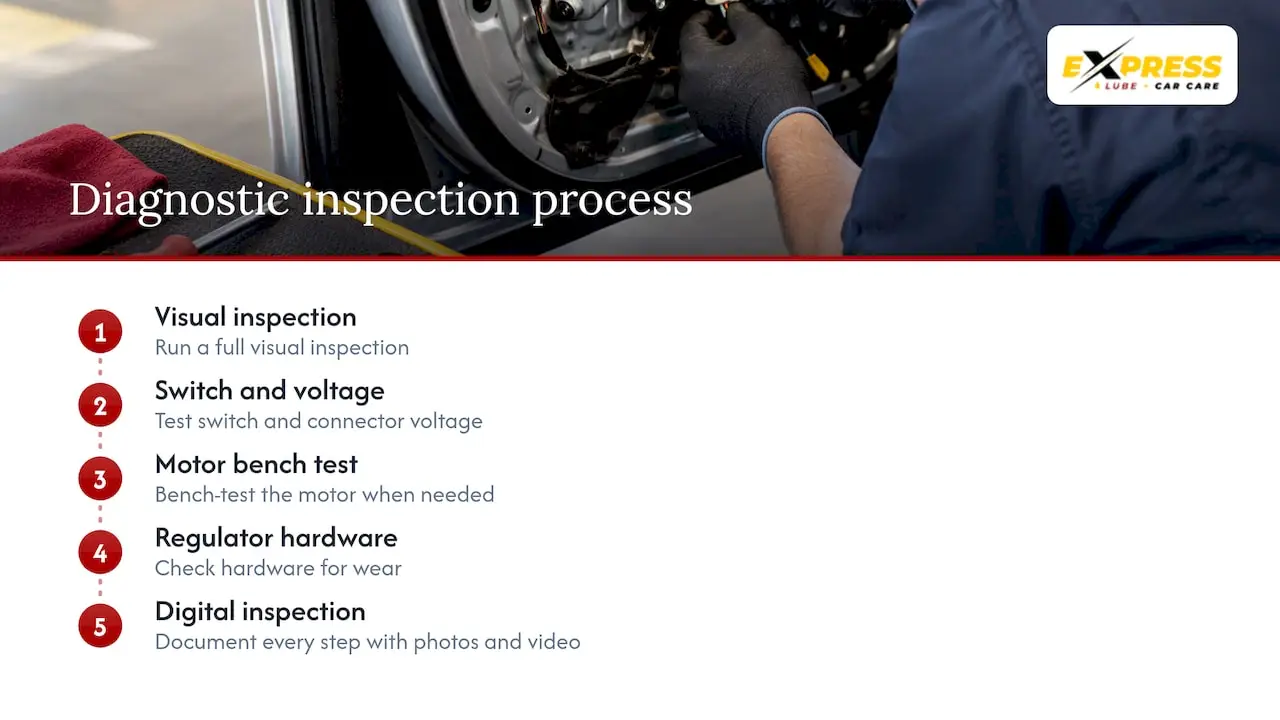
Technicians run a full visual inspection, test the switch and voltage at the connector, bench-test the motor when needed, and check the regulator hardware for wear. Every step is documented with photos and video through a digital vehicle inspection process. It is also worth checking your VIN on NHTSA’s recall lookup for any open recall tied to window reversal or anti-pinch systems, since manufacturers remedy those at no charge.
A short note on safety and getting a fair repair
Never force a window that is stuck or operate it while the glass is loose in the track. Hands and fingers near a binding regulator are not worth the risk. If an electrical repair estimate feels high, a second opinion is a fair and reasonable ask. Bringing a short video of the symptom to whichever shop you choose speeds up diagnosis and often keeps the cost down.
— Express Lube & Car Care
Schedule a window repair or diagnostic with us
A power window that will not budge is frustrating, but it is not something you have to live with or guess your way through. We handle electrical diagnostics, window motor and regulator repair, and document every finding through our digital vehicle inspections so you see exactly what we found and why.

- Technicians diagnose the switch, motor, and wiring before recommending any part.
- The shop is recognized through RepairPal and CARFAX for dependable workmanship.
- Repairs are backed by a warranty.
Bring your vehicle in or schedule a service appointment and we will get your window working again.
FAQ
How do I reset my power window?
Many vehicles let you reset the window’s anti-pinch memory by rolling the window fully up, holding the switch for a few extra seconds, then repeating the process with the window fully down. The exact sequence varies by make and model, so check your owner’s manual if the window still will not respond normally afterward.
Can I fix the power window myself?
Simple fixes like replacing a blown fuse, clearing debris from the track, or disengaging the child safety lock are reasonable DIY jobs for most car owners. Motor replacement, regulator repair, and wiring issues usually call for a shop with diagnostic tools and door-panel experience.
Can you manually pull up a power window?
You can sometimes gently assist a window that is just binding, but you should never force glass that is stuck or disconnected from the regulator. Forcing a broken regulator or stripped motor gears risks shattering the glass or injuring your hands.
How do I tell if it’s the window motor or the switch?
If one window fails while every other window works fine from the master switch, the individual door switch or its wiring is the likely cause. If you hear the motor running but the glass does not move, or a multimeter shows voltage at the motor with no movement, the motor itself has probably failed.