

TL;DR:
- Choosing between repair and replace depends on assessing repair costs, vehicle value, and future expenses. High repair costs relative to car value and upcoming repairs favor replacement, especially if safety issues are involved. Building a trusted mechanic relationship and thorough cost comparison help owners make informed, financially sound decisions.
Knowing how to choose between repair vs replace is the single most important financial decision a car owner faces when something major breaks. The repair or replace decision comes down to three numbers: what the fix costs, what your car is worth, and what a replacement would actually run you each month. Get those three numbers wrong and you either sink money into a dying car or take on a car payment you didn’t need. This guide walks you through the math, the inspection checklist, and the red flags that tell you which way to go.
What costs and factors should you consider when choosing to repair or replace?
The cost of repair vs replacement is rarely as simple as comparing a repair bill to a sticker price. Annual repair and maintenance costs for U.S. drivers typically run between $400 and $1,200 per year. That range matters because it sets your baseline. If your car stays within that window, you’re in normal territory. If one repair suddenly pushes you well past it, you need to think harder.
Start by separating routine maintenance from true repairs. Routine costs are predictable, while repairs are random and can blindside you financially. Oil changes, tire rotations, and brake pads are expected lifecycle costs. A blown transmission or a cracked engine block is a different animal entirely.
Here are the key factors to weigh before making your call:
- Repair cost vs. vehicle value. Get a private-party value estimate from a trusted source like Kelley Blue Book. A $2,000 repair on a $15,000 car is very different from a $2,000 repair on a $3,500 car.
- Vehicle history and reliability. A car with a clean maintenance record and no recurring issues is a much safer bet to repair than one with a growing list of problems.
- Safety concerns. Frame corrosion or extensive rust often means replacement regardless of repair cost. Safety failures are non-negotiable.
- Upcoming repair runway. Ask your mechanic what else is likely to need attention in the next 12–24 months. One big repair is manageable. Three big repairs in a row is a money pit.
- Your financial situation. A car payment on a new vehicle is a fixed monthly obligation. A repair is a one-time hit. Know which one your budget handles better.
Pro Tip: Ask your mechanic to separate the repair quote into “fix now” and “fix soon” categories. That breakdown tells you whether you’re buying yourself one more year or five more years.
How to do the math: comparing repair costs with replacement costs
The 50% rule is the most widely cited starting point for the repair or replace decision. When repair costs exceed roughly 50% of your car’s private-party value, replacement becomes worth a serious look. A car worth $6,000 with a $3,200 repair bill is right at that threshold. But the rule has real limits. It only compares the repair bill to the car’s value. It ignores what a replacement actually costs you.
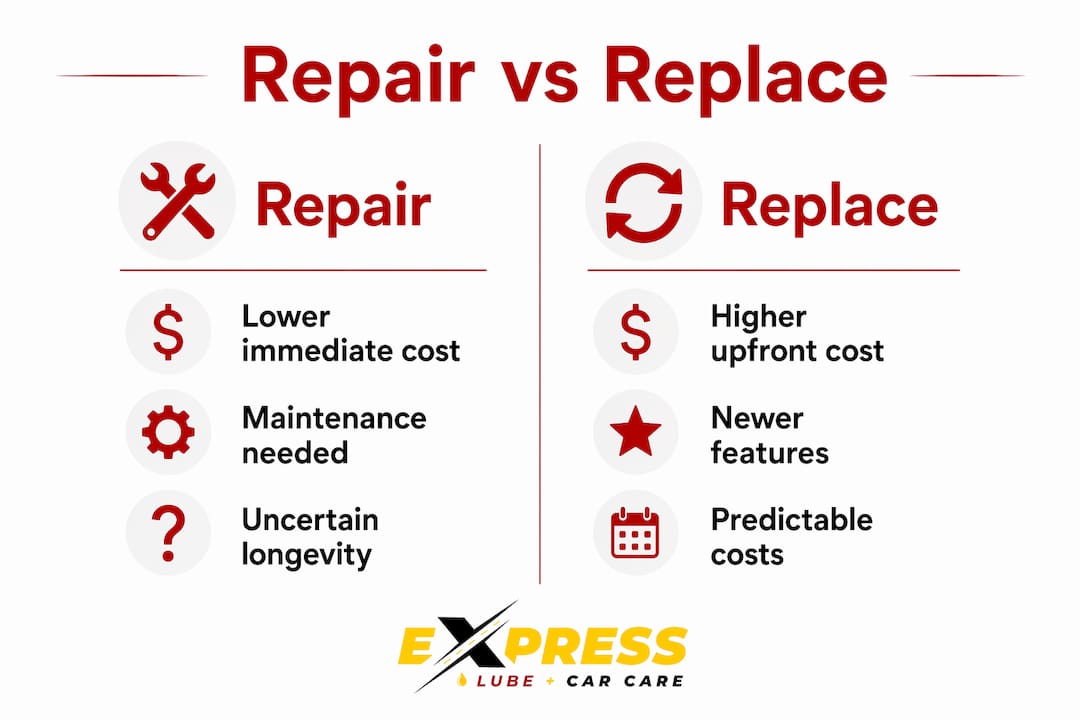
New cars now cost about $15,000 more than a decade ago, and average monthly payments have climbed to $773. That number reframes the entire conversation. At $773 a month, you’re spending $27,828 over three years before you add insurance and registration. A $3,000 repair suddenly looks like a bargain.
Total replacement ownership costs include monthly payments, higher insurance premiums on a newer vehicle, and registration fees that most car owners forget to factor in. Skipping those numbers leads to bad decisions. The table below shows how to structure a fair comparison.
| Cost Category | Repair Path | Replace Path |
|---|---|---|
| Immediate out-of-pocket cost | Repair bill (one-time) | Down payment + fees |
| Monthly ongoing cost | $0 car payment | ~$773/month average |
| Insurance cost | Current rate | Higher rate on new vehicle |
| 3-year total estimate | Repair + maintenance | $27,828+ payments alone |
| Risk factor | Known vehicle history | Unknown reliability |
Pro Tip: Run the replacement math over 36 months, not just month one. Most car owners compare a repair bill to a monthly payment and forget that the payment never stops.
Comparing repair costs to total ownership costs over a three-year horizon gives you a realistic picture. A $4,000 repair that keeps a paid-off car running for three more years almost always beats financing a replacement. The math works in your favor when you own the car free and clear.
For more ways to keep repair bills manageable, the team at Expresslubearlington has put together practical guidance on reducing car repair costs without sacrificing quality.
How to assess your car’s condition before deciding
A repair bill alone does not tell you enough. You need a full picture of your car’s current health and what’s coming next. Work through this checklist before you commit to either path.
- Check the frame and body. Look underneath for rust, especially around the frame rails and floor pans. Structural rust is a replacement signal regardless of what the engine looks like.
- Evaluate the engine and transmission. These are the most expensive systems to repair. A major repair like a transmission rebuild can still be worth it if the rest of the car is solid.
- Inspect brakes and tires. These are expected wear items. Factor their replacement cost into your ownership math but don’t let them alone drive a replace decision.
- Request a mechanic’s runway assessment. A runway assessment estimates upcoming repairs over the next 12–24 months. An expensive repair that buys you two years of reliability is very different from one that is the first of five failures.
- Get at least two repair quotes. Prices vary significantly between shops. Understanding how repair estimates work helps you spot fair pricing and avoid overpaying.
- Separate isolated problems from patterns. Some repairs fix a single incident and the car runs great afterward. Frequent and growing problems are a clear signal that replacement makes more sense.
- Prioritize safety-critical systems. Brakes, steering, and structural integrity always come first. A cosmetic issue is optional. A brake failure is not.
Working with a trusted mechanic relationship makes this assessment far more reliable. A mechanic who knows your car’s history gives you honest, specific advice rather than a generic opinion.
Common mistakes car owners make in the repair vs replace decision
The biggest mistake is letting emotion drive the math. Car owners tend to judge repair costs emotionally rather than mathematically. Attachment to a vehicle, or fear of a car payment, both cloud the numbers. The fix is simple: write down the actual figures and compare them side by side.
Watch out for these common traps:
- Ignoring upcoming repairs. Fixing one problem while ignoring three others waiting in line is how a car becomes a money pit. Always ask what’s next before you approve a repair.
- Forgetting warranty status. If your current car is still under a manufacturer or extended warranty, a repair may cost you nothing. Factor that in before you walk into a dealership.
- Skipping price negotiation. Repair prices are not always fixed. Learning how to negotiate repair prices can save you hundreds of dollars on a single job.
- Chasing a “perfect” used car. Repairing a reliable car often beats trading for an unknown used replacement. You know your car’s history. You don’t know the next one’s.
- Letting frequent repairs drain your finances without reassessing. If you’re at the shop every two months, that pattern is a red flag. Add up what you’ve spent in the last 12 months and compare it honestly to a replacement cost.
Pro Tip: Safety always wins over cost. If a repair involves brakes, steering, or structural integrity, fix it or replace the car. There is no middle ground on occupant safety.
Avoiding common car repair mistakes is just as important as making the right repair vs replace call. Small errors in judgment compound quickly into large financial losses.
Key Takeaways
The best option for repair or replace comes down to comparing total ownership costs over three years, not just the repair bill against the car’s current value.
| Point | Details |
|---|---|
| Use the 50% rule as a starting point | Reconsider repair when costs exceed 50% of your car’s private-party value. |
| Run a 3-year replacement cost comparison | Include monthly payments, insurance, and registration before deciding to replace. |
| Request a runway assessment | Ask your mechanic what repairs are likely in the next 12–24 months before committing. |
| Separate emotion from math | Car owners who rely on numbers rather than attachment make better financial decisions. |
| Safety repairs are never optional | Structural, brake, or steering failures require immediate action regardless of cost. |
What I’ve learned from watching car owners make this call
I’ve seen this decision go wrong in both directions more times than I can count. Car owners who hold onto a vehicle out of pure loyalty end up spending more in six months than a replacement would have cost. And car owners who panic at a big repair bill and rush to a dealership end up with a $773 monthly payment they didn’t need.
The clearest lesson I’ve taken from years of watching this play out: the car owners who make the best decisions are the ones who already have a trusted mechanic before the crisis hits. When you have a mechanic who knows your car, you get a straight answer on the runway assessment. You know whether that $3,500 repair buys you two years or two months. That relationship is worth more than any online calculator.
Regular maintenance is the other factor that almost never gets enough credit. The car owners who stay on top of oil changes, fluid checks, and scheduled service rarely face the brutal repair vs replace dilemma. Their cars age predictably. Problems get caught early, when they’re still cheap. The owners who skip maintenance are the ones sitting across from a mechanic getting a $4,000 estimate on a car worth $5,000.
My honest advice: treat the repair vs replace decision like a business decision, not a personal one. Run the numbers. Get the runway assessment. And if you don’t have a mechanic you trust completely, that’s the first problem to solve.
— Hassan
When Expresslubearlington can help you make the right call
Facing a big repair estimate and not sure if it’s worth it? That’s exactly the conversation Expresslubearlington was built for.
At Expresslubearlington, our ASE and RepairPal certified technicians give you an honest assessment of your vehicle’s condition, not just a quote for the job in front of them. Every repair we perform comes backed by a 24-month auto repair warranty, which changes the math on repair vs replace in your favor. You’re not just paying for a fix. You’re buying peace of mind and documented reliability. Drivers across the DFW area trust us because we tell them the truth, even when the truth is “this car isn’t worth fixing.” Stop by and let’s look at your car together.
FAQ
What is the 50% rule for car repair decisions?
The 50% rule states that you should reconsider repair when the cost exceeds roughly 50% of your car’s private-party value. It’s a useful starting point, but always factor in upcoming repairs and total replacement costs before deciding.
Should I repair or replace a car with high mileage?
High mileage alone does not make replacement the right call. A well-maintained high-mileage vehicle with a clean repair history can be more reliable than an unknown used replacement. Request a mechanic’s runway assessment to see what’s coming.
How do I calculate the true cost of replacing my car?
Add up monthly payments over 36 months, higher insurance premiums on a newer vehicle, and registration fees. Total ownership costs almost always exceed what car owners expect when they only compare a repair bill to a sticker price.
What repairs are always worth doing regardless of cost?
Safety-critical repairs involving brakes, steering, and structural integrity are always worth addressing. Safety-related failures should prompt immediate repair or replacement to protect everyone in the vehicle.
How can I get a fair repair estimate before deciding?
Get at least two quotes from reputable shops and ask each mechanic to break down what’s needed now versus what’s coming soon. Understanding how repair estimates work helps you verify that pricing is fair and the scope of work is accurate.