
You press the lever, the wipers drag across a dusty windshield, and nothing comes out. Annoying, and on a bug-splattered Interstate 30 commute, a little scary. The good news: when washer fluid isn’t spraying, the cause is usually simple. It’s most often an empty reservoir or a clogged nozzle. Less often it’s a pinched or disconnected hose, a failed pump, or an electrical fault. Below is a quick way to tell which one you have, what you can safely check in your driveway, and when it’s time to hand the car to a pro.
TL;DR
- Start with the obvious: check that the reservoir actually has fluid, and that you’re looking at the washer tank, not the coolant tank.
- If the tank is full, the blockage is often in the nozzle openings themselves. AAA notes that mineral deposits from plain water are a common culprit.
- Listen for the pump. A humming pump with no spray points to a clog or hose problem. Silence points to the pump, a fuse, or wiring.
- Never fill the tank with plain water, and don’t attempt a repair you’re unsure about.
- If the basics don’t fix it, we can diagnose it at our Arlington shop, usually as part of a regular visit.
Table of Contents
- Why a washer system stops spraying
- Play detective: what the symptoms tell you
- Step 1: Check the reservoir (and make sure it’s the right one)
- Step 2: Clear clogged washer nozzles
- Step 3: Look for a kinked, split or disconnected hose
- Step 4: Is the pump working?
- Step 5: Fuses, connectors and the electrical side
- Frozen fluid: a rare but real Arlington problem
- Why this matters beyond the annoyance
- Our perspective: fix the small stuff before it becomes the big stuff
- Prevent it from happening again
- Fleet drivers and rideshare: don’t run dry
- When to book a visit
- FAQ
- Sources
Why a washer system stops spraying
The system is simpler than it looks. A plastic reservoir holds the fluid. A small electric pump pushes it through rubber or plastic hoses to nozzles at the base of the windshield (and the rear glass on many SUVs, wagons and hatchbacks). A switch on the steering column tells the pump to run.
That gives you five places things can go wrong:
- The reservoir is empty, cracked or leaking.
- The nozzles are plugged with wax, grit or mineral scale.
- The hoses are kinked, split, or popped off a fitting.
- The pump has worn out or seized.
- The electrical side, meaning a fuse, connector or switch, isn’t getting power to the pump.
The trick is to figure out which one by paying attention to what the car does when you press the switch.
Play detective: what the symptoms tell you
Before you touch anything, run the washers once with the engine off and the key in the accessory position, and listen. Ideally have a friend watch the nozzles while you work the lever.
| What you notice | Most likely cause | What to check first |
|---|---|---|
| No sound at all, no spray | Blown fuse, bad pump, wiring or switch | Owner’s manual fuse chart, then the pump connector |
| Pump hums, nothing comes out | Clogged nozzles or a blocked or disconnected hose | Nozzle openings, then hose connections |
| Weak dribble instead of a fan | Partial clog or a tired pump | Nozzle cleaning, then test flow at the hose |
| Front fails, rear works (or the reverse) | Problem past the pump: one nozzle or one hose | The dead nozzle and its line |
| Fluid puddles under the front fender | Split hose or leaking reservoir | Trace the hose from the tank |
| Worked yesterday, dead on a cold morning | Frozen fluid | Park somewhere warmer and retry later |
That “front works, back doesn’t” case is one of the most common questions drivers ask. Since the pump feeds both lines, a pump that works for the front but not the rear usually means the trouble is in the rear hose (often routed through a hatch or tailgate hinge area) or at the rear nozzle, not the pump itself.
Step 1: Check the reservoir (and make sure it’s the right one)
It sounds too basic, but an empty reservoir is the first thing AAA says to rule out when the washers stop working. If you haven’t topped it off in a while, that’s likely your answer.
Be careful which cap you open. On some modern vehicles it’s easy to mistake the washer reservoir for the engine coolant reservoir, and AAA’s guidance is to check your owner’s manual before adding any fluid. Washer caps usually carry a windshield-and-spray symbol. Pouring washer fluid into the cooling system, or coolant into the washer tank, is a mistake you don’t want to make. If you aren’t certain, stop and ask us. A top-off is quick work during a routine visit.
When you refill:
- Use pre-mixed washer solvent, or a concentrate mixed with distilled water, as AAA recommends.
- Don’t use plain water. AAA warns it can promote algae growth and leave mineral deposits that clog nozzles.
- Pick a formula for the season. AAA’s guidance is to check the reservoir monthly and top off with a solution made to break down insects and road debris, and in winter one that won’t freeze at low temperatures.
After filling, run the washers for several seconds. A dry line can take a moment to prime.
Step 2: Clear clogged washer nozzles
If the tank is full and the pump hums, the nozzle openings are the prime suspect. They’re tiny on purpose, which makes them easy to block. Car wax, road dust, pollen and dried fluid residue all settle in there, and AAA points to mineral deposits from plain water as a frequent cause.
Here’s a gentle approach:
- Look closely at each nozzle. Wipe away visible grime with a damp cloth.
- Use a thin, soft tool, such as a sewing needle or a straightened fine wire, to carefully clear the opening. Go in straight and light. Don’t dig or pry, because the nozzle opening shapes the spray fan and scratching it can ruin the pattern.
- Run the washers again and watch for a fan of fluid.
- If only a trickle comes out, the clog may be farther back in the line.
Safety note: Keep the tool away from your paint and glass, and never run the washers while your hands are near the wiper arms. If the nozzle is cracked, loose or its fan is badly off, replacing it is a better move than more poking.
Step 3: Look for a kinked, split or disconnected hose
Washer hoses are thin, and over years of heat cycles under a Texas hood they get brittle. Sometimes a hose simply slips off its fitting, particularly after someone has worked under the hood or replaced a wiper cowl panel.
With the hood open, follow the hose from the pump at the reservoir up toward the cowl at the base of the windshield. You’re looking for:
- A hose that’s popped off a fitting or a T-connector
- A visible crack, split or soft spot
- Dampness or fluid stains along the route
- A kink where the hose bends sharply
A pushed-back-on connector is an easy fix. A cracked hose needs replacing. If you can’t see the full path, or reaching it means pulling trim panels, that’s a good point to let a technician take over.
Step 4: Is the pump working?
With the washer system running, put your ear near the reservoir. A healthy pump makes a distinct whirring sound. Three outcomes:
- You hear it running but get little or no spray. Fluid is leaving the pump and getting stuck, so back to the nozzles and hoses. A pump can also wear out and run weakly.
- You hear nothing. Either the pump has failed or it isn’t receiving power.
- You hear a grinding or straining sound. The pump may be seized or fighting a blockage.
The pump sits on or in the reservoir, and on some vehicles reaching it means removing the tank or a wheel-well liner. That’s where many drivers decide a shop visit is worth it. AAA’s advice is to avoid complex repairs when you’re unsure of the procedure.
Step 5: Fuses, connectors and the electrical side
If the pump is silent, check the fuse. Your owner’s manual has a fuse chart that shows which one covers the washer pump. A blown fuse can be a one-off, but a fuse that blows again right after replacement tells you something is shorted, and that needs proper diagnosis rather than a bigger fuse.
Other electrical causes include a corroded pump connector, a damaged wire, or a faulty column switch. Electrical gremlins can be sneaky, and they often show up in clusters. If your washers died around the same time as other accessories misbehaved, see our guide on what to check when a power window stops working, since the same logic applies: simple checks first, then a pro for anything involving wiring.
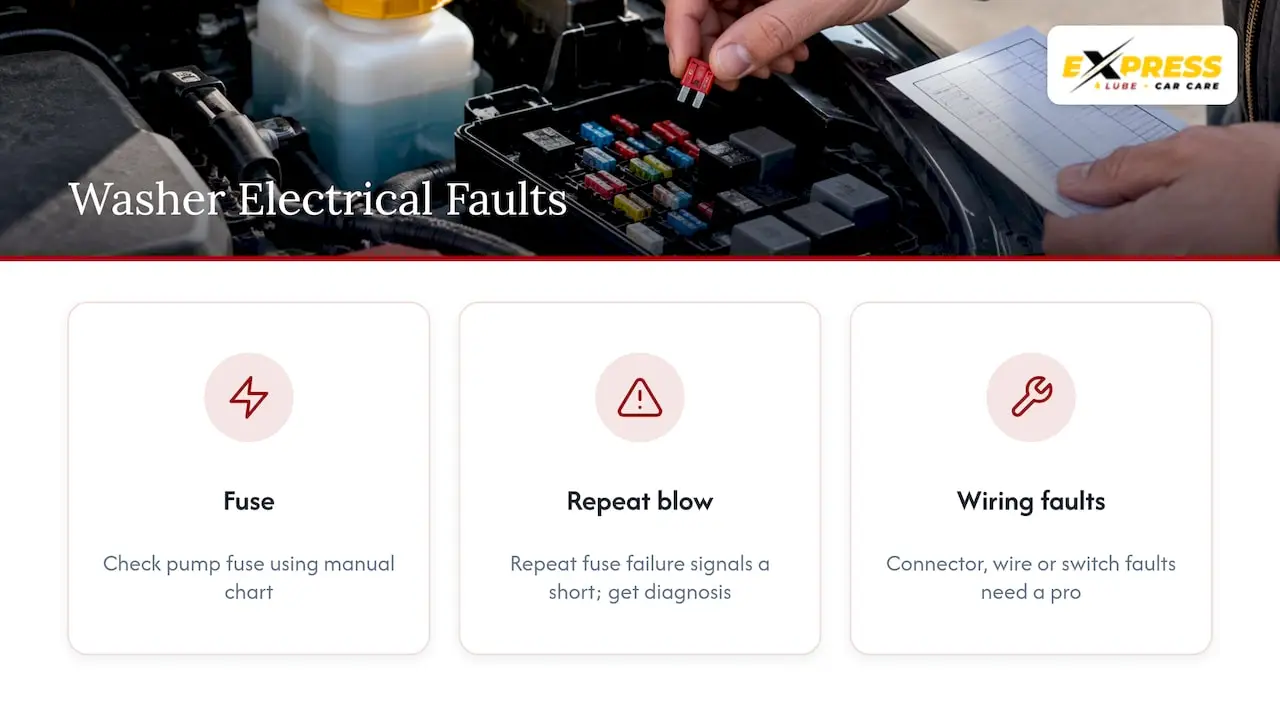
AAA’s advice is to get a professional diagnosis when the basics don’t restore function, to avoid further damage to the electrical or pumping system.
Frozen fluid: a rare but real Arlington problem
North Texas isn’t Minnesota, but we do get hard freezes some winters. If you’ve been running a summer-formula fluid or a diluted mix and the temperature drops, the fluid can freeze in the reservoir, lines or nozzles. The pump then can’t push anything, and a strained pump is a damaged pump.
What helps:
- Pull into a warm garage, or wait for the day to warm up, before trying the washers again.
- Don’t keep hammering the lever on a frozen system.
- Switch to a cold-weather formula before the next freeze. The Car Care Council’s fall checklist suggests cold-weather washer fluid alongside checking that your wipers and defrosters work.
Want the whole cold-season routine? Our winterize car checklist covers it, and our guide to seasonal car maintenance explains how to plan it around the year.
Why this matters beyond the annoyance
A washer system that doesn’t spray isn’t just a comfort issue. Dry-wiping a dirty windshield can smear grime across your line of sight, and dragging a dry blade over glass wears the rubber. Low sun on a smeared windshield, a dusty construction zone, or a bug-covered highway run can cut your visibility when you need it most.
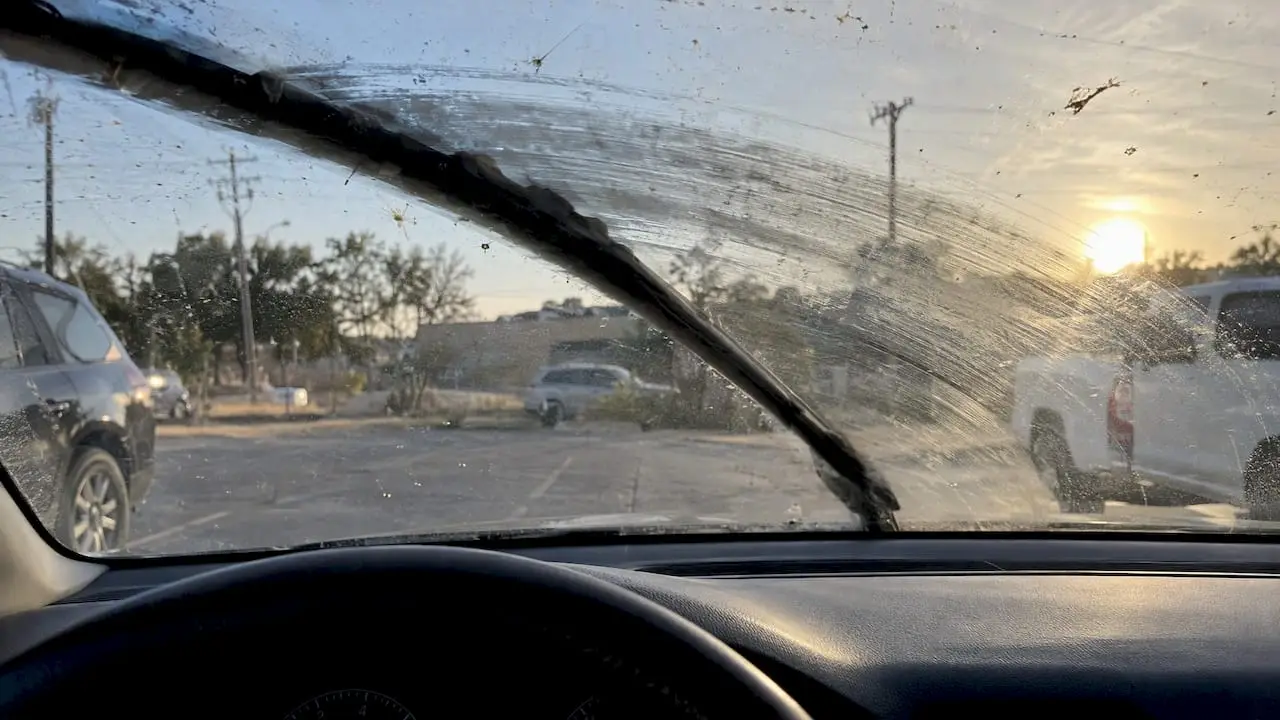
Speaking of wipers: if your blades are streaking or chattering, fresh ones make the biggest difference. The Car Care Council’s rule of thumb is that wiper blades should generally be replaced every six months. See our wiper blade replacement service in Arlington.
Our perspective: fix the small stuff before it becomes the big stuff
We see a lot of washer complaints, and they rarely arrive alone. Someone comes in for an oil change and mentions the washers have been dead for months. That’s a good moment for us to take a look, because a washer system is part of the vehicle’s overall safety picture, along with wipers, lights and glass.
Here’s how we approach it:
- We start with the cheap, likely answers. Fluid level, nozzles, hose connections. No need to chase a pump if a nozzle is plugged.
- We document what we find. Our digital vehicle inspections include photos and videos, so you can see the problem for yourself instead of taking our word for it.
- We tell you what’s urgent and what can wait. A dead washer pump is worth fixing soon, but it isn’t a stop-driving emergency the way a brake problem is.
- We put certified hands on it. Our technicians are ASE-certified, and we’re a RepairPal Certified Shop. Learn more about our certifications.
If you’ve been wondering whether a non-spraying washer is the kind of thing worth bringing in, the honest answer is: try the five-minute checks above, and if they don’t solve it, bring it in and we’ll find out why.
— Express Lube & Car Care
Prevent it from happening again
A few habits keep washer systems healthy:
- Check the level monthly, as AAA suggests, ideally when you check your oil. A look at the fluid replacement schedule shows what else to check on the same day.
- Use real washer fluid, never plain tap water.
- Switch formulas with the seasons, a bug-removing blend for summer and a freeze-resistant one when winter approaches.
- Don’t let the tank run dry. Running the pump with no fluid can wear it faster.
- Include the washers in routine inspections. Our car inspection checklist is a handy reference for what a thorough check covers.
Fleet drivers and rideshare: don’t run dry
If you drive for Uber, Lyft or deliveries, or you manage vehicles for a business, a working washer system is part of keeping your vehicle road-ready and your windshield clear. A quick check at each fill-up costs nothing. For businesses with several vehicles, we offer fleet services in Arlington that fit routine checks into scheduled maintenance.
When to book a visit
Book a diagnosis if:
- The tank is full, the nozzles are clear, and nothing sprays
- The pump is silent and the fuse is fine, or a replacement fuse blows again
- You see fluid leaking under the car
- You can’t reach or identify the hose or pump safely
- The fluid keeps disappearing with no sign of use
We handle the whole range, from routine maintenance to electrical work and other repairs. Our technicians can check the washer system alongside your other services, and most jobs are done the same day. Bring it by our Arlington shop or visit our home page to schedule an appointment.
FAQ
Why is my washer fluid not coming out even though the tank is full?
The most likely cause is a clogged nozzle, followed by a blocked or disconnected hose. If you hear the pump running, the problem is downstream of it. If you hear nothing, check the fuse and have the pump and wiring tested.
Why does my washer fluid spray in the front but not the back?
The front and rear lines usually share a pump, so a pump that sprays the front is probably working. The rear problem is usually a clogged rear nozzle or a hose that’s split, kinked or disconnected somewhere along its longer route.
Can I unclog a washer nozzle myself?
Often, yes. Wipe the nozzle, then gently clear the opening with a fine needle or thin wire, without scratching it. If that doesn’t restore the spray, the clog is farther back or the nozzle needs replacing.
Can I use water instead of washer fluid?
No. AAA warns that plain water can promote algae growth and leave mineral deposits that clog nozzles. Use pre-mixed washer fluid, or concentrate mixed with distilled water.
How do I know if the washer pump is bad?
If the reservoir is full, the nozzles are clear and the fuse is good, but you hear no whir when you press the switch, the pump or its wiring is the likely culprit. A technician can confirm that by testing power at the pump connector.
Sources
- Car’s Windshield + Wipers, AAA Northway
- AAA Car Care: Windshields (PDF)
- Know Before You Go, AAA Newsroom
- Motorist Checklist for Fall Car Care Month, Be Car Care Aware