

The most common signs of a failing engine mount (also called a motor mount) are extra vibration at idle or under acceleration, a clunk or thud when you shift gears or change speed, and an engine that visibly rocks more than it should. If your car does any of that, have it inspected soon. A worn mount rarely fixes itself, and other parts can take the strain. We see these complaints regularly from drivers along Brown Blvd, I-30 and Highway 360, and the good news is that the cause is often easy to confirm once a technician has the car on a lift.
TL;DR
- Watch for vibration you feel in the seat, floor or steering wheel, especially at idle and when you press the gas.
- Listen for a clunk or thud when you shift into Drive or Reverse, accelerate hard, or let off the throttle.
- Bad mounts can mimic, and be mimicked by, misfires, worn suspension bushings, tire imbalance and exhaust contact, so get a proper diagnosis before buying parts.
- Typical replacement costs run from a few hundred dollars to about $1,000, mostly labor.
- Driving on a badly failed mount is a gamble. Have it checked before the next long highway trip.
Table of Contents
- What does an engine mount actually do?
- Engine mount failure symptoms: the main warning signs
- What makes mounts wear out?
- What else can feel like a bad engine mount?
- How a technician confirms a bad mount
- Which engine mount fails first?
- Can you drive with a bad engine mount?
- How much does engine mount replacement cost?
- Our perspective: diagnose first, then fix what’s actually worn
- Get it checked at our Arlington shop
- FAQ
- Schedule your mount inspection in Arlington
- Sources
What does an engine mount actually do?
Your engine and transmission weigh hundreds of pounds and twist hard every time you accelerate. Mounts are the rubber-and-metal (or fluid-filled) supports that hold that assembly to the frame. They do two jobs at once: keep the engine where it belongs, and soak up vibration so you don’t feel it in the cabin.
Most cars use several mounts, plus a torque strut or link on many front-wheel-drive layouts. Older designs relied on fairly stiff solid rubber, because the rubber has to resist engine rock under load. Tomorrow’s Technician notes that idle vibration is often most noticeable on engines with an odd-fire layout, such as some V6s, and gets worse when high-load accessories like the A/C compressor kick in. Newer vehicles may use hydraulic or electronically controlled mounts, which cost more to replace.
Engine mount failure symptoms: the main warning signs
1. Vibration that gets worse under load
This is the classic sign. Anchor Industries says excessive engine vibration is among the most common symptoms of worn mounts, especially under heavy acceleration or revving, when engine movement is greatest. A worn mount can’t absorb the load, so the shake travels into the body and the passenger compartment.
A useful clue: mount-related vibration tends to follow engine effort, not road speed. If the shake rises when you rev the engine in Park, a mount (or an engine problem) is a better suspect than a tire. If it appears only at a certain speed, such as the 55 to 65 mph range, start with wheels and tires. Our guide to steering wheel vibration at highway speed walks through that side of the diagnosis.
2. Clunks, thuds and bangs
A failed mount lets the engine move suddenly, then slam into its stops. AutoZone lists a thud or lurch when starting or stopping and impact noises from the engine compartment among the common symptoms. You’ll typically hear it:
- when you shift from Park into Drive or Reverse
- when you step on the gas from a stop
- when you lift off the throttle or brake firmly
- when you shut the engine off
Noise from a mount is usually event-driven. It happens when the load changes, not as a constant rattle. That detail helps separate it from a loose heat shield or a failing wheel bearing.
3. Visible engine movement
Open the hood with the engine running and you shouldn’t see the engine lurch much when someone shifts gears. Car Talk describes the shop test: with the car in gear and the brake held, a helper gives it some gas while an observer watches. If a mount is broken, the engine may lift and twist noticeably. Please don’t try this alone or with anyone standing near the fan or belts. Leave it to a technician.
4. A harsh, jolting drive
Drivers often describe it as the car feeling “loose” or jerky. Anchor’s Why Mounts Fail sheet ties worn mounts to thumping noises during braking or acceleration, clutch chatter, exhaust system leaks or sagging, and odd shift patterns on automatic transmissions. If your car has started to shift roughly and you’ve also noticed a shudder at certain speeds, a torque converter is another suspect, so see our notes on torque converter symptoms.
5. Cracked, split or oil-soaked rubber
Sometimes you can simply see it. Cracked, collapsed or separated rubber, a mount soaked in oil, or a hydraulic mount that has leaked its fluid all point to failure. A flashlight can show a lot, but many mounts sit low or behind other parts, so a lift inspection is the reliable way to check.
What makes mounts wear out?
Rubber ages. According to Anchor’s failure sheet, deterioration speeds up with rapid acceleration, extreme temperature swings, age, engine torque and vibration, sudden braking, rough roads, and exposure to oil, water and heat. Texas summers put a lot of heat under the hood, and stop-and-go traffic on I-30 means plenty of load changes. That doesn’t mean your mounts will fail early, only that the conditions are demanding.
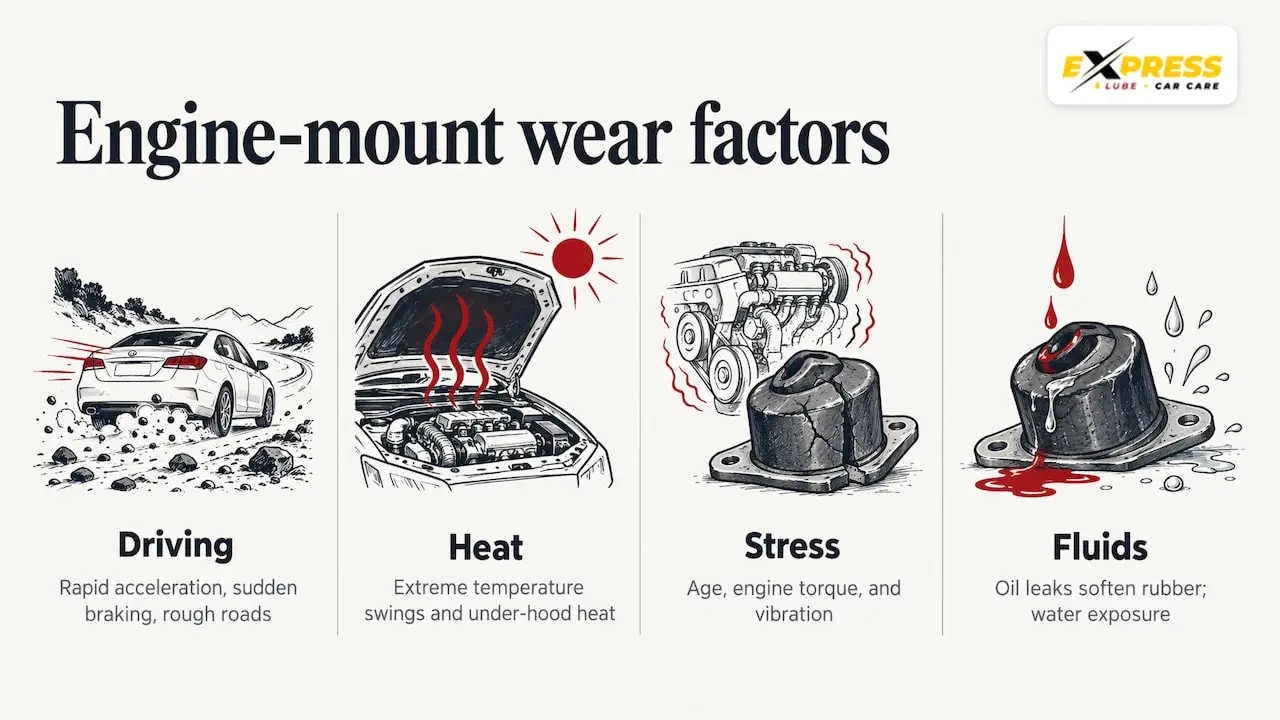
Oil leaks deserve special attention. Oil from a leaking valve cover or gasket can drip onto a mount and soften the rubber. If a mount fails and the leak is never fixed, the replacement may not last.
What else can feel like a bad engine mount?
This is where guessing gets expensive. Several problems copy mount symptoms:
| Symptom | Could be a mount | Other common causes |
|---|---|---|
| Vibration at idle | Yes | Misfire, worn spark plugs or ignition parts, dirty fuel injectors, vacuum leak |
| Vibration at highway speed | Less likely | Tire or wheel imbalance, bent wheel, worn suspension parts |
| Clunk on acceleration | Yes | Worn CV axle, loose exhaust, worn bushings |
| Clunk over bumps | Sometimes | Ball joints, control arm bushings, sway bar links, struts |
| Rattle after shifting | Yes | Exhaust touching the body, loose heat shield |
If the clunk shows up mostly over bumps, our guides on clunking over bumps and control arm bushing symptoms will help you sort the possibilities. A rough idle that happens only when you’re stopped may be an engine or fuel problem, covered in our piece on rough idle at a stop.
How a technician confirms a bad mount
A good diagnosis doesn’t start with a parts catalog. It usually goes like this:
- Listen to your description. When does it happen: cold start, shifting, accelerating, braking? Specifics save time.
- Inspect visually. The technician looks at the mounts, brackets and bolts for collapsed or cracked rubber, separation, and fluid leaks.
- Check engine movement under light load. With the car secured, a technician watches how the engine moves when it’s put in gear with the brakes applied.
- Rule out lookalikes. Misfires, tires, exhaust contact and suspension wear get checked so you aren’t replacing a healthy mount.
A few vehicles have scheduled mount replacement in their service plan. RepairPal’s estimator notes that in those cases a separate diagnosis isn’t always required. For most cars, though, inspection comes first.
A practical example
Say your front-wheel-drive SUV clunks every time you shift from Park to Drive, and the steering wheel buzzes at idle at a red light on Cooper Street. A technician finds the engine rocking too far with the brakes applied and a cracked rubber on one mount. That’s a straightforward mount repair. Now say the buzz appears only at 60 mph and the engine barely moves on the lift. The better suspect is a tire or wheel issue, and a new mount would have fixed nothing.
Which engine mount fails first?
It depends on the vehicle. Many front-wheel-drive cars carry a torque strut (sometimes called a dogbone mount) that works hard resisting engine rock, and it’s often among the first to wear. Others fail first at the transmission mount or the mount on the side carrying the most weight. There’s no universal answer, which is one reason a vehicle-specific inspection beats a general guess. Technicians also commonly recommend looking at the other mounts while one is being replaced, since they’ve lived the same miles.
Can you drive with a bad engine mount?
Short answer: for a brief, careful trip to a shop, often yes. As a daily habit, no. Here is why.
- Other parts take the hit. Extra engine movement can stress hoses, wiring, exhaust connections and remaining mounts.
- Controls can bind. Anchor reports that on some front-wheel-drive vehicles, a broken mount can let the engine lift during acceleration and make the accelerator linkage bind or stick.
- Handling can suffer. AutoZone notes that in extreme cases engine movement can cause unpredictable handling, especially in emergency maneuvers or sudden stops.
- Fasteners matter. NHTSA recall 20V-788 covered certain 2020 to 2021 Ford Explorer and Lincoln Aviator vehicles where loose motor mount fasteners could let the axle disconnect from the engine and cause a loss of power. If you drive a model with a mount-related recall, ask a dealer to check your VIN.
Safety first: if the engine is visibly shifting, the pedal sticks, or you lose power, pull over safely and call for a tow rather than driving on.
How much does engine mount replacement cost?
It varies by vehicle, mount type and how hard the mount is to reach. Published estimates give a sense of the range:
- Car Talk puts a typical replacement between $400 and $1,000, with about $500 as the usual figure, and says labor is most of the bill because other parts may need to come off for access.
- Lemonade estimates $250 to $600 including parts and labor, with a single mount ranging from $50 to $250 and labor from $100 to $350.
- AutoZone says labor can run $100 to $450 per mount depending on access, and that hydraulic or active mounts cost more than simple rubber ones.
Those are national estimates, not our prices. We don’t publish a flat price for this job because the right quote depends on your vehicle and which mounts are worn. If you’d like to understand how shops build a repair estimate, read our automotive labor rate explainer.

Our perspective: diagnose first, then fix what’s actually worn
Mount problems are a good example of why we start with a diagnosis and a look underneath the car. A buzz at idle can be a mount, but it can just as easily be a misfire or a tire. We’d rather show you what’s really wrong than swap parts and hope.
Our ASE-certified technicians do digital vehicle inspections with photos and videos, so you can see a cracked mount, a leaking hydraulic mount or a loose bracket yourself before you approve anything. Because we’re a full-service shop and not just an oil change stop, the same team can handle the mount, an oil leak that’s softening it, the exhaust that’s rubbing, or the suspension work that turns up alongside it.
Qualifying repairs are backed by our 24-month/24,000-mile warranty, and we’re a RepairPal Certified Shop. If your car clunks or shakes, bring it in and let us find the cause.
Express Lube & Car Care
Get it checked at our Arlington shop
If your car is clunking, shaking at idle or lurching when you shift, we can inspect the mounts and the parts that mimic them. Our engine diagnostics and repair team handles everything from mounts to major engine work, and you can see our full list on the services page. Fleet managers can ask about fleet vehicle services for work trucks and vans that rack up hard miles.

If the repair is bigger than you planned for, ask us about third-party financing options through Snap Finance, subject to provider approval and terms. Details are on our auto repair financing page.
FAQ
What are the first signs of a bad engine mount?
Usually a new vibration at idle or under acceleration, plus a clunk when you shift into gear or change speed. These often start small and grow. If you notice either one, schedule an inspection before the mount tears completely.
Can a bad engine mount cause a check engine light?
Not directly in most cases, since a mount isn’t an electronic sensor. But excess engine movement can stress wiring and hoses, and a vibration from a misfire might be what you’re actually feeling. If a light is on, a scan and diagnosis will sort out which problem is which. Our check engine light diagnostics service covers that.
Do I need to replace all the engine mounts at once?
Not always. Often only one has failed. A technician will look at each mount and tell you which are worn, and whether replacing a neighbor at the same time makes sense because it’s already accessible during the job. We’ll show you the condition of each in your inspection report.
Is it worth fixing a bad engine mount?
Usually yes, if the rest of the car is in good shape. A worn mount makes the car harsher to drive and can lead to damage elsewhere. Compared with the cost of repairing hoses, exhaust parts or other mounts that took the extra strain, replacing the mount early is typically the better value.
How long does a mount replacement take?
It depends on the vehicle and how many parts block access. We don’t quote a universal time because some mounts are quick and others need a lot of disassembly. We’ll give you an estimate after we see your car.
Schedule your mount inspection in Arlington
Hearing a clunk on the way up Brown Blvd or feeling a shake at the light near Highway 360? Let’s find out why. Book online at our appointment page, call us at (682) 248-3416, or stop by Express Lube & Car Care at 2105 Brown Blvd, Arlington, TX 76006. You can also learn more about us on our website.
Sources
- Anchor Industries: Mounting Trouble Signs brochure
- Anchor Industries: Why Mounts Fail
- AutoZone: Motor Mount Replacement Cost
- AutoZone: Signs You Need to Replace Your Motor Mount
- Car Talk: Motor Mounts, To Replace or Not to Replace
- Car Talk: How Much Does it Cost to Replace an Engine Mount
- Lemonade: How Much Does a Motor Mount Replacement Cost?
- NHTSA recall 20V-788
- Tomorrow’s Technician: Diagnosing and Replacing Active Motor Mounts
- RepairPal: Toyota RAV4 Engine Mount Replacement Cost Estimate